
Canonized saint
St. Monica
Mother of Augustine
She prayed for decades for a son moving in the opposite direction, and endured a difficult marriage that should never be held up as a model to imitate.
- Dates
- c. 331 – 387
- Feast day
- 27 August
- Places
- Thagaste (present-day Algeria) · Carthage · Milan · Ostia, Italy
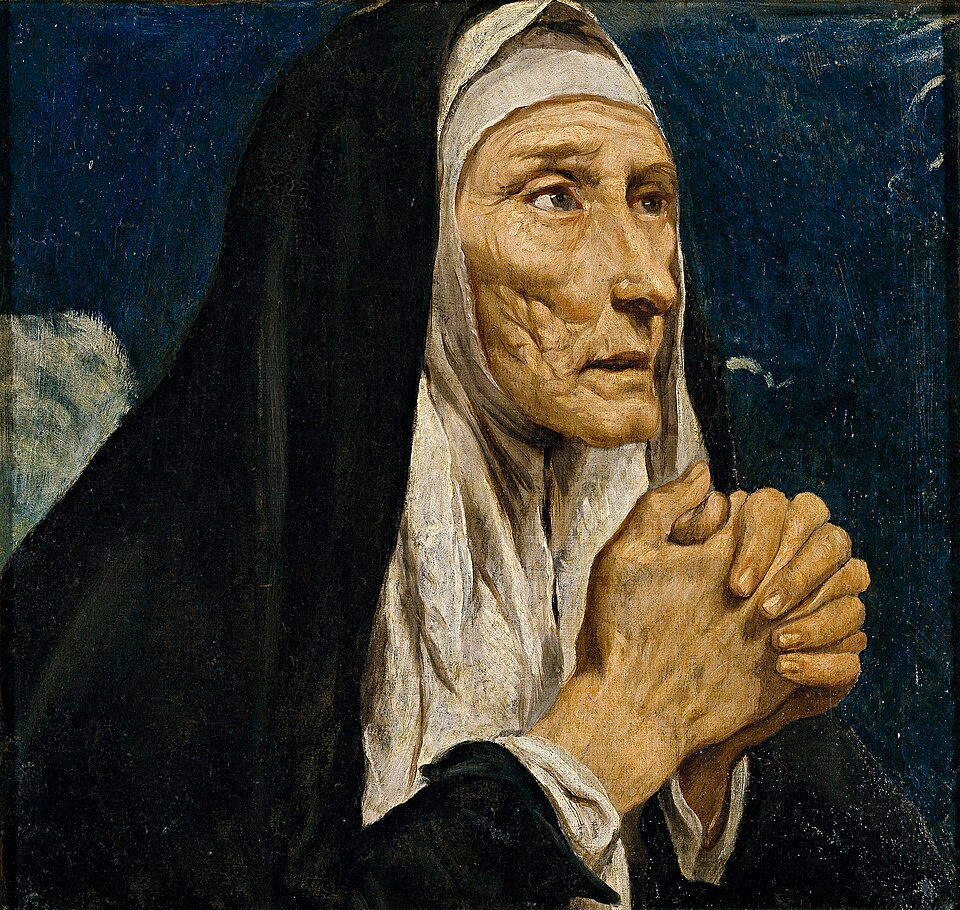
Artwork information
Title: St. Monica
Artist: Luis Tristán de Escamilla
Date: 1616
Rights: Public domain
Patronage
- Mothers
- Wives
- Victims of abuse and of infidelity
- Difficult marriages
Symbols
- Tears
- A sash
Key virtues
- Perseverance in prayer
- Hope for a wayward child
Lived experience
- A difficult and unfaithful husband
- Estrangement from a child
- Long waiting
- Widowhood
Causes served
- Families
When you need…
- Company while waiting for someone you love
- A saint for mothers
- Hope in a hard marriage without being told to endure it
A young wife in Thagaste
Monica was born around 331 in Thagaste, in Roman North Africa, to a Christian family, and was given in marriage while young, as was customary, to Patricius, a local official of the town who was not a Christian at the time of their marriage. Augustine, their son, describes his father as a man of hot temper and infidelity, whom Monica managed with patience and tact rather than confrontation, a strategy that fit the limited options available to a woman in her legal and social position at the time.
Patricius was baptised shortly before his death in 371, reportedly influenced by years of Monica's example and prayer. Augustine also records that Monica helped other married women in Thagaste, some of whom bore visible marks of their husbands' violence, and counselled them, though the sources do not detail exactly what she advised beyond urging them not to provoke their husbands to anger, guidance shaped entirely by the constraints of her time.
A mother's long campaign
Monica's greater struggle, as it comes down to us, was over her son. Augustine spent roughly a decade with the Manichaean sect she considered a dangerous heresy, and years living with a woman outside marriage. She wept, prayed, sought counsel from at least one bishop who told her a son of so many tears could not be lost, and at one point had Augustine's departure for Rome kept secret from her, only to follow him first to Rome and then to Milan when she learned of it.
In Milan she witnessed, at last, Augustine's turn toward Christian belief under the influence of Bishop Ambrose, and his baptism at Easter 387. She died later that same year at the port town of Ostia, as she and Augustine prepared to sail back to Africa, in a scene he records at length in his Confessions describing a shared moment of contemplative peace between them shortly before her death.
Marriage and a woman's position in the fourth century
In Roman North Africa a wife had little legal power to leave a marriage or compel a husband's behaviour, and social and religious teaching of the period commonly counselled wives toward patience and deference as the available strategy in a difficult marriage, since almost no other recourse existed. Monica's life reflects the constraints of that world, not a timeless template for marriage.
What she is honestly recorded to have endured, and why that is not the point
Augustine describes his father as prone to infidelity and temper. Monica is recorded as having endured this without leaving, because in her time and place there was effectively no institution or law that offered her another option, and because the sources present her patience as strategic and dignified rather than passive.
Her patronage is sometimes invoked today to counsel women to remain in abusive marriages. That is a misuse of her story and should be named as one plainly. A person today in an abusive marriage is not obliged to endure it, has legal and pastoral options Monica did not have, and should seek safety, including contacting local authorities, a trusted priest, or a domestic violence hotline. Monica's holiness is found in her prayer and hope for her son, not in a blueprint for tolerating cruelty.
Scripture that runs alongside this life
Hebrews 12:1
We also having so great a cloud of witnesses over our head, let us lay aside every weight.
Translation: Douay-Rheims (public domain) · Short excerpt; full chapter linked.
Prayer
Original prayer written for this site
A prayer with St. Monica
This prayer was written for this site; it is not an ancient or officially approved text.
St. Monica, you prayed for years for someone who did not seem to be listening.
Pray with everyone waiting for a child, spouse, or friend to come home to themselves, and with anyone in a marriage that is hurting them who needs the courage to seek safety rather than more patience.
Amen.
Not a traditional prayer of the Church. You are never required to have a devotion to any particular saint: you may always pray directly to God.
How to ask this saint to pray with you
- 1.A simple 'St. Monica, pray with me' is enough; no special formula is required.
- 2.If you are waiting for someone you love to come back to faith or to themselves, you can ask her to pray with you in that specific waiting.
- 3.If you are in a relationship that frightens you, consider pairing this prayer with a call to a domestic violence hotline or a trusted priest; her patience is not a reason to delay your safety.
Reflection
Monica is sometimes flattened into a symbol of endurance. She was a real woman navigating a marriage with no legal exit and a son who caused her real grief. Her hope for Augustine is worth honouring; her marriage is not a template.
Sources
- Augustine, Confessions, Book IX (primary source describing Monica's life and death)
- Pope Benedict XVI, General Audience on St. Monica (2008)