
Canonized saint
St. Óscar Romero
Archbishop of San Salvador; martyr
A cautious archbishop who became the public voice of the poor during El Salvador's descent into civil war, and was shot while celebrating Mass.
- Dates
- 15 August 1917 – 24 March 1980
- Feast day
- 24 March
- Places
- Ciudad Barrios, El Salvador · San Salvador
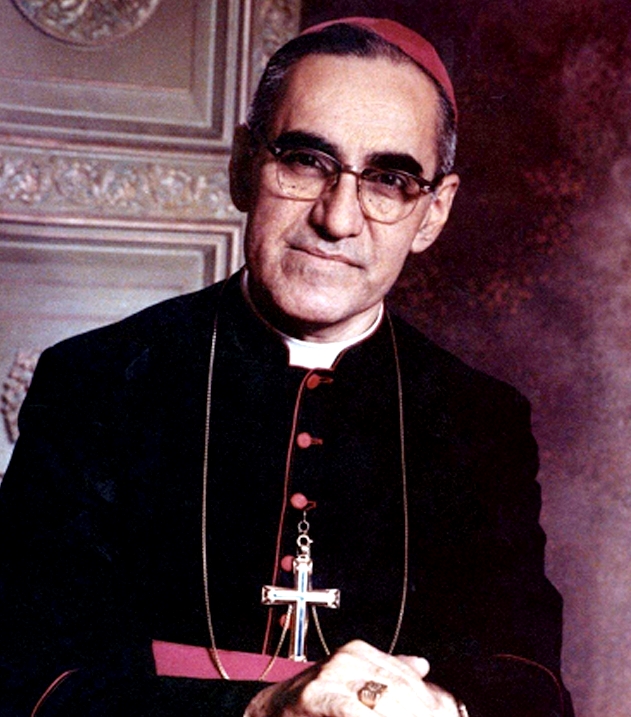
Artwork information
Title: Monseñor Óscar Arnulfo Romero
Artist: Unknown photographer
Date: 1978
Rights: Public domain
Patronage
- El Salvador
- Persecuted Christians
- Those who speak for the poor
Symbols
- A chalice
- A radio microphone
- The altar
Key virtues
- Courage
- Conversion
- Truthfulness
Lived experience
- Political violence
- Fear
- Public opposition
- Loss of a friend
Causes served
- Human rights
- The poor
- Nonviolence
- Justice
When you need…
- Courage to say something true
- A saint who changed his mind
- Hope under political violence
A conventional beginning
Born in Ciudad Barrios in 1917, Romero trained as a carpenter's apprentice before entering seminary, studying in San Salvador and then in Rome. For most of his priesthood he was known as a careful, bookish, doctrinally cautious cleric: precisely why the Salvadoran establishment welcomed his appointment as Archbishop of San Salvador in February 1977.
The murder of Rutilio Grande
Weeks after his installation, his friend Fr. Rutilio Grande, a Jesuit who had organised campesinos, was shot dead along with two companions. Romero drove out to see the bodies.
What followed was a public change. He cancelled Masses across the archdiocese for one Sunday and celebrated a single Mass in the cathedral square. He opened an office to document disappearances and torture. His Sunday homilies, broadcast by radio across the country, began to read out the names of the killed and the missing week after week.
Assassination
El Salvador was sliding into civil war. Death squads operated with impunity; the archdiocesan radio station was bombed. Romero appealed publicly to soldiers to refuse orders to kill their own people, and wrote to the President of the United States asking that military aid be halted.
On 24 March 1980, while celebrating Mass in the chapel of the Hospital of Divine Providence, he was shot dead at the altar. At his funeral, gunfire and explosions in the crowded square killed dozens more.
Canonisation
For years his cause was contested, in part because his witness was read as political. Pope Francis beatified him in 2015, declaring him a martyr killed in hatred of the faith, and canonised him on 14 October 2018.
El Salvador, 1977–1980
Land ownership was concentrated in very few hands; organised peasants, catechists, teachers, and union members were being disappeared. The Church itself was split: some clergy were killed, others defended the government.
Romero's homilies were not commentary from a distance. They named the previous week's dead, on the radio, in a country where naming them was dangerous.
Who he stood with
Families of the disappeared, who had nowhere else to register what had happened. Campesinos. Catechists. Refugees sheltering in church buildings.
He also kept preaching to soldiers and to the wealthy, refusing to treat either as beyond conversion.
A saint who changed
Romero's importance lies partly in the fact that he was not always brave. He became so, publicly, in his late fifties, under pressure, and against the expectations of the people who had promoted him.
He is a patron for anyone who suspects it is too late to become a different kind of person.
Scripture that runs alongside this life
Luke 4:16–21
The Spirit of the Lord is upon me: wherefore he hath anointed me to preach the gospel to the poor.
Translation: Douay-Rheims (public domain) · Short excerpt; full chapter linked.
Matthew 25:31–46
As long as you did it to one of these my least brethren, you did it to me.
Translation: Douay-Rheims (public domain) · Short excerpt; full passage linked.
Prayer
Original prayer written for this site
A prayer with St. Óscar Romero
St. Óscar Romero, you learned courage late and in public.
Pray with those who are afraid to say what they have seen, and with those whose names no one is reading aloud.
Amen.
Not a traditional prayer of the Church. You are never required to have a devotion to any particular saint: you may always pray directly to God.
How to ask this saint to pray with you
- 1.Ask him to pray with you before a conversation you are dreading.
- 2.His feast, 24 March, is kept in some places as a day of prayer for those killed for defending human rights.
Reflection
Speaking the truth about harm is not disloyalty to the Church. Romero was accused of exactly that, and the Church now calls him a saint.
Courage is rarely felt as courage from the inside. It usually feels like being frightened and continuing anyway.
One actionRead a homily of his in full rather than a quotation from one. Notice how ordinary and pastoral the language is.