
Biblical figure
St. Paul the Apostle
Persecutor of the Church turned missionary and letter-writer
He organised the arrest and, by his own account, approved the killing of the first Christians before becoming the most widely travelled preacher and writer among them.
- Dates
- 1st century (traditionally d. c. AD 64-67)
- Feast day
- 29 June (Sts. Peter and Paul); 25 January (the Conversion of St. Paul)
- Places
- Tarsus · Jerusalem · Damascus · Asia Minor · Greece · Rome
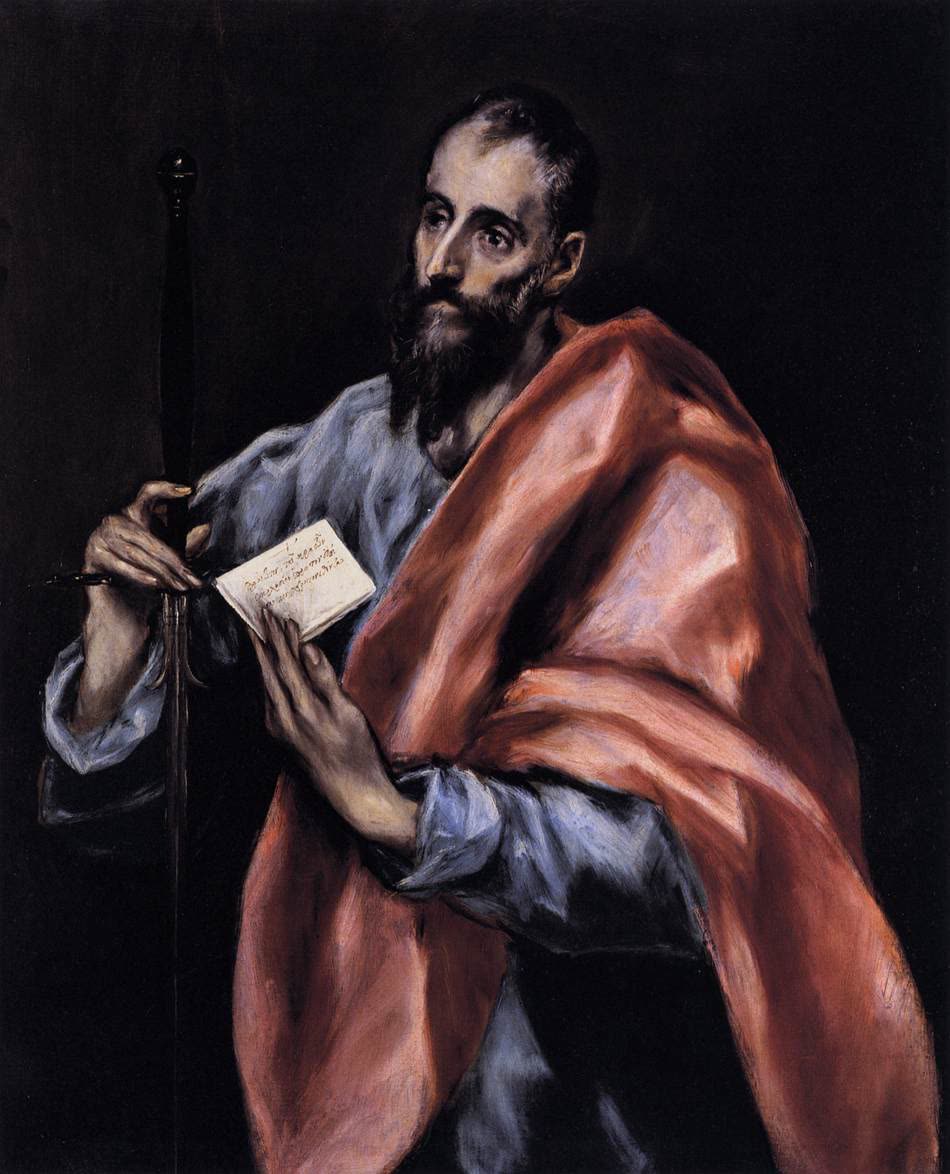
Artwork information
Patronage
- Missionaries
- Writers and journalists
- Evangelists
- Tentmakers and saddlers
Symbols
- A sword (his martyrdom and his description of the word of God)
- A scroll or book
- A snake (recalling Acts 28)
Key virtues
- Honest conversion
- Endurance through repeated hardship
- Working with his own hands
Lived experience
- Guilt for serious harm done to others
- Imprisonment
- Shipwreck
- A chronic, unresolved affliction
Causes served
- Unity between Jewish and Gentile believers
When you need…
- A saint who caused real harm and genuinely changed direction
- Perseverance through a long, difficult undertaking
- Someone who lived with an affliction God did not remove
A Jew of the Diaspora, and a Roman citizen
Paul, called Saul in his earlier life, was born in Tarsus, a Greek-speaking city in Asia Minor, into a Jewish family of the Diaspora, the substantial Jewish population living outside the land of Israel and organized around local synagogues. Acts records that he was a Roman citizen by birth, an unusual and legally valuable status that he later invokes to demand a proper trial and to appeal his case directly to Caesar, rights an ordinary provincial without citizenship did not have.
He was trained, by his own account, as a Pharisee, and studied under the respected teacher Gamaliel in Jerusalem, placing him within the more rigorous and observant stream of Second Temple Judaism. This combination, Diaspora upbringing, Roman legal status, and rigorous Pharisaic training in Jerusalem, gave him a fluency in Jewish, Greek, and Roman worlds that shaped his entire later mission.
A persecutor of the Church, honestly remembered
Before his conversion, Saul is described in Acts as approving of the stoning of Stephen, the Church's first recorded martyr, and as actively pursuing the destruction of the young Christian movement, entering houses and dragging off men and women to prison. He himself, later, in his letters, does not minimize this: he calls himself a blasphemer and a persecutor, and in 1 Corinthians states plainly that he is 'not worthy to be called an apostle, because I persecuted the church of God.'
This should be named without softening: Paul organized real violence against real people because of their faith, before his conversion, and the New Testament records this candidly rather than concealing it.
Damascus
Acts records that while travelling to Damascus carrying official letters authorizing him to arrest followers of Jesus there, Saul was confronted by a blinding light and the voice of the risen Christ, asking why he was persecuting him. Blinded for three days, he was restored by a disciple named Ananias, who Acts records approached him only reluctantly, given his reputation, and was baptized. This event, traditionally dated within a few years of the crucifixion, is treated by historians as one of the best-attested episodes in Paul's life, since Paul refers to it himself in his own letters (Galatians 1) independently of the Acts narrative.
Missionary journeys, tentmaking, and the letters
Paul undertook several extended missionary journeys across Asia Minor and Greece, founding and corresponding with churches in cities including Corinth, Philippi, Thessalonica, and Ephesus. He supported himself at points through his trade as a tentmaker or leatherworker rather than depending financially on the communities he served, a practice he mentions explicitly and with some pride in his letters.
Thirteen New Testament letters bear his name, though scholars generally agree on his direct authorship of seven (Romans, 1 and 2 Corinthians, Galatians, Philippians, 1 Thessalonians, and Philemon), with the remainder either co-authored, written by disciples in his tradition, or debated. These letters, addressing real conflicts and real communities, form a large part of the New Testament and shaped much of the Church's early theological vocabulary.
Repeated hardship, and a thorn in the flesh
Paul catalogues his own suffering directly in 2 Corinthians 11: repeated imprisonment, beatings, a stoning, three shipwrecks, and constant travel danger. He also refers, without specifying what it was, to 'a thorn in the flesh,' an affliction he asked God three times to remove, and was told instead that grace was sufficient, that power is made perfect in weakness. Scripture does not identify what this affliction was, and any claim to know it precisely goes beyond the text.
Rome and martyrdom: Scripture, history, and tradition
Acts ends with Paul under house arrest in Rome, having appealed his case to Caesar as a citizen's right, preaching openly while awaiting trial; the narrative does not describe his death. Early Christian tradition, including the letter of Clement of Rome (writing around AD 96, within living memory of the events) and later writers, holds that Paul was executed in Rome, traditionally by beheading, a method consistent with his Roman citizenship, which exempted him from crucifixion, during or shortly after Nero's persecution in the mid-60s AD. This should be understood as early and widely credited Christian tradition, not as an event narrated in the New Testament itself.
Diaspora Judaism, Roman citizenship, and a divided early Church
Paul's ministry took place across a network of Diaspora synagogues, existing Jewish communities scattered through cities of the Roman Empire, which became his regular starting point for preaching in each new city before conflict often forced him elsewhere. His Roman citizenship gave him legal protections, such as exemption from summary flogging and the right to appeal to the emperor, unavailable to most people in the provinces he travelled, including most of his own converts.
The early Church Paul served was genuinely divided over whether Gentile converts needed to observe the full Jewish Law, a conflict serious enough to require the Council of Jerusalem described in Acts 15 and to produce a documented public confrontation between Paul and Peter at Antioch, recorded in Paul's own letter to the Galatians.
The communities he founded and corresponded with
Paul is credited with founding or strengthening churches across Asia Minor and Greece, and with articulating, in his letter to the Galatians, the principle that in Christ 'there is neither Jew nor Greek, there is neither bond nor free, there is neither male nor female,' a statement the early Church applied specifically to full standing in Christ and access to baptism, within a social world that otherwise sharply divided all three.
What he records enduring
By his own written account: repeated imprisonment, multiple floggings, a stoning that left him for dead, three shipwrecks, constant travel dangers, and an unnamed chronic affliction he asked God three times to remove without being granted removal. Tradition holds his life ended in execution in Rome.
Before any of this, he also carried the weight of having caused serious harm to others, imprisoning and, by his own account, consenting to the killing of the earliest Christians. His letters do not present his later suffering as erasing or balancing out that earlier harm; they simply record both facts about the same man.
Honest conversion, and reading his letters carefully
Paul's conversion is significant partly because of how honestly the New Testament preserves what came before it. He is not presented as always having been essentially good and merely misdirected; he is presented as someone who did real, serious harm and then genuinely changed course, without the text erasing or minimizing the earlier harm to make the later story more comfortable.
Some verses from Paul's letters, taken out of their argument and their era, have been used to demand submission within marriage, silence women in church settings, or pressure people to endure mistreatment. Reading a single line apart from the letter's argument, audience, and historical moment is how Scripture gets turned into a weapon; it is not how the Church teaches these letters should be read. No line from Paul's letters overrides the basic Christian conviction that abuse is never something a person is required to endure.
Scripture that runs alongside this life
Romans 8:38–39
Nor any other creature shall be able to separate us from the love of God, which is in Christ Jesus our Lord.
Translation: Douay-Rheims (public domain) · Short excerpt; full chapter linked.
1 Corinthians 13:4–7
Charity is patient, is kind: charity envieth not, dealeth not perversely, is not puffed up.
Translation: Douay-Rheims (public domain) · Short excerpt; full chapter linked.
Galatians 3:28
There is neither Jew nor Greek: there is neither bond nor free: there is neither male nor female. For you are all one in Christ Jesus.
Translation: Douay-Rheims (public domain) · Short excerpt; full chapter linked.
Philippians 3:4-14
I count all things to be but loss for the excellent knowledge of Jesus Christ my Lord.
Translation: Douay-Rheims (public domain) · Short excerpt; full chapter linked.
Prayer
Original prayer written for this site
A prayer asking St. Paul to pray with us
This prayer was written for this site; it is not an ancient or officially approved text.
St. Paul, you once dragged people out of their homes for believing what you now believed yourself.
You did not pretend that was a small thing, and you did not let it stop you from being sent.
Pray with everyone carrying real guilt for real harm they have caused, that they might tell the truth about it and still keep moving.
Pray too with everyone still living with an affliction that has never been taken away, that they might find, as you did, that they are not carrying it alone.
Amen.
Not a traditional prayer of the Church. You are never required to have a devotion to any particular saint: you may always pray directly to God.
How to ask this saint to pray with you
- 1.A simple 'St. Paul, pray with me' is enough.
- 2.If you are carrying guilt over real harm you caused someone, you can ask him to pray with you toward honest accountability rather than either denial or endless self-punishment.
- 3.If you are living with a chronic illness, disability, or affliction that has not gone away despite prayer, you might sit with 2 Corinthians 12 and ask him to pray with you toward whatever 'grace is sufficient' can actually mean for you right now.
Reflection
Paul never asks his communities to forget what he did before his conversion, and the Church has never asked that either. His holiness is not presented as separate from his history of harm; it includes an honest reckoning with it.
His unresolved thorn in the flesh is one of Scripture's clearest statements that not every affliction is removed, even for someone praying in good faith, and that this does not mean God has abandoned the person carrying it.
One actionIf you are carrying guilt for something serious you have done, take one concrete step toward accountability this week, whether that is confession, an honest conversation, or restitution, rather than staying in private shame alone.