
Canonized saint
St. Augustine of Hippo
Bishop; Doctor of the Church
A North African teacher whose long, restless search, and his own honest but troubling account of it, shaped Western Christian thought.
- Dates
- 13 November 354 – 28 August 430
- Feast day
- 28 August
- Places
- Thagaste and Hippo Regius (present-day Algeria) · Carthage · Rome · Milan
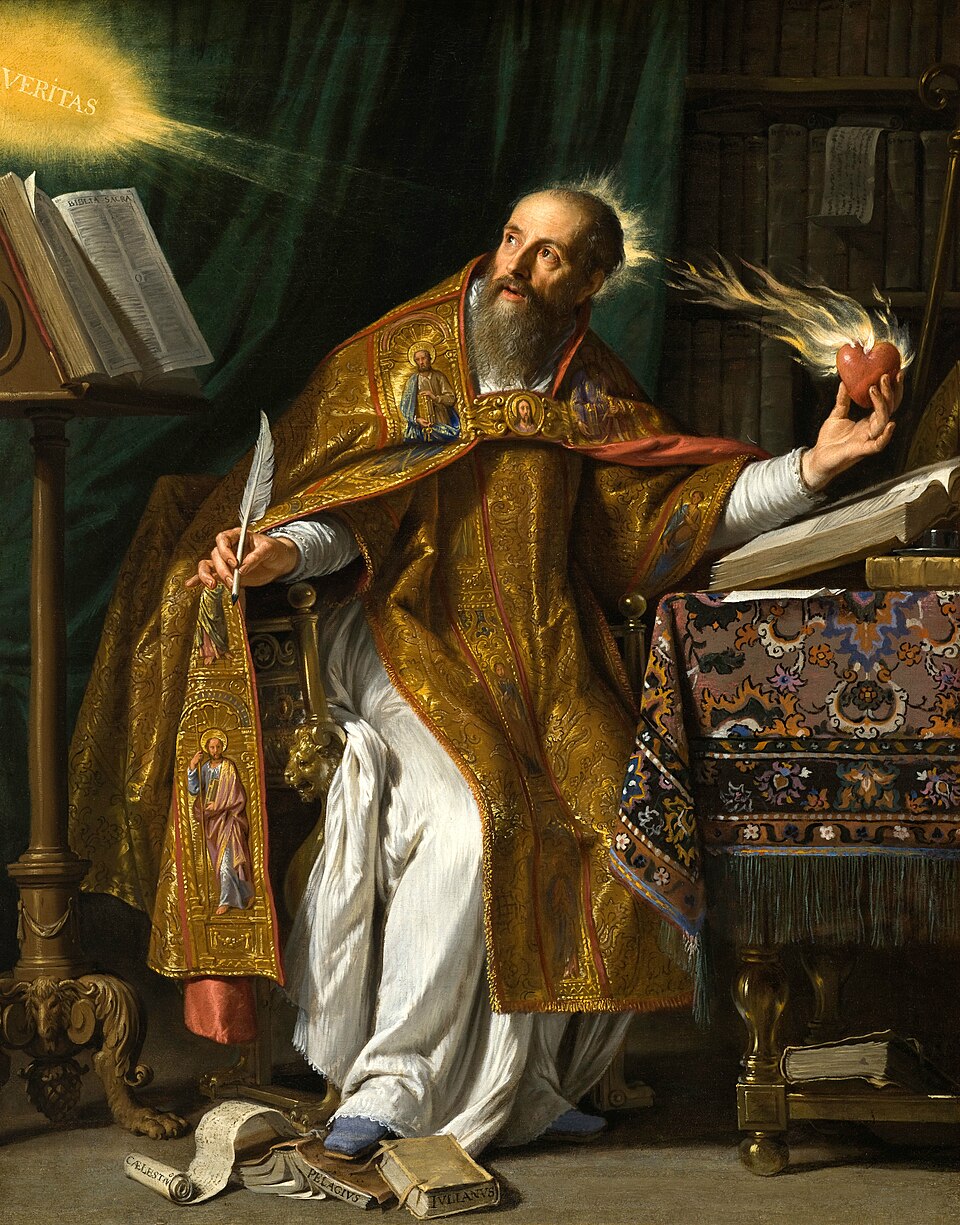
Artwork information
Title: Saint Augustine
Artist: Philippe de Champaigne
Date: c. 1645 to 1650
Rights: Public domain
Patronage
- Theologians
- Printers
- Brewers
Symbols
- A burning heart
- A book
- A pen
Key virtues
- Honesty about oneself
- Intellectual courage
- Conversion
Lived experience
- Long unbelief
- Ambition
- Grief
- Complicated family life
Causes served
- Education
- Understanding of grace
When you need…
- A saint for people who think too much
- A long road back
- Honesty about past relationships
A Berber childhood in Roman Africa
Augustine was born in 354 in Thagaste, a market town in Roman North Africa in what is now Algeria, part of a Berber population living under Roman administration and Latin culture for centuries. His mother, Monica, was a devout Christian; his father, Patricius, a local official of modest means, was not baptised until near his death.
Augustine's family stretched to fund a classical education aimed at rhetoric, the discipline of persuasive public speaking that was the standard path to advancement in the Roman civil and legal world. He studied in Thagaste, Madauros, and Carthage, and by his own later account was a talented, ambitious, and at times dissolute young student.
A long relationship, a son, and a woman he later dismissed
Around the age of seventeen or eighteen, while a student in Carthage, Augustine entered into a relationship with a woman whose name he never records in his Confessions. They lived together for over a decade, a recognised, though not legally married, arrangement common at the time, and she bore him a son, Adeodatus, in 372.
When Augustine's mother arranged a socially advantageous marriage for him to a young heiress, he sent this woman away, back to North Africa, keeping their son with him. He wrote afterward that his heart was 'torn and wounded and bleeding' by the separation, but the decision itself was his, made for social advancement, not something done to him. She is a real person who shared over a decade of his life and raised their son with him, not a symbolic obstacle in his story, and the account is worth reading with her in view, not only his.
Manichaeism, teaching, and restlessness
For roughly nine years Augustine followed Manichaeism, a dualist religious movement popular in the late Roman world that promised rational answers to the problem of evil. He taught rhetoric in Carthage and then, seeking better prospects, moved to Rome and finally to Milan, then an imperial capital, where he held a prestigious professorship.
In Milan he grew disillusioned with Manichaeism, was influenced by Neoplatonist philosophy, and came under the preaching of Bishop Ambrose of Milan. His mother Monica followed him to Milan and continued to press him toward conversion and baptism.
Conversion and ordination
In 386, in a garden in Milan, Augustine described a moment of intense inner crisis followed by resolve, associated in his account with hearing a child's voice and opening a passage of Paul's letters. He was baptised by Ambrose at Easter 387. Monica died later that year at Ostia, as they prepared to return to Africa together.
Back in North Africa, Augustine was ordained a priest in Hippo Regius in 391 under pressure from the local congregation, and became its bishop around 395, a position he held until his death in 430, as Roman authority in North Africa was collapsing under Vandal invasion; he died during the Vandal siege of Hippo.
A vast and contested legacy
Augustine's Confessions, an extended prayer of self-examination addressed to God, is one of the first sustained works of personal introspection in Western literature. His other major works, including The City of God and extensive writings on grace, sin, and the Trinity, shaped Catholic theology for over a millennium and remain foundational for Catholic and much of Protestant thought.
His legacy is also genuinely disputed among later Christians and historians: his teaching on predestination, his harsh later views on the fate of unbaptised infants, and his evolving support for state coercion against the Donatist schism in North Africa are cited by critics, including many Catholic theologians, as areas where his thought did lasting harm or was later corrected by the Church's development of doctrine. Naming this is not disloyalty to him; he himself wrote a book late in life, the Retractationes, revisiting and correcting his earlier positions.
Late Roman North Africa
Augustine's homeland was religiously and ethnically mixed: indigenous Berber populations, Punic cultural traces from Carthage's earlier history, and several centuries of Roman rule and Latin Christianity coexisted. Rhetoric was the recognised ladder to public office and status, which is why his family invested so heavily in his education despite modest means.
Cohabiting relationships like the one Augustine had with the mother of Adeodatus were a recognised, if lower-status, social arrangement in Roman law, distinct from formal marriage and more easily dissolved for social advancement, which is precisely what happened to her.
What the record shows plainly
Nine years given to a belief system he later concluded was false. The loss of a close friend in youth, which he wrote of with real grief. A years-long relationship ended for the sake of a marriage that never actually took place. The death of his mother shortly after his baptism. Living to see his own city besieged in the collapse of Roman order in Africa.
Scripture that runs alongside this life
Romans 8:38–39
Nor any other creature shall be able to separate us from the love of God, which is in Christ Jesus our Lord.
Translation: Douay-Rheims (public domain) · Short excerpt; full chapter linked.
Hebrews 12:1
We also having so great a cloud of witnesses over our head, let us lay aside every weight.
Translation: Douay-Rheims (public domain) · Short excerpt; full chapter linked.
Prayer
Original prayer written for this site
A prayer with St. Augustine of Hippo
This prayer was written for this site; it is not an ancient or officially approved text.
St. Augustine, you searched for a long time and wrote about it with unusual honesty, including the parts where you did not act well.
Pray with anyone still searching, and with anyone who has been the one left behind in someone else's search for a better arrangement.
Amen.
Not a traditional prayer of the Church. You are never required to have a devotion to any particular saint: you may always pray directly to God.
How to ask this saint to pray with you
- 1.A simple 'St. Augustine, pray with me' is enough; no special formula is required.
- 2.If you are in a long season of doubt or searching, you might ask him to pray with you as someone who took decades to arrive.
- 3.If you recognise yourself in the woman he sent away rather than in Augustine, it is fair to bring that anger or grief honestly into prayer too.
Reflection
Augustine's Confessions are often read only as a triumphant conversion story. They also record, in his own hand, a decision to end a long relationship for social gain. Holding both is part of telling his story truthfully.
Sources
- Augustine, Confessions, Books III–IX (primary source for the biographical details)
- Pope Benedict XVI, General Audiences on St. Augustine (2008)