
Canonized saint
St. Teresa of Calcutta
Foundress of the Missionaries of Charity
She left a teaching order to live and work in the slums of Calcutta, and privately endured decades of spiritual darkness while doing it.
- Dates
- 26 August 1910 – 5 September 1997
- Feast day
- 5 September
- Places
- Skopje · Ireland · Calcutta (Kolkata), India
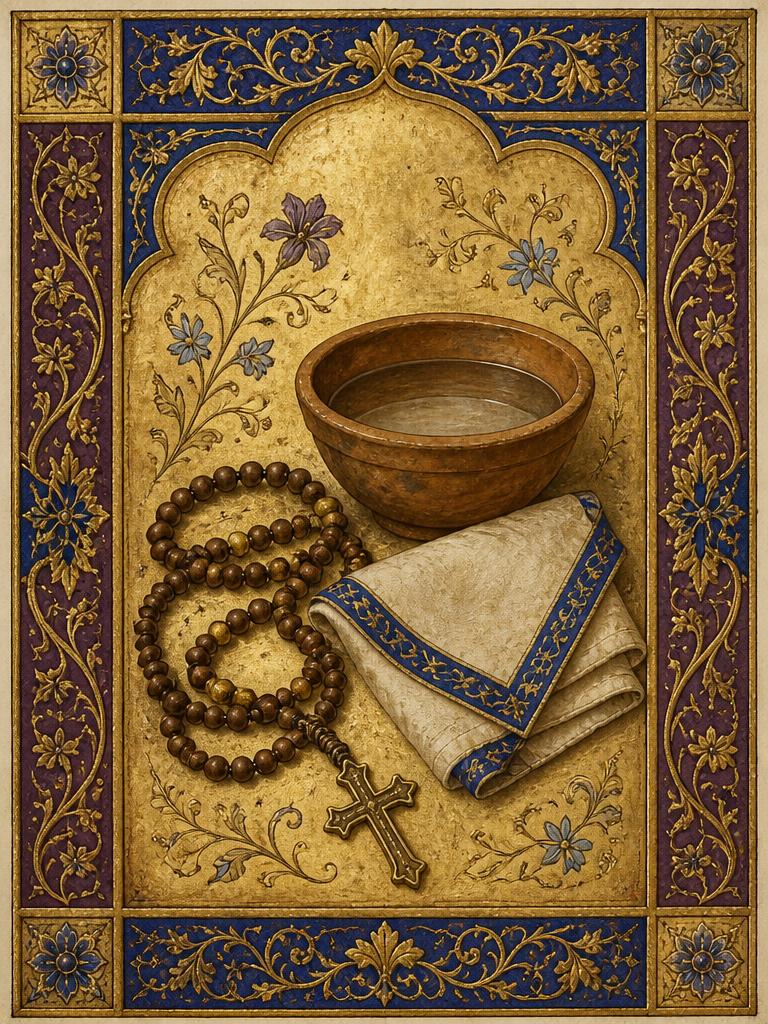
Symbolic treatment, not a likeness: A knotted rosary, a clay water bowl, and a blue bordered white cloth
Attributes drawn from her documented life, painted for this site as an illuminated panel. The rosary recalls her constant prayer and the blue bordered cloth the sari worn by her sisters. Painted for Thorns & Light. No photograph or historic portrait of St. Teresa of Calcutta is reproduced here.
Patronage
- The dying
- World Youth Day
Symbols
- A white sari with blue border
- A rosary
Key virtues
- Faithfulness without consolation
- Attention to the dying
Lived experience
- Spiritual darkness
- Doubt
- Criticism
Causes served
- The destitute
- The dying
- Abandoned children
When you need…
- A saint for when God feels absent
- Faith without feelings
Skopje, and a decision made at eighteen
Anjezë Gonxhe Bojaxhiu was born in 1910 in Skopje, then part of the Ottoman Empire and now the capital of North Macedonia, into an Albanian Catholic family. Her father, a merchant involved in local politics, died when she was about eight, and the household afterward depended on her mother, Drana, who kept the family financially afloat and by several accounts fed poor neighbours at their table.
At eighteen she left home to join the Sisters of Loreto in Ireland, learned English, and was sent to India in 1929. She took the name Teresa after Thérèse of Lisieux. She never saw her mother again. That detail is documented and worth sitting with: her vocation cost her a permanent separation from her family, and she wrote of missing them.
For roughly seventeen years she taught, chiefly at a Loreto school in Entally, Calcutta, eventually as headmistress. This was ordinary, respectable religious life: classrooms, examinations, and a convent behind a wall.
1946: what she reported, and what remains interior
In September 1946, travelling by train to Darjeeling, she became convinced that Christ was asking her to leave the convent and live among the poorest of Calcutta directly. Her own later accounts and letters to her spiritual directors describe this as a series of interior locutions. Those documents exist and are the historical evidence; the experience itself is not the kind of thing history can verify, and the Church's judgement about her holiness does not depend on our being able to.
It took nearly two years of correspondence, refusals, and negotiation before Rome permitted her to leave Loreto. She trained briefly in basic nursing with the Medical Mission Sisters at Patna, then began work in the slums in 1948. The Missionaries of Charity were approved as a diocesan congregation in 1950.
The work, described plainly
The early work was small and unglamorous: teaching children in the open air, washing people who were dying in the street, carrying them to a rented room. In 1952 the city made a former pilgrim hostel available and it became Nirmal Hriday, a home for the destitute dying. Homes for abandoned children, for people with Hansen's disease, and later for people with HIV followed, and the congregation spread to well over a hundred countries.
What her sisters did was mainly to bring people indoors who would otherwise have died on pavement, wash them, feed them, and stay with them. That is the historically solid core of her work, and it should not be inflated into something it was not: the homes were never hospitals, and she did not claim they were.
Fame, and the uses others made of it
From the late 1960s onward, television and print coverage made her one of the most recognised people alive. She received the Nobel Peace Prize in 1979 and used the occasion to speak against abortion, which drew both admiration and sharp criticism. She accepted donations and hospitality from political figures and businessmen whose conduct was later condemned, including some whose money had been taken from others, and she did not generally publish accounts of what was given or how it was spent. Critics have pressed this point fairly; her defenders note she had no interest in institutional finance and treated money as something to pass on rather than to manage.
She died on 5 September 1997, was beatified in 2003, and was canonised by Pope Francis on 4 September 2016.
Calcutta in the years she arrived
The city she worked in was shaped by catastrophes she did not cause and could not undo. The Bengal famine of 1943 had killed roughly two to three million people, many of whom died in Calcutta after walking there for food. Partition in 1947 drove enormous numbers of refugees into the city. Public health infrastructure for the destitute was overwhelmed to the point of nonexistence for people without money or family.
Understanding that context matters in both directions. It explains why the simple act of taking a dying stranger off a pavement was not a symbolic gesture but a real intervention that nobody else was making. It also explains why serious observers argued that what Calcutta needed was clinics, housing, and political change rather than hospices, and why her preference for personal presence over systemic reform became a genuine point of disagreement rather than mere hostility.
The interior darkness, without decoration
The letters published in 2007 as Come Be My Light, drawn from her correspondence with spiritual directors, show that from around 1949 until near the end of her life she experienced a persistent absence of any felt sense of God. She used the language of emptiness, of not being wanted, and in some letters of doubting whether heaven or God existed at all. She asked that these letters be destroyed. They were not, and their publication was authorised as part of her cause.
This should not be presented as a spiritual achievement or as something to want. She described it as painful and at times frightening, and she sought help for it repeatedly from priests who did not always understand what she was describing. Some readers, including clinicians, have suggested elements of what would now be assessed as depression. The Church's own tradition also has a category for prolonged loss of consolation in prayer. Those two readings are not mutually exclusive, and neither one is settled fact.
If you are living without any felt sense of God, her letters are honest company. They are not an instruction to refuse treatment, to keep silence, or to interpret your own suffering as a divine assignment.
Criticism, held alongside the witness
The most substantial criticisms concern medical standards: reused needles in the early decades, limited pain relief, minimal diagnostic care, and reliance on untrained volunteers in homes that were receiving large donations. Journalists and physicians documented these conditions, and later leadership of the congregation made changes. There were also criticisms of her opposition to divorce and contraception in a city of extreme poverty, and of her willingness to appear alongside figures who benefited from association with her.
Canonisation is the Church's judgement that a person lived charity heroically and is with God. It is not a declaration that every operational decision was sound, nor a bar on asking hard questions. Holding both at once is the honest position, and it is the one this site takes.
Scripture that runs alongside this life
Psalm 22:2 (Psalm 21:2 in the Douay-Rheims numbering)
O God my God, look upon me: why hast thou forsaken me?
Translation: Douay-Rheims (public domain) · Short excerpt. Psalm numbering differs between translations; both references are given.
Matthew 25:31–46
As long as you did it to one of these my least brethren, you did it to me.
Translation: Douay-Rheims (public domain) · Short excerpt; full passage linked.
Prayer
Original prayer written for this site
A prayer asking St. Teresa of Calcutta to pray with us
This prayer was written for this site; it is not an ancient or officially approved text.
St. Teresa of Calcutta, you prayed for decades into what felt like an empty room, and you kept your hands busy anyway.
Pray with everyone whose prayer feels like talking to a wall tonight, and with everyone dying somewhere no one has come.
Ask God for the ordinary courage to stay in the room with a person who is suffering.
Amen.
Not a traditional prayer of the Church. You are never required to have a devotion to any particular saint: you may always pray directly to God.
How to ask this saint to pray with you
- 1.Plain words are enough: 'St. Teresa, pray with me, because I cannot feel anything.'
- 2.If prayer is dry, you might simply sit for two minutes without trying to generate a feeling. That is what she did for decades.
- 3.If your darkness comes with hopelessness, sleeplessness, or thoughts of ending your life, treat that as a medical matter as well as a spiritual one, and read our Find help page.
- 4.Her witness was hands as much as prayer: consider one concrete act of presence toward someone sick or alone this week.
Reflection
Her life separates two things people often fuse: felt closeness to God, and faithfulness. She had almost none of the first and a great deal of the second. If you have concluded that your dryness means you are faithless, her letters say otherwise.
She is also a caution against turning admiration into exemption. Her defenders did her no favours by refusing to hear the criticisms; the criticisms do not erase the thousands of people who were washed, fed, and held while they died.
One actionVisit or telephone one person who is ill, housebound, or bereaved, and stay longer than is comfortable without offering advice.