
Biblical figure
St. Joseph
Husband of Mary; carpenter of Nazareth
A Jewish working man of occupied Galilee who chose to protect rather than expose the woman betrothed to him, and who moved his family across a border to keep a child alive.
- Dates
- 1st century
- Feast day
- 19 March (Solemnity of St. Joseph); 1 May (St. Joseph the Worker)
- Places
- Nazareth · Bethlehem · Egypt
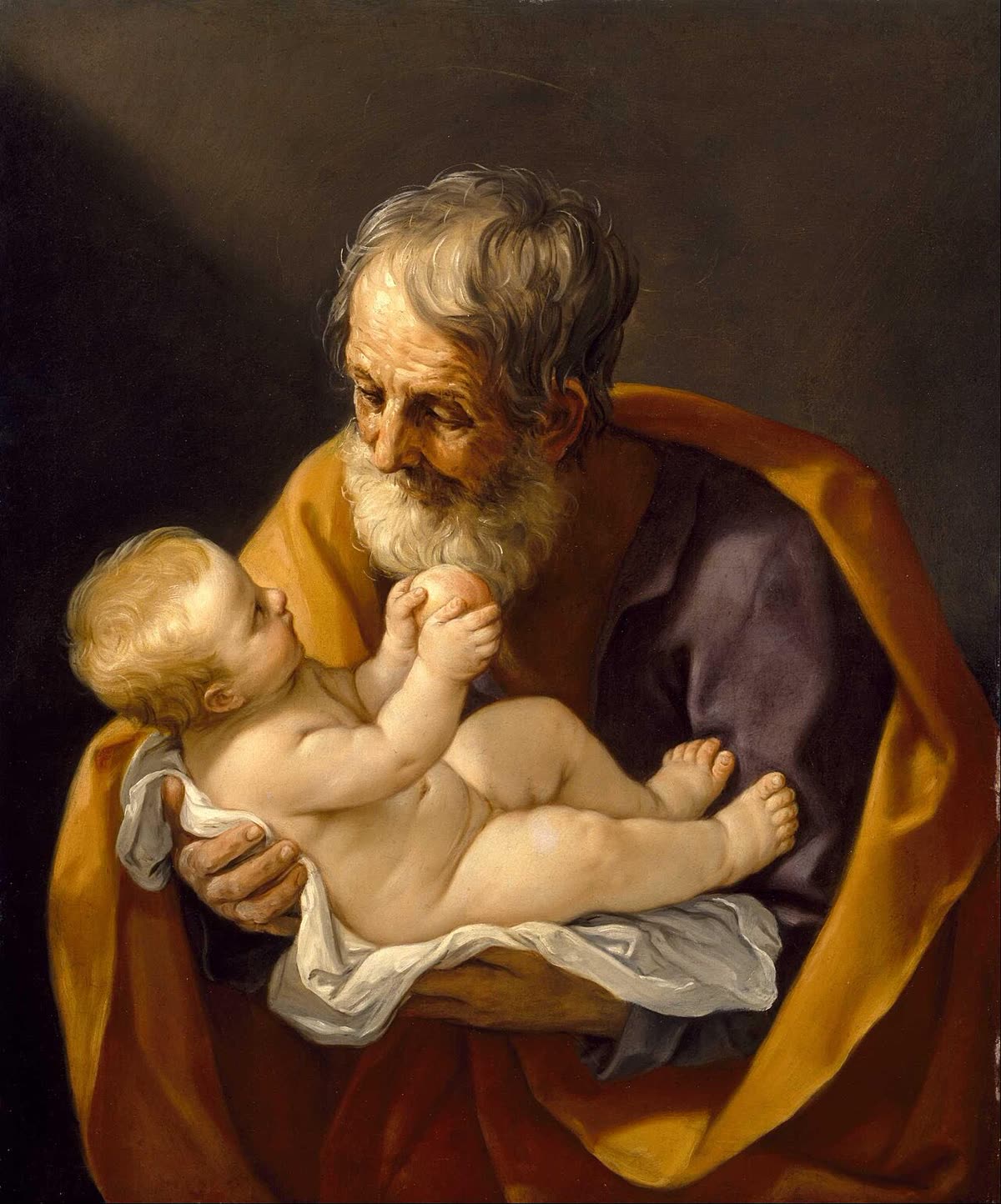
Artwork information
Title: St. Joseph and the Christ Child
Artist: Guido Reni
Date: 17th century
Rights: Public domain
Patronage
- The universal Church
- Workers
- Fathers
- A happy death
- Immigrants and refugees
Symbols
- A carpenter's square
- Lilies
- A lantern
- A flowering staff
Key virtues
- Protection over exposure
- Restraint
- Quiet responsibility
- Obedience under uncertainty
Lived experience
- Refugee flight
- Manual labour
- Public shame avoided for another's sake
- Silence in Scripture
Causes served
- Families
- Workers
- Refugees
When you need…
- A model of protective masculinity
- A saint for work and for fathers
- Someone who acted well without needing to be seen doing it
A tekton in a Galilean village
The Gospels identify Joseph as a tekton, a Greek word usually translated 'carpenter' but covering general work in wood and stone: building, repairing, and making tools and furniture for a village community. This was skilled manual labour, not wealth; villages the size of Nazareth offered a modest, uncertain living, and much of the surrounding region's larger building projects (Herod Antipas was expanding the nearby city of Sepphoris during this period) may have drawn craftsmen like Joseph for work beyond the village itself.
Joseph is described as being of the house of David, a lineage that carried religious significance for later Jewish and Christian readers but no political power or wealth in his own lifetime. He lived, like his neighbours, under Roman occupation and its taxes, with no realistic path to changing that arrangement.
A decision that protected rather than exposed
Matthew's Gospel records that Joseph, betrothed to Mary, discovered she was pregnant before they had come together, and describes him as a 'just man' unwilling to expose her publicly, who resolved to end the betrothal quietly rather than through a public accusation that could have exposed her to serious social and possibly legal danger under the harsher readings of the Law. Before he acts on that decision, Matthew records an angel appearing to him in a dream, telling him not to fear taking Mary as his wife, and Joseph obeys.
This decision, made before the angel intervenes, is itself part of what the Gospel presents as his character: faced with a choice between rigid enforcement of his rights and a quieter mercy, he chooses mercy first.
Bethlehem, flight into Egypt, and return
Both Luke and Matthew place Joseph as head of the household during the birth of Jesus in Bethlehem. Matthew alone records the family's flight into Egypt after a further dream warning Joseph of Herod's intent to kill the child, making Joseph responsible for moving his family, apparently with little notice or resource, across a political border to escape state violence. Egypt had a substantial Jewish population at the time, likely offering some existing community for the family to join.
After Herod's death, a further dream directs Joseph to return, and then, on learning who now rules in Judea, to settle instead in Nazareth in Galilee. Each of these moves is presented as Joseph acting immediately on what he understands to be divine direction, without recorded protest.
The Temple, and a household under the Law
Luke shows Joseph and Mary presenting Jesus in the Temple according to the requirements of the Law, and making the family's yearly Passover pilgrimage to Jerusalem, consistent with observant Jewish practice of the period. When the twelve-year-old Jesus is found teaching in the Temple after being lost for three days, both parents are described as searching for him with distress, Joseph included, though only Mary speaks in the account.
This is Joseph's last appearance in the Gospels as an active participant in the narrative. He is not mentioned during Jesus' public ministry, and the most common inference, though not stated directly in Scripture, is that he had died before it began.
A man who speaks no recorded words
Across all four Gospels, Joseph is not recorded as saying a single word. Everything known of him comes from what he is described as doing: deciding, obeying, travelling, providing, searching. The Church has drawn its picture of his character almost entirely from action rather than speech, and later tradition, reflected in the title 'silent Joseph,' honours that pattern rather than filling in words Scripture never gives him.
Fatherhood, honour, and risk in a first-century Jewish household
In a culture where a household's honour rested heavily on the sexual conduct of its women and the authority of its male head, Joseph's choice to protect Mary quietly rather than assert his full legal standing publicly was a real departure from the harsher options available to him. Jewish households of the period also carried the ordinary risks of occupied territory: forced travel for census and taxation, exposure to a client king's violence, and no legal recourse against a ruler like Herod.
Joseph's flight into Egypt places him among the countless displaced families of the ancient world who left everything to keep a child alive, with no guarantee of welcome or provision on arrival.
The household he provided for and protected
The Gospels present Joseph's entire recorded role as service to his family: providing through his trade, protecting Mary's safety and reputation, and safeguarding the life of a child who was not, by any account he could have verified himself, his by blood.
What is actually recorded
A betrothal complicated by a pregnancy he did not cause, with real social danger attached to it. Forced travel during a census while his betrothed was heavily pregnant. Sudden, unplanned flight from his home country to escape a ruler's violence. Ordinary manual labour in a village economy under foreign occupation. The Gospels record no complaint from him at any of these points, but neither do they record him as unaffected; he simply is not given words at all.
Strength used to shelter, not to control
Joseph is one of the few models in Scripture of male authority used consistently to protect rather than to dominate or expose. For anyone whose experience of fatherhood, marriage, or male authority has been frightening or controlling, Joseph's pattern, choosing mercy over public exposure, obedience over self-assertion, and protection over control, is worth sitting with. If that comparison is too painful right now, setting it aside is entirely legitimate; nothing about honouring Joseph requires forcing a comparison that does not yet feel safe.
Pope Francis's 2020 apostolic letter Patris Corde reflects on Joseph precisely along these lines: as a father who is 'beloved, tender and loving, obedient, and accepting,' who shows 'creative courage' in difficult circumstances rather than asserting control over them.
Prayer
Original prayer written for this site
A prayer asking St. Joseph to pray with us
This prayer was written for this site; it is not an ancient or officially approved text.
St. Joseph, you were given no easy word to say and no comfortable place to raise a child.
You chose mercy before you had certainty, and you kept moving when moving was frightening.
Pray with everyone carrying responsibility for someone else's safety right now, especially those doing it quietly, without praise.
Pray too with anyone for whom fatherhood or male authority has meant fear rather than protection, that they may find, in your example if nowhere else, what it should have looked like.
Amen.
Not a traditional prayer of the Church. You are never required to have a devotion to any particular saint: you may always pray directly to God.
How to ask this saint to pray with you
- 1.A simple request, 'St. Joseph, pray with me,' is enough; he needs no elaborate formula.
- 2.If you are a parent or guardian carrying responsibility for a child's safety right now, you might ask him specifically to pray with you for the next difficult decision in front of you.
- 3.If male authority in your life has been used to harm rather than protect you, you can ask him to pray with you toward what real protection should have felt like, at whatever pace feels safe.
Reflection
Joseph never explains himself in Scripture. He simply acts, repeatedly, in ways that protect the people entrusted to him. If your own life has taught you that authority usually means being controlled or exposed, his pattern is a quiet counter-example, not a demand that you trust it immediately.
One actionThis week, do one concrete, unglamorous thing to protect or provide for someone in your care, without mentioning it to anyone afterward.