
Canonized saint
St. André Bessette
Holy Cross brother; porter at Saint Joseph's Oratory
An orphaned, chronically ill, barely literate French-Canadian laborer who worked forty years as a doorkeeper in Montreal, viewed with suspicion by his own religious superiors for much of that time, and became the human center of one of the largest shrines in North America.
- Dates
- 9 August 1845 – 6 January 1937
- Feast day
- 6 January
- Places
- Saint-Grégoire-d'Iberville, Quebec · Farnham, Quebec · New England mill towns · Montreal, Quebec
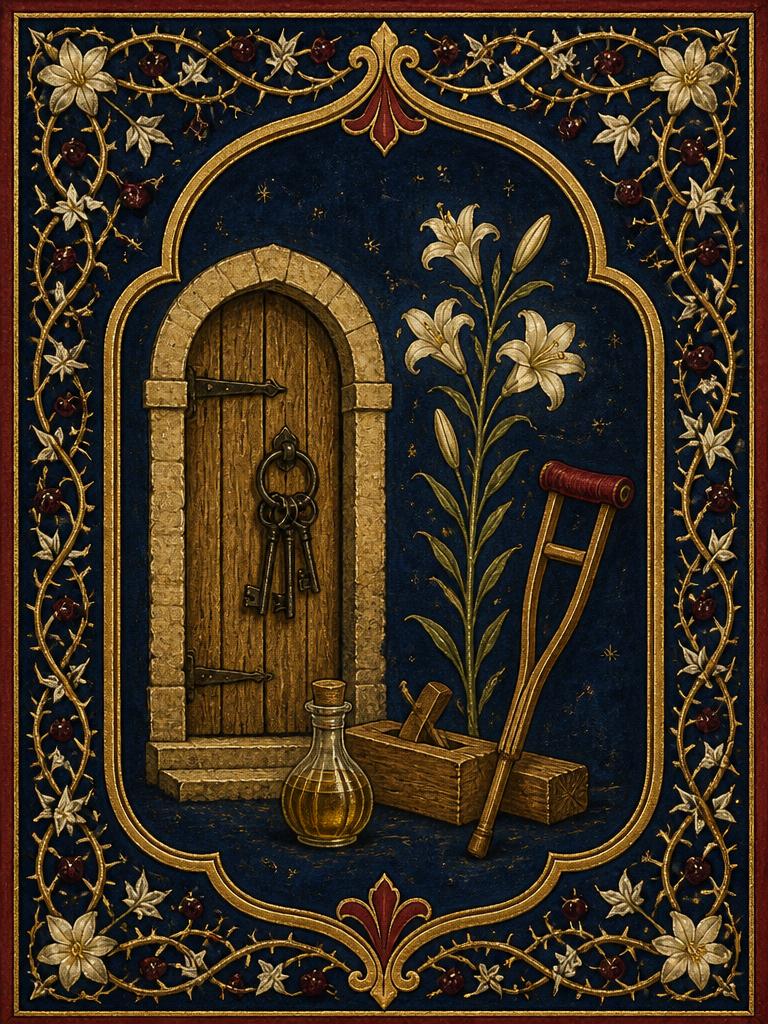
Symbolic treatment, not a likeness: A porter's door with keys, the lily of St. Joseph, a vial of oil, and a crutch
Attributes traditionally associated with this saint, painted for this site as an illuminated panel. It is a symbolic treatment, not a likeness. Painted for Thorns & Light. No photograph or historic portrait of St. André Bessette is reproduced here.
Patronage
- Saint Joseph's Oratory
- Caregivers
- People with chronic illness
Symbols
- A porter's bell
- A statue of St. Joseph
- Simple black habit
Key virtues
- Perseverance despite frailty
- Humility under suspicion
- Devotion to St. Joseph
Lived experience
- Chronic illness
- Low literacy
- Migration
Causes served
- Worker dignity
- Disability dignity
When you need…
- A saint who was chronically sick his whole life and was doubted for it
- A patron for immigrant and working-class labor that goes unnoticed
- Company for anyone who was written off early because of how little schooling or standing they had
Orphaned young, and sickly from birth
Alfred Bessette was born in 1845 near Saint-Grégoire-d'Iberville, Quebec, the eighth of twelve children born to a poor carpenter and farmer. He was small and frail from birth, with a chronic digestive ailment that would trouble him his entire life and that he was, for decades, unable to keep solid food down consistently.
His father died in a logging accident when Alfred was nine, and his mother died of tuberculosis three years later, leaving him an orphan by twelve. He was raised afterward by an aunt and uncle, received almost no formal schooling because of his poor health and the family's poverty, and remained functionally illiterate for most of his life, able to sign his name but relying on others to read and write for him.
Migrant labor in New England
As a young man, Alfred followed a common path for poor rural French Canadians of his generation and worked for several years as a laborer in New England textile mills, part of a large wave of Quebecois migration south across the border for factory work. He also worked as a farmhand, a baker, a blacksmith's helper, and a shoemaker in Canada, never staying long in any trade, in part because his health made sustained manual labor difficult.
He returned to Quebec in his mid-twenties still without a settled path, and it was his parish priest who suggested he try his vocation with the Congregation of Holy Cross in Montreal.
A vocation almost refused
When Alfred applied to the Holy Cross brothers in 1870, taking the religious name André, his evident poor health and lack of education led his superiors to hesitate over accepting him at all; he was nearly dismissed from the novitiate on health grounds before his local bishop intervened on his behalf. He made his final vows in 1874.
He was assigned as porter, doorkeeper, at Notre Dame College in Montreal, a post he later described, without bitterness recorded in the sources, as one where 'they showed me the door, and I stayed there forty years.' For much of that time his own community viewed him as a minor figure: a doorman with strange habits of devotion, not someone to be taken seriously.
The porter people came to see
From his post at the door, Brother André began visiting the sick in Montreal, praying with them and encouraging devotion to St. Joseph, whom he credited for the recoveries that followed. As word spread, growing numbers of visitors began arriving specifically to see him, first dozens, then hundreds, then, by the early twentieth century, thousands a year, seeking his prayers for healing.
This growth unsettled his religious superiors and Montreal's medical establishment alike. Doctors publicly accused him of quackery and of endangering public health by encouraging crowds of the sick to gather; some members of his own congregation, embarrassed by an unlettered brother drawing this kind of attention, tried at various points to restrict or redirect his activity. The local archbishop's own initial skepticism delayed formal support for the small chapel Brother André wanted to build across from the college in honor of St. Joseph.
Saint Joseph's Oratory
Despite that resistance, the chapel he began in 1904 on Mount Royal grew, through small donations and his own persistent fundraising rather than institutional backing, into Saint Joseph's Oratory of Mount Royal, eventually one of the largest shrines dedicated to St. Joseph in the world. Brother André spent his final years greeting visitors there daily, still functioning primarily as a doorkeeper even as the building around him became a basilica.
He died in Montreal on 6 January 1937, at ninety-one. More than a million people are recorded as having filed past his body in the days that followed, an extraordinary outpouring for a man his own order had, for much of his life, regarded as a marginal figure.
Canonization
He was beatified by Pope John Paul II in 1982 and canonized by Pope Benedict XVI on 17 October 2010, becoming the first Canadian-born man to be canonized.
Quebec labor migration, poverty, and low literacy
Nineteenth-century rural Quebec sent hundreds of thousands of French Canadians south to New England mill towns in search of work, a migration driven by land shortages and poverty at home. Formal schooling was inconsistent and often unavailable to children who were sick, orphaned, or needed for farm labor, and low literacy among laborers of this background was common rather than exceptional.
Within Catholic religious life at the time, brothers without education or ordination, as opposed to priests, were routinely assigned to manual and menial roles and were not expected to exercise significant influence, which is precisely the assumption Brother André's later ministry unsettled.
Who came to him
The sick and their families, many of them working-class Montrealers with no ready access to consistent medical care, who found in him someone willing to sit with them, pray with them, and treat their hope as reasonable rather than embarrassing.
He also insisted, throughout, that any healing be attributed to St. Joseph and to God rather than to himself, and declined to accept money personally for his visits, directing donations toward the chapel instead.
Doubted by his own, and by the medical establishment
Brother André's chronic ill health, minimal education, and low social standing led his own religious superiors to nearly refuse his vocation at the outset and, decades later, to regard his growing ministry with embarrassment or suspicion rather than support. Montreal physicians publicly labeled him a charlatan and campaigned against the crowds gathering around him, at times pressuring Church authorities to restrict him.
None of this hardship is presented here as something that made him holy. It is named because it is factually part of his story, and because it illustrates a pattern worth naming honestly: institutions, including the Church's own religious communities, can be slow to recognize the standing of members who lack formal education or social status, even when those members are doing real good.
What his life says
Brother André spent his life at a door, literally and institutionally: on the threshold of a religious community that was uncertain whether to keep him, and later at the literal entrance of a college, greeting whoever came. He never stopped being, on paper, the least credentialed man in most rooms he occupied.
His witness is that sustained, unglamorous, physically difficult service, done for decades without formal recognition and often against active institutional doubt, can still be exactly where holiness is found.
Scripture that runs alongside this life
Matthew 11:28–30
Come to me, all you that labour, and are burdened, and I will refresh you.
Translation: Douay-Rheims (public domain) · Full passage shown because this translation is in the public domain.
Mark 10:46–52
And Jesus said to him: Go thy way, thy faith hath made thee whole.
Translation: Douay-Rheims (public domain) · Short excerpt; full chapter linked.
Prayer
Original prayer written for this site
A prayer asking St. André Bessette to pray with us
This prayer was written for this site and is not a translation of a historic devotional text.
St. André Bessette, you were sick most of your life, barely able to read, and doubted by the very community you had joined.
Pray with everyone who has been underestimated because of how little schooling, health, or standing they have, and with everyone doing patient, unnoticed work at a door no one else wants to answer.
Amen.
Not a traditional prayer of the Church. You are never required to have a devotion to any particular saint: you may always pray directly to God.
How to ask this saint to pray with you
- 1.'St. André, pray with me' is enough; he was not a man for elaborate formality.
- 2.If you live with a chronic illness that limits what you can do, you can ask him to pray with you specifically about the frustration of a body that will not cooperate.
- 3.If you were told, by school, family, or work, that your lack of education made you less capable, ask his prayers while remembering he was told the same thing by his own religious order.
- 4.Visiting or reading about Saint Joseph's Oratory, which he began with almost no resources, can be its own quiet form of asking.
Reflection
If you live with an illness that never fully resolves, or if a lack of formal education has led people, sometimes people whose job it was to support you, to underestimate what you're capable of, Brother André's own religious superiors did exactly that to him, more than once, for decades. It did not turn out to be an accurate measure of him.
His life is not evidence that illness or hardship builds character; the text is clear that his ministry consisted of ordinary attentiveness to sick people who needed someone to take them seriously. That is available to you too, on whatever scale your own life allows, whether or not anyone above you currently recognizes it.
One actionIf you or someone you love struggles with chronic illness and feels dismissed by others, including within a faith community, it can help to name that experience directly to a trusted priest, spiritual director, or counselor rather than carrying it alone; feeling unseen is a legitimate weight, not a character flaw.