
Canonized saint
St. Dulce Lopes Pontes, 'St. Dulce of the Poor'
Franciscan sister; founder of hospitals and shelters for the poor of Bahia
A Brazilian sister who lived for decades with a disabling chronic respiratory illness while building hospitals, clinics, and shelters for people living in poverty and on the streets of Salvador, Bahia.
- Dates
- 26 May 1914 – 13 March 1992
- Feast day
- 13 August
- Places
- Salvador, Bahia, Brazil
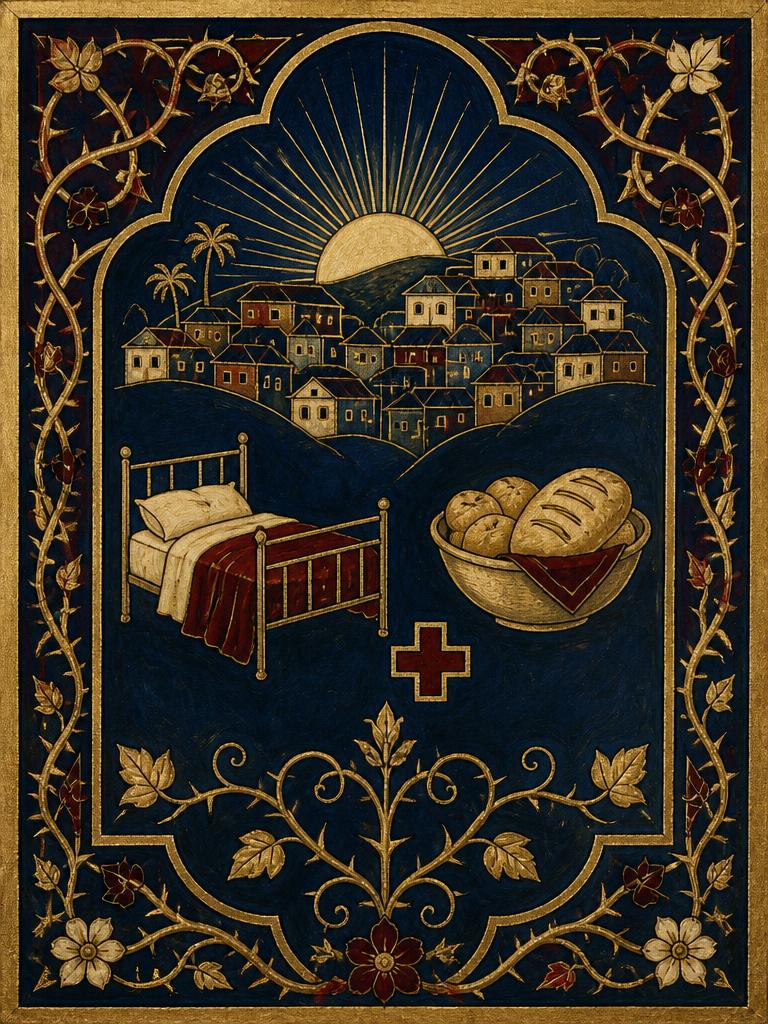
Symbolic treatment, not a likeness: A simple bed, a bowl of bread, a medical cross, and hillside rooftops at sunrise
Attributes traditionally associated with this saint, painted for this site as an illuminated panel. It is a symbolic treatment, not a likeness. Painted for Thorns & Light. No photograph or historic portrait of St. Dulce Lopes Pontes, 'St. Dulce of the Poor' is reproduced here.
Patronage
- Brazil
- The sick
- People experiencing homelessness
- Healthcare workers
Symbols
- A stethoscope
- A Franciscan habit
- An open door
Key virtues
- Persistence in illness
- Practical mercy
- Founding courage
Lived experience
- Chronic illness
- Disability
- Homelessness
Causes served
- Housing
- Hospital reform
- Street outreach
- Disability dignity
When you need…
- A saint who kept working while chronically ill herself
- Hope that a body that struggles to breathe can still build something lasting
- A patron for people sleeping on the street tonight
Early life and a call toward the poor
Maria Rita de Souza Brito Lopes Pontes was born in 1914 in Salvador, the capital of Bahia state in northeastern Brazil, into a middle-class family. As a teenager she was already organising groups of lay volunteers, the 'Little Workers of Saint Francis', to visit and assist the sick and poor of the city's poorer neighborhoods.
In 1933 she entered the Congregation of the Missionary Sisters of the Immaculate Conception of Mother of God, taking the religious name Dulce. She trained and worked as a teacher and nurse, and from the beginning oriented her ministry toward Salvador's most excluded residents: factory workers, the sick poor, and people living on the street.
Building shelter where none existed
In 1935 she founded the Workers' Union of Saint Francis to organise support for the urban poor, and through the following years, often without the resources or permission she needed, she began sheltering sick and homeless people wherever she could, including, according to well-documented accounts, in an abandoned building and eventually in a chicken coop on convent property when no other space was available.
That improvised shelter grew into the Santo Antônio Hospital, which she continued to expand for the rest of her life; it remains today one of the largest philanthropic hospital complexes in Brazil, treating patients regardless of their ability to pay.
A body that struggled to breathe
From young adulthood, Dulce suffered from severe, progressive respiratory illness, later understood to include emphysema and related lung disease, which left her breathless and physically limited for most of her working life. She continued administrating her growing network of clinics and shelters from a wheelchair and eventually with the aid of supplemental oxygen in her final years.
Her illness was not a hidden footnote to her ministry; it shaped daily life for someone who was simultaneously running hospital wards for other sick and disabled people. She did not treat her own disability as disqualifying her from leadership, and her congregation and collaborators built structures that let her keep directing the work despite it.
National recognition and final years
By the later decades of the twentieth century, Sister Dulce's work had grown to include hospitals, clinics, shelters, and vocational programs serving tens of thousands of people a year in Salvador. She was nominated for the Nobel Peace Prize in 1988 in recognition of this work, and met with Pope John Paul II during his visit to Brazil that year.
She died on 13 March 1992 from the respiratory failure she had lived with for decades.
Canonisation
Pope Francis canonised her on 13 October 2019 in Rome, the second Brazilian-born saint. Her canonisation was framed explicitly around her decades of direct service to people living in poverty and on the streets of Salvador, work she carried out while chronically ill herself.
Salvador, favela poverty, and gaps in public healthcare
Twentieth-century Salvador, like much of urban Brazil, saw rapid growth of poor and informal neighborhoods with little access to public hospitals or stable housing, leaving people who were sick, elderly, disabled, or homeless with few places to turn. Public and charitable healthcare capacity consistently failed to meet the scale of need in the city's poorest districts.
Sister Dulce's institutions filled gaps that both the Brazilian state and, at times, her own religious order's limited resources could not: she was repeatedly reprimanded by her superiors for taking in more patients than the convent could formally support, before her work was later embraced and expanded by the same congregation.
Who she served
Sick and injured workers with nowhere else to be treated. People sleeping on the streets of Salvador. Disabled and elderly people without family support. Children in need of basic medical care and vocational training.
She treated patients regardless of their ability to pay, a stance that placed real financial strain on her institutions and required constant fundraising and negotiation with civil authorities.
What she carried
A progressive lung disease that left her physically limited and eventually dependent on supplemental oxygen, while she continued to direct a growing hospital system. Repeated institutional obstacles, including resistance from her own congregation's leadership in the early years over the scale of the poor she was sheltering.
Her chronic illness is not presented here as something that made her holy. What the Church recognises is that she kept building shelter and care for others without waiting to be well herself, and that her institutions did not treat her disability as a reason to sideline her.
What her life says to the sick and the housing-insecure
She is a rare example of a canonised founder who ran her institutions from a wheelchair and, later, while using an oxygen tank, a detail her official biographies do not minimize. Disability and leadership were not treated as contradictions in her case.
Her witness to people without stable housing is concrete rather than symbolic: she built actual beds, actual clinics, and actual shelter, understanding that dignity for people living on the street required real infrastructure, not only kindness.
Scripture that runs alongside this life
Matthew 25:31–46
As long as you did it to one of these my least brethren, you did it to me.
Translation: Douay-Rheims (public domain) · Short excerpt; full passage linked.
Matthew 11:28–30
Come to me, all you that labour, and are burdened, and I will refresh you.
Translation: Douay-Rheims (public domain) · Full passage shown because this translation is in the public domain.
Prayer
Original prayer written for this site
A prayer asking St. Dulce of the Poor to pray with us
This prayer was written for this site; it is not a historic or officially approved text.
St. Dulce, you kept building shelter for others while your own body struggled for breath.
Pray with everyone living with a chronic illness who is told to slow down and cannot, and with everyone sleeping outside tonight in Salvador and everywhere else.
Ask God for the actual beds, clinics, and homes that people need, not only for comfort in their absence.
Amen.
Not a traditional prayer of the Church. You are never required to have a devotion to any particular saint: you may always pray directly to God.
How to ask this saint to pray with you
- 1.Simple words are enough: 'St. Dulce, pray with me.'
- 2.If you live with a chronic illness or disability, you can ask her specifically to pray with you about carrying responsibility while unwell.
- 3.Her feast day, 13 August, is a good day to support a local shelter or free clinic in her memory.
Reflection
If you live with a chronic illness or disability and feel you have less to offer because your body limits you, her life does not ask you to push through pain as proof of worth; it shows that her communities built support around her limits so her work could continue, and that is a model worth asking for, not shame for needing it.
If you are without stable housing, or love someone who is, her ministry insists that this is a solvable material problem the Church and society are called to address directly, not only a spiritual one to be endured.
One actionFind a shelter, clinic, or street outreach program in your own city and ask what they actually need this month, whether that is volunteer hours, funds, or advocacy for shelter beds.