
Biblical figure
Mary, the Mother of God
Mother of Jesus
A young Jewish woman of occupied Galilee whose free consent to God, and whose song about the hungry filled and the powerful pulled down, the Church still prays every day.
- Dates
- 1st century
- Feast day
- 1 January (Solemnity of Mary, Mother of God); 15 August (Assumption); 8 December (Immaculate Conception); and many others
- Places
- Nazareth · Bethlehem · Egypt · Jerusalem
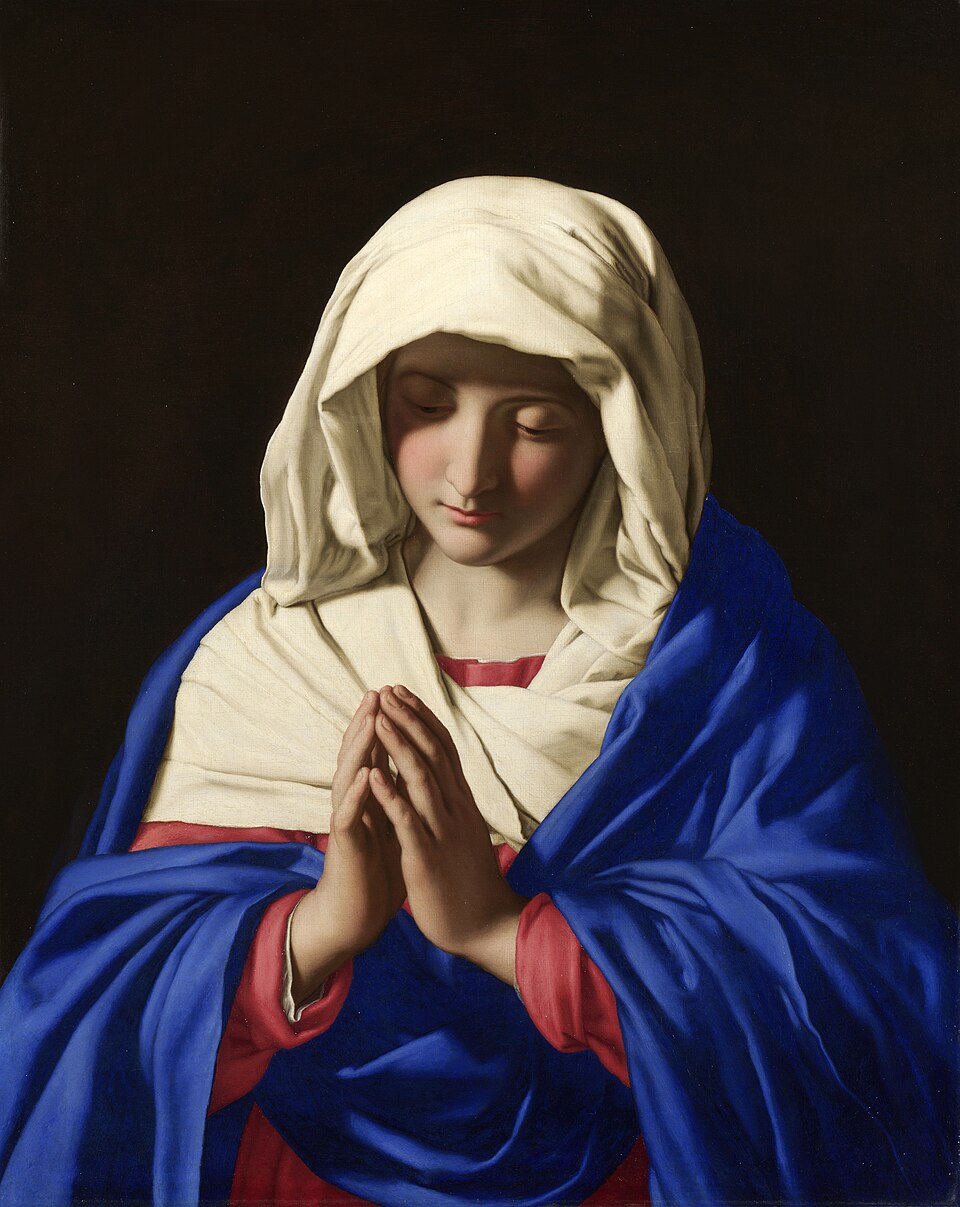
Artwork information
Title: The Virgin in Prayer
Artist: Giovanni Battista Salvi da Sassoferrato
Date: 17th century
Rights: Public domain
Patronage
- The whole Church
- The human race
- Expectant mothers
Symbols
- A blue mantle
- A rose
- Stars
- A lily
Key virtues
- Consent freely given
- Steadfastness at the cross
- Trust in uncertainty
Lived experience
- Poverty
- Unplanned and socially dangerous pregnancy
- Displacement and refugee flight
- Watching her child be executed
Causes served
- The lowly
- Refugees
When you need…
- A mother's presence
- Company in grief
- Someone who also said yes to something frightening
A young woman of Nazareth
Nazareth, in the first century, was a small Galilean village of perhaps a few hundred people, without the prominence of Jerusalem or the larger towns of the region. Luke's Gospel places Mary there as a young woman, likely still in her teens by the marriage customs of the time, engaged to a local craftsman named Joseph. Galilee itself was under Roman occupation, administered through client rulers and taxed by an empire most villagers would never see and could not vote to remove.
Luke records an angel announcing to Mary that she will conceive and bear a son, and Mary's own question about how this can be, since she is not married. Her answer, 'Let it be done to me according to thy word,' is presented in Scripture as free consent, not compulsion. The Church has always read this consent as central: God does not act on Mary without her agreement.
Betrothal, pregnancy, and the risk she carried
In first-century Jewish practice, betrothal was a binding legal stage before the wife moved into her husband's household; unfaithfulness during it was treated with the same seriousness as adultery within marriage. A pregnancy discovered before the marriage was completed could expose a woman to public disgrace and, under the harshest reading of the Law, to real danger. Matthew's Gospel shows Joseph's own struggle with exactly this situation before an angel reassures him.
Luke also records Mary's visit to her relative Elizabeth, and the Magnificat, Mary's song of praise, which speaks of God scattering the proud, pulling down the mighty from their thrones, and lifting up the lowly. The Church prays this song every evening at Vespers. It is not a private sentiment; it is a claim about how God acts in history, placed in the mouth of an unmarried pregnant girl from an occupied village.
Bethlehem, Egypt, and an ordinary Jewish household
Luke places the birth of Jesus in Bethlehem during a Roman census, with no room at the inn, and Matthew records the family's flight into Egypt to escape Herod's violence against the children of Bethlehem. Mary is a refugee mother in this account before she is anything else public. The family later returns to Nazareth.
The Gospels describe an observant Jewish household: Jesus is circumcised on the eighth day, presented in the Temple according to the Law, and the family makes the yearly Passover pilgrimage to Jerusalem, where the twelve-year-old Jesus is found teaching among the doctors of the Law. Mary's Judaism is not incidental background; it is the faith she formed her son within, in a Second Temple world organized around synagogue, Sabbath, purity law, and the Temple itself as the center of national and religious identity.
Cana, the cross, and Pentecost
Mary appears at the wedding at Cana asking Jesus to help a family facing public embarrassment over a failed wine supply, and at points during his ministry among those seeking him out. John's Gospel places her at the foot of the cross, one of the only followers named as present at the execution, where Jesus entrusts her to the beloved disciple.
Acts of the Apostles records her present with the disciples in the upper room after the ascension, praying together before Pentecost. This is her last explicit appearance in the New Testament: not a private figure withdrawn from the community, but a member of it, present at its founding moment.
What the Church holds as doctrine, and what remains devotion
Four things are defined Catholic doctrine, binding on the faithful: that Mary is truly the Mother of God (Theotokos, affirmed at the Council of Ephesus in 431, defending the full divinity and full humanity of Christ, not primarily elevating Mary); that she was conceived without original sin (the Immaculate Conception, defined in 1854); that she was assumed body and soul into heaven at the end of her earthly life (the Assumption, defined in 1950); and that she remained a virgin (a belief held from the earliest centuries of the Church). These are matters of faith, not options.
Distinct from these dogmas are private devotions: particular titles, feast days beyond the core ones, the rosary's meditations, and claims of Marian apparitions such as Lourdes or Fatima. The Church may approve an apparition as 'worthy of belief,' meaning it contains nothing contrary to faith and morals and can be safely trusted, but no Catholic is required to believe in any apparition, however popular, as a matter of faith. Worship (latria) belongs to God alone; the honour given to Mary (hyperdulia) is a different category entirely, and Catholics do not worship her.
A woman of Second Temple Judaism under Roman rule
Mary's world was shaped by two overlapping realities: the religious life of Second Temple Judaism, centered on Torah, Temple sacrifice, and synagogue teaching, and the political reality of Roman occupation, administered in Galilee through Herod Antipas and enforced ultimately by Roman military power. Honour and shame governed social standing closely; a family's reputation, a woman's sexual conduct, and a household's ability to meet its obligations were matters of public visibility, not private concern.
Within that world, an unmarried pregnant girl carried real risk, and a family fleeing political violence into another country had no legal protections beyond what hospitality and kinship networks might offer. The Gospels do not shield Mary from these realities; they place her inside them.
Whom she accompanied
Mary is shown accompanying Jesus' public ministry at points, present with the community of disciples both before and after his death, and interceding, in the Cana account, on behalf of a family facing shame. The Church's tradition holds her up chiefly as a companion in prayer for anyone who asks her intercession, on the model of asking a member of the Church to pray alongside you.
What she is recorded as enduring
A pregnancy that could have exposed her to social danger and possibly worse before Joseph chose to protect rather than expose her. Giving birth away from home during a forced census journey. Fleeing as a refugee to escape a ruler's violence against children. Standing at the public execution of her son, an event Luke's Gospel anticipates when Simeon tells her, at the Temple, that a sword will pierce her own heart also.
None of this is presented in Scripture or in Church teaching as something Mary sought out or as suffering that should be imitated for its own sake. It is presented as what she actually lived through, and as the reason her 'yes' to God is described as costly rather than easy.
Devotion that must never be used to demand silence
Marian devotion has, in some settings, been distorted into a tool for demanding female silence, sexual shame, or passive endurance of mistreatment, holding up an idealized, sanitized image of Mary as a standard used to control real women. That distortion has nothing to do with what the Gospels actually record: a woman who spoke a long, pointed song about the powerful being brought down, who questioned an angel, and who is never once told by Christ or by the Church to be silent about what has been done to her.
If Marian devotion has been used against you in this way, whether to demand you stay quiet, endure abuse, or accept mistreatment as some kind of imitation of her, you are free to set that distortion aside without setting aside your faith. Nothing in Catholic teaching asks anyone to endure abuse in Mary's name.
Scripture that runs alongside this life
Luke 1:46–55 (the Magnificat)
My soul doth magnify the Lord. And my spirit hath rejoiced in God my Saviour.
Translation: Douay-Rheims (public domain) · Full text of the opening verses shown; this translation is public domain.
Matthew 1:18-24
Joseph, son of David, fear not to take unto thee Mary thy wife, for that which is conceived in her is of the Holy Ghost.
Translation: Douay-Rheims (public domain) · Full passage shown because this translation is in the public domain.
Prayer
Traditional prayer
The Hail Mary
Hail Mary, full of grace, the Lord is with thee.
Blessed art thou amongst women, and blessed is the fruit of thy womb, Jesus.
Holy Mary, Mother of God, pray for us sinners, now and at the hour of our death.
Amen.
Source: Traditional Catholic prayer, combining Luke 1:28 and 1:42 with a later ecclesial petition
How to ask this saint to pray with you
- 1.The Hail Mary is itself drawn from Scripture: the angel's greeting to Mary and Elizabeth's greeting to her, followed by a simple request for prayer.
- 2.The Memorare is a traditional prayer asking Mary's intercession by recalling that no one who sought her help was ever left unaided; it can be prayed in a single sitting when you need to ask quickly.
- 3.If Marian devotion has been used against you, to demand silence, purity, or endurance of harm, you are free to leave it aside entirely. It is offered as a gift, never required as a test.
Reflection
Mary's 'yes' was given inside real risk, not in a situation made safe for her first. If you are being asked to trust God inside a situation that still feels dangerous or uncertain, her story does not minimize that; it was true for her too.
Her song, the Magnificat, is one of the most direct statements in Scripture about God's concern for the poor and the powerless. Devotion to Mary that ignores this song, and turns her only into an image of quiet submission, is not reading her whole story.
One actionRead the Magnificat (Luke 1:46-55) slowly once this week, and notice which line names something happening in the world right now.