
Priest
A priest can hear Confession, offer the sacraments, celebrate Mass, and walk with you spiritually. He is not a substitute for a therapist, psychiatrist, or physician.
Find Healing
A Catholic refuge for people living with depression, anxiety, trauma, intrusive thoughts, scrupulosity, and mental illness.
Depression is not ingratitude. Anxiety is not failed trust. Trauma responses are not sin.
Intrusive thoughts are not chosen acts. Psychosis is not proof of possession. Treatment is not betrayal.
Your mind can be unwell and your soul still beloved by God.
You do not have to make your brain behave before you are allowed to pray.
Quick exit leaves this page immediately and opens a neutral search page. It cannot delete your browsing history: if someone may check your device, consider using a device they cannot access.
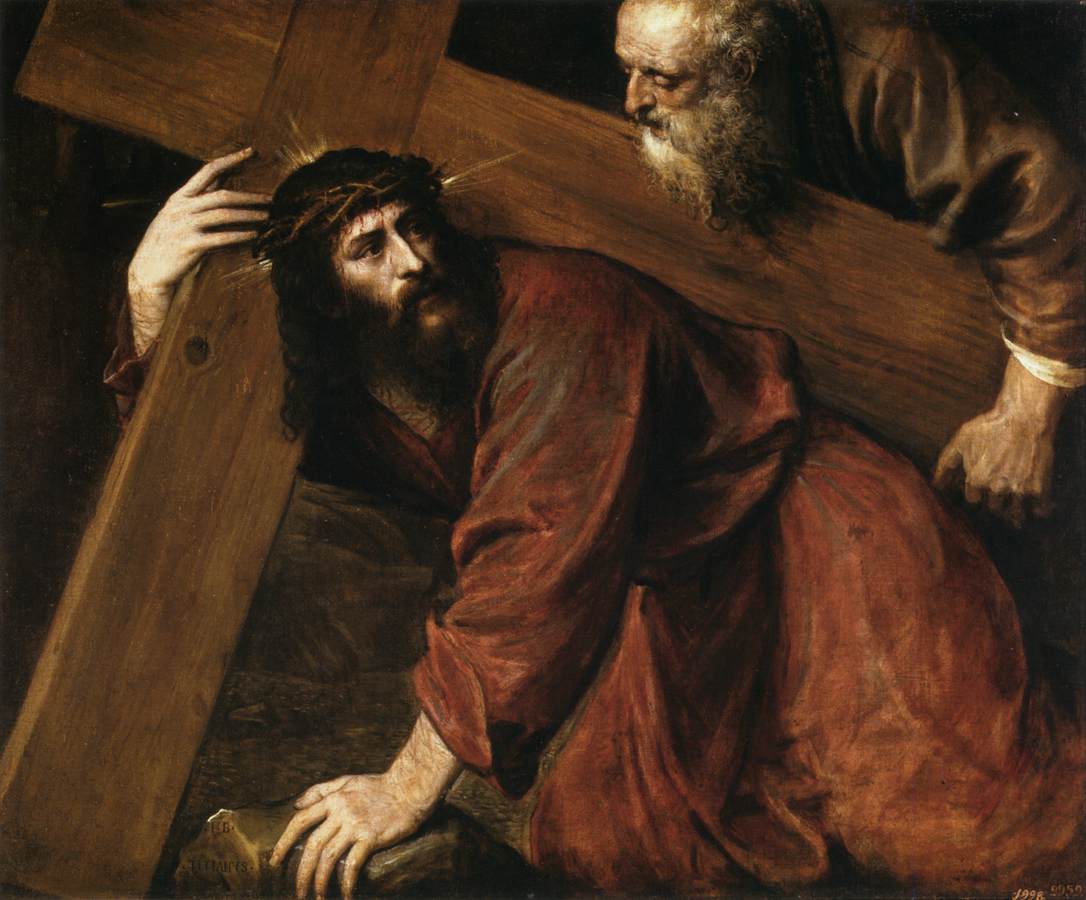
Christ Carrying the Cross, Titian (Tiziano Vecellio), c. 1565.
Christ under the weight of the cross. Some suffering is carried, not solved, and it is not a verdict on the one who carries it.
Title: Christ Carrying the Cross
Artist: Titian (Tiziano Vecellio)
Date: c. 1565
Rights: Public domain (copyright expired)
The state of your mind does not measure the state of your soul.
Depression is not ingratitude. A person can be deeply grateful and still unable to feel joy. Anxiety is not failed trust. A person can believe God cares for them and still have a body that sounds alarms it cannot turn off.
Trauma responses are not sin. Flashbacks, hypervigilance, dissociation, and numbness are the body's attempt to survive something that overwhelmed it. They are not chosen acts and they are not moral failures.
Intrusive thoughts are not chosen acts. The mind can produce blasphemous, violent, sexual, or disturbing images without any consent or desire. What matters morally is what you deliberately choose, not what invades you.
Psychosis is not proof of possession. Hallucinations, delusions, and breaks with reality are medical events that require competent psychiatric care. They are not evidence of demons, curses, or a soul beyond grace.
Treatment is not betrayal. Therapy, medication, hospitalization, and crisis care are forms of mercy, not signs that you have given up on God. The Catechism recognizes that fear, external pressure, and psychological factors can diminish or even remove responsibility for an act.
Scrupulosity turns religion into a source of terror. It is treatable, and it is not your fault.
Scrupulosity is a form of obsessive religious anxiety. It can show up as intrusive blasphemous, sexual, or violent thoughts that feel like your own sin; compulsive Confession because you fear a previous confession was invalid; repeated mortal-sin checking; endless reassurance loops; or terror that a prayer was said incorrectly and must be started over.
These experiences are real and painful, but they are not evidence of a bad soul. An involuntary thought is not the same as a deliberate choice. A feeling that something is wrong is not the same as actual guilt. The compulsion to confess again and again often feeds the anxiety rather than resolving it.
This page will not offer reassurance about specific fears, because reassurance loops are part of the problem. What helps is steadiness: one consistent confessor who knows your struggle, clear boundaries around how often you confess, and licensed support for obsessive-compulsive patterns if you want it.
You might say to a priest: "Father, I struggle with obsessive religious thoughts. I need you to help me confess once and leave it, rather than letting me repeat." A good confessor will understand and protect you from the loop.
Different helpers serve different needs. You do not have to choose between God and medicine.
A priest can hear Confession, offer the sacraments, celebrate Mass, and walk with you spiritually. He is not a substitute for a therapist, psychiatrist, or physician.
A spiritual director helps you notice God's presence in your life, pray honestly, and discern next steps. Good directors know the limits of their training and refer when needed.
A licensed therapist helps you understand patterns, process trauma, and build skills. For obsessive religious thoughts, therapists trained in ERP or ACT can be especially helpful.
A psychiatrist evaluates whether medication or other medical treatment could help. Prescribed medication is not a lack of faith; it is care for a biological reality.
A physician looks at the whole body. Sleep, thyroid, hormones, nutrition, and chronic illness can all affect mental health and deserve medical attention.
A crisis worker or emergency responder is there when you may harm yourself or cannot stay safe. They are the right call when prayer and conversation are not enough in the moment.
These roles are not in competition. A priest can anoint you, a therapist can help you understand your thoughts, a psychiatrist can stabilize severe symptoms, and a crisis worker can keep you safe. Each one is doing a different piece of the same work: helping you live.
If someone tells you that faith requires you to stop treatment, see only them, or refuse evaluation, that is a warning sign. Good spiritual care does not isolate you from competent clinical care.
Some things are never pastoral care, even when spoken in religious language.
No one but your prescriber should change or remove medication. Stopping abruptly can be dangerous. If someone has taken your medication, contact your prescriber, pharmacy, or emergency services.
Prayer can accompany you in any crisis, but it does not replace calling emergency services, a crisis line, or a clinician when you are in immediate danger.
Mental illness is not demonic possession. Exorcism or repeated deliverance sessions are not treatment for depression, anxiety, OCD, psychosis, or trauma, and should never be forced.
Your diagnosis, treatment, and struggles are yours to share when and with whom you choose. No minister, family member, or community has the right to announce them.
Mental illness is not caused by weak faith, unconfessed sin, or a failure to pray. The saints themselves walked through darkness, despair, and what we would now recognize as trauma.
If any of this is happening to you, it is a safety matter first and a spiritual conversation later. You are allowed to protect your medication, your privacy, your treatment plan, and your body. You may leave a room, end a conversation, or ask someone else to speak for you.
Quick exit leaves this page immediately and opens a neutral search page. It cannot delete your browsing history: if someone may check your device, consider using a device they cannot access.
These prayers are offered for the nights when words are hard and thoughts are loud.
God, my thoughts are loud tonight and they do not feel like my own. I cannot make them stop by trying harder. Hold me while they pass, and do not let me confuse their noise with your voice. Amen.
Original prayer from Thorns & Light
Lord, everything feels flat and far away. I am praying anyway, because faith is sometimes just keeping the door open. If you are near, let me know it. If not, I will wait here with you. Amen.
Original prayer from Thorns & Light
God, I take this medicine as a gift, not as a betrayal of you. Bless the hands that prescribed it, the body that receives it, and the mind it helps to steady. Let care be holy. Amen.
Original prayer from Thorns & Light
Christ, send me a confessor who knows me, who will not shame me for returning, and who can help me tell the difference between real guilt and the fear my mind invents. Amen.
Original prayer from Thorns & Light
God, I am afraid my prayer was invalid, incomplete, or displeasing to you. I hand that fear to you. You do not love me because I prayed well. You love me because I am yours. Amen.
Original prayer from Thorns & Light
Lord, someone I love is afraid of you now. Their religion has become a mirror for anxiety, not a path to peace. Give them one gentle listener, one steady clinician, and the courage to rest. Amen.
Original prayer from Thorns & Light
You do not have to wait until things feel spiritual enough to ask for help.
If you are thinking about hurting yourself, if you cannot care for yourself, or if someone else is in danger, this is a crisis. Prayer can be with you, but it does not replace urgent professional help.
In the United States, you can call or text 988 for the Suicide and Crisis Lifeline. If you are outside the United States, reach your local emergency number or a crisis line in your country. If you are not sure where to turn, start with emergency services.
If you are not in immediate danger but need ongoing support, Find help can point you toward licensed therapists, support groups, and other resources. Immediate danger has direct lines and safety planning guidance.
Quick exit leaves this page immediately and opens a neutral search page. It cannot delete your browsing history: if someone may check your device, consider using a device they cannot access.