
Saints
Why Catholics ask saints to pray for them.
It is the same instinct as asking a friend to pray for you, and Catholic teaching is careful about the difference between honour and worship.
The short answer
When a Catholic asks St. Josephine Bakhita or St. Joseph to pray for them, they are doing what they would do if they phoned a friend and said: please pray for me this week. The prayer is still addressed to God. The saint is being asked to pray alongside, not instead.
Catholics do not believe saints grant anything by their own power. Every good thing comes from God.
Honour and worship are different things
Catholic theology distinguishes worship, which belongs to God alone, from the honour given to holy people. The Second Commandment is not being quietly set aside; the distinction is deliberate and ancient.
In practice: you kneel before God. You may light a candle by an image of a saint the way you would keep a photograph of a grandmother: attention to a person, not adoration of an object.
Why Catholics think death does not end membership
The Church describes itself as one body in Christ, including those who have died in him. If death does not sever a person from the love of God, it does not sever them from the Church's prayer either.
This is what the Creed means by the communion of saints, and it is why Catholic funerals speak of a change of state rather than a severed relationship.
What is not required of you
No Catholic is obliged to have a devotion to any particular saint. No one is required to pray a novena, wear a medal, or feel anything at all.
If devotion to saints was used against you (as a test of loyalty, or to pressure you into silence) you may leave it entirely aside and pray directly to God. That is fully Catholic.
Scripture Catholics read here
Hebrews 12:1
We also having so great a cloud of witnesses over our head, let us lay aside every weight.
Translation: Douay-Rheims (public domain) · Short excerpt; full chapter linked.
Romans 8:38–39
Nor any other creature shall be able to separate us from the love of God, which is in Christ Jesus our Lord.
Translation: Douay-Rheims (public domain) · Short excerpt; full chapter linked.
One example: a mother who kept praying
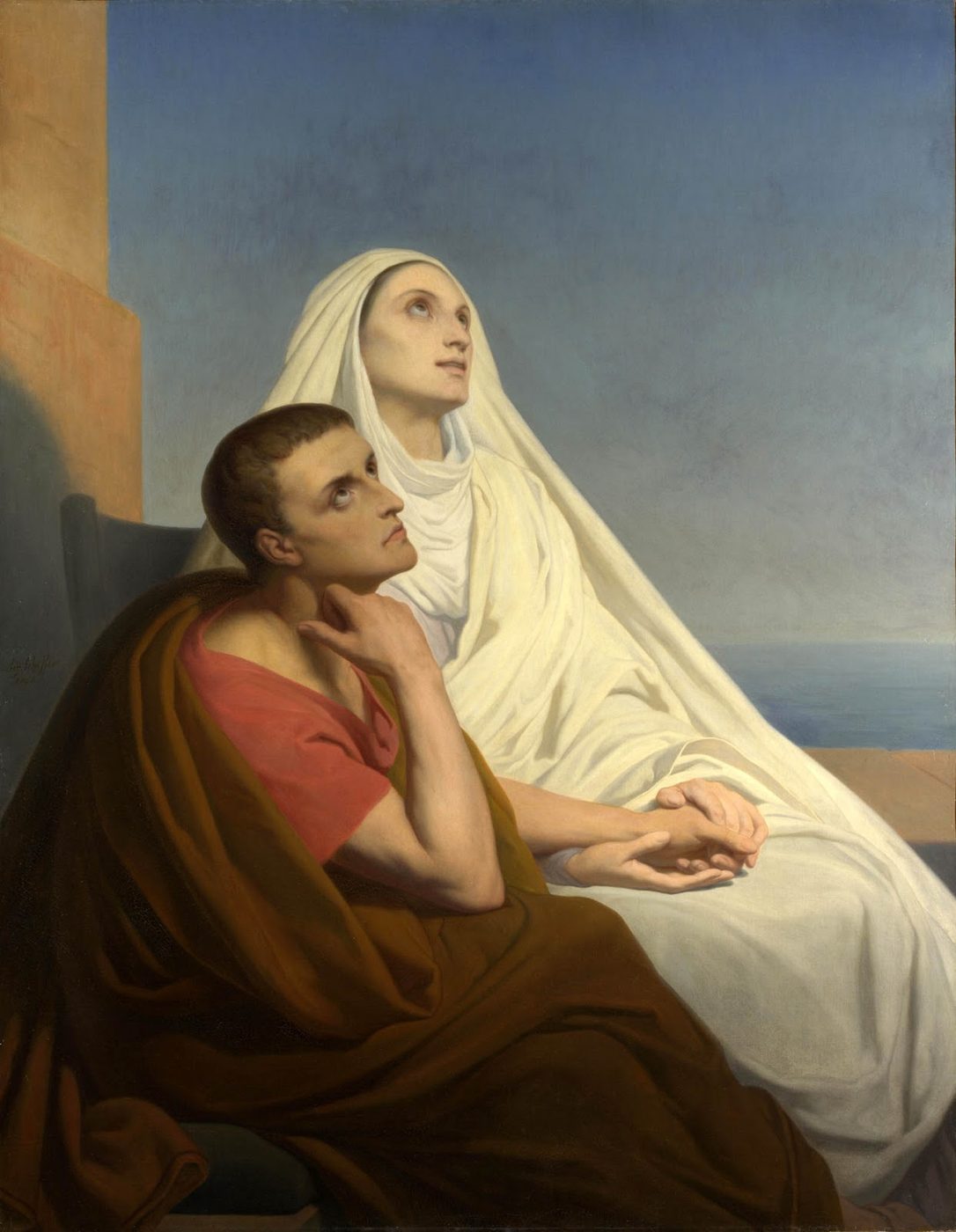
Saint Augustine and Saint Monica, Attributed after Ary Scheffer, 19th century.
Monica prayed for her son Augustine for decades before anything changed. Catholics ask her prayers for the same reason they asked hers then.
Artwork information
Title: Saint Augustine and Saint Monica
Artist: Attributed after Ary Scheffer
Date: 19th century
Rights: Public domain (copyright expired)
Augustine spent years arguing his way out of the faith his mother held. She did not shame him back into it. She kept praying, and she kept the relationship.
He later wrote about a long conversation the two of them had near the end of her life, sitting at a window in Ostia, talking about God without the argument in it. That scene, not a miracle story, is what most of the paintings of the pair are trying to show.
Asking Monica to pray is not asking her to fix a person. If you are praying for someone who has walked away, or waiting on someone who cannot yet be reached, she is asked because she waited too, and because nobody should have to do that alone.
Common questions
Sources
- Catechism of the Catholic Church, 946–962 (the communion of saints)
- Catechism of the Catholic Church, 2683–2684 (the witnesses who have preceded us)
- Second Vatican Council, Lumen Gentium, 49–51 (the Church in heaven and on earth)