
Saints
Mary, and the Church that does not end at death.
Honoured, not worshipped. And if her image was once used to keep you quiet, this page is written with that in mind.
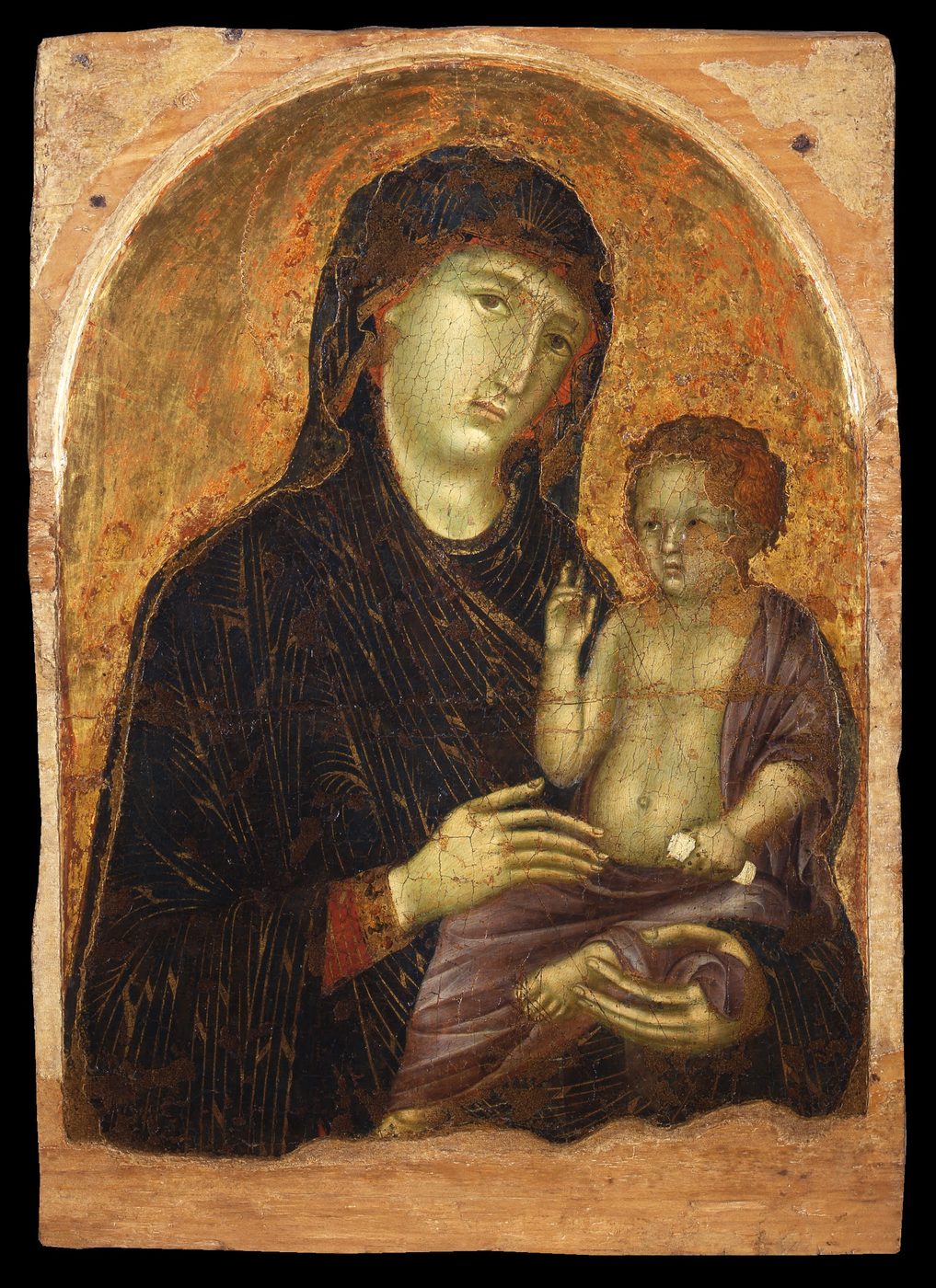
Madonna and Child, Duccio di Buoninsegna, c. 1290 to 1300.
Duccio paints an ordinary gesture: a child reaching up to pull back his mother's veil. Catholic devotion to Mary begins here, in a real relationship, not in a title.
Artwork information
Title: Madonna and Child
Artist: Duccio di Buoninsegna
Date: c. 1290 to 1300
Rights: Public domain (copyright expired)
Start with what she actually says
The longest speech Mary makes in Scripture is the Magnificat: God has scattered the proud, pulled the powerful off their seats, filled the hungry, and sent the rich away empty. It is prayed every evening by the Church, all over the world.
Any devotion to Mary that produces silence in the face of abuse of power has lost contact with the words she is given in the Gospel.
What Catholics believe
That Mary is the mother of Jesus, who is God: hence the ancient title Mother of God, defined at the Council of Ephesus in 431 to protect a claim about Christ, not to elevate Mary above him.
That she was preserved from sin from the first moment of her existence (the Immaculate Conception, defined 1854), and that at the end of her earthly life she was taken up body and soul into heaven (the Assumption, defined 1950).
That she prays for the Church, and that she is honoured above the other saints, but that she is a creature, saved by Christ like everyone else.
What Catholics do not believe
Catholics do not worship Mary. Worship belongs to God alone, and the Church says so explicitly.
Mary is not a fourth person of the Trinity, does not forgive sins, and does not have to be gone through in order to reach Jesus. Devotion to her is a gift offered, never a gate.
If Marian devotion was used to control you
Images of Mary have been used to demand a particular kind of femininity: silent, compliant, uncomplaining, sexually blameless, and to shame women who did not fit. Survivors of abuse have been told to be 'pure like Mary', or to suffer quietly because she did.
That is a misuse. Mary is not recorded enduring cruelty for its own sake; she is recorded consenting freely, speaking prophetically, travelling, questioning an angel, and standing at an execution.
You are free to set this devotion down for as long as you need. Prayer directly to God is fully Catholic, and always has been.
The communion of saints, in one paragraph
Catholics believe the Church is one body across death: those on earth, those being purified, and those with God. Members of a body can pray for one another. That is the whole claim.
It means you are not spiritually alone even when you are physically alone at 3 a.m. which is precisely the hour many people find this page.
The Magnificat, and the promise underneath it
Luke 1:46–55 (the Magnificat)
My soul doth magnify the Lord. And my spirit hath rejoiced in God my Saviour.
Translation: Douay-Rheims (public domain) · Full text of the opening verses shown; this translation is public domain.
Hebrews 12:1
We also having so great a cloud of witnesses over our head, let us lay aside every weight.
Translation: Douay-Rheims (public domain) · Short excerpt; full chapter linked.
Common questions
Foundational figures
Mary, Joseph, Mary Magdalene, Peter, Paul, and others the whole tradition rests on.
St. Francis of Assisi
A merchant's son who renounced his inheritance publicly, embraced people with Hansen's disease, and rebuilt a movement around poverty.
Mary, the Mother of God
A young Jewish woman of occupied Galilee whose free consent to God, and whose song about the hungry filled and the powerful pulled down, the Church still prays every day.
St. Joseph
A Jewish working man of occupied Galilee who chose to protect rather than expose the woman betrothed to him, and who moved his family across a border to keep a child alive.
St. Mary Magdalene
The first witness of the resurrection, sent by Christ himself to tell the other disciples, and not, despite centuries of retelling, a prostitute; Scripture never says this.
St. Peter the Apostle
He denied knowing Jesus three times in a single night and was still entrusted with the care of the whole Church: the standing argument against the idea that failure disqualifies you.
St. Paul the Apostle
He organised the arrest and, by his own account, approved the killing of the first Christians before becoming the most widely travelled preacher and writer among them.
St. Thérèse of Lisieux
She died at twenty-four having done nothing remarkable by the world's measure, and taught that small, hidden love is the path.
St. Augustine of Hippo
A North African teacher whose long, restless search, and his own honest but troubling account of it, shaped Western Christian thought.
St. Monica
She prayed for decades for a son moving in the opposite direction, and endured a difficult marriage that should never be held up as a model to imitate.
Sources
- Catechism of the Catholic Church, 963–975
- Second Vatican Council, Lumen Gentium, chapter 8 (on Mary)
- Council of Ephesus (431), on the title Theotokos