
Biblical figure
St. Peter the Apostle
Galilean fisherman; first among the apostles
He denied knowing Jesus three times in a single night and was still entrusted with the care of the whole Church: the standing argument against the idea that failure disqualifies you.
- Dates
- 1st century (traditionally d. c. AD 64-67)
- Feast day
- 29 June (Sts. Peter and Paul); 18 January (Chair of St. Peter, historically 22 February in the current calendar)
- Places
- Bethsaida · Capernaum · Galilee · Jerusalem · Rome
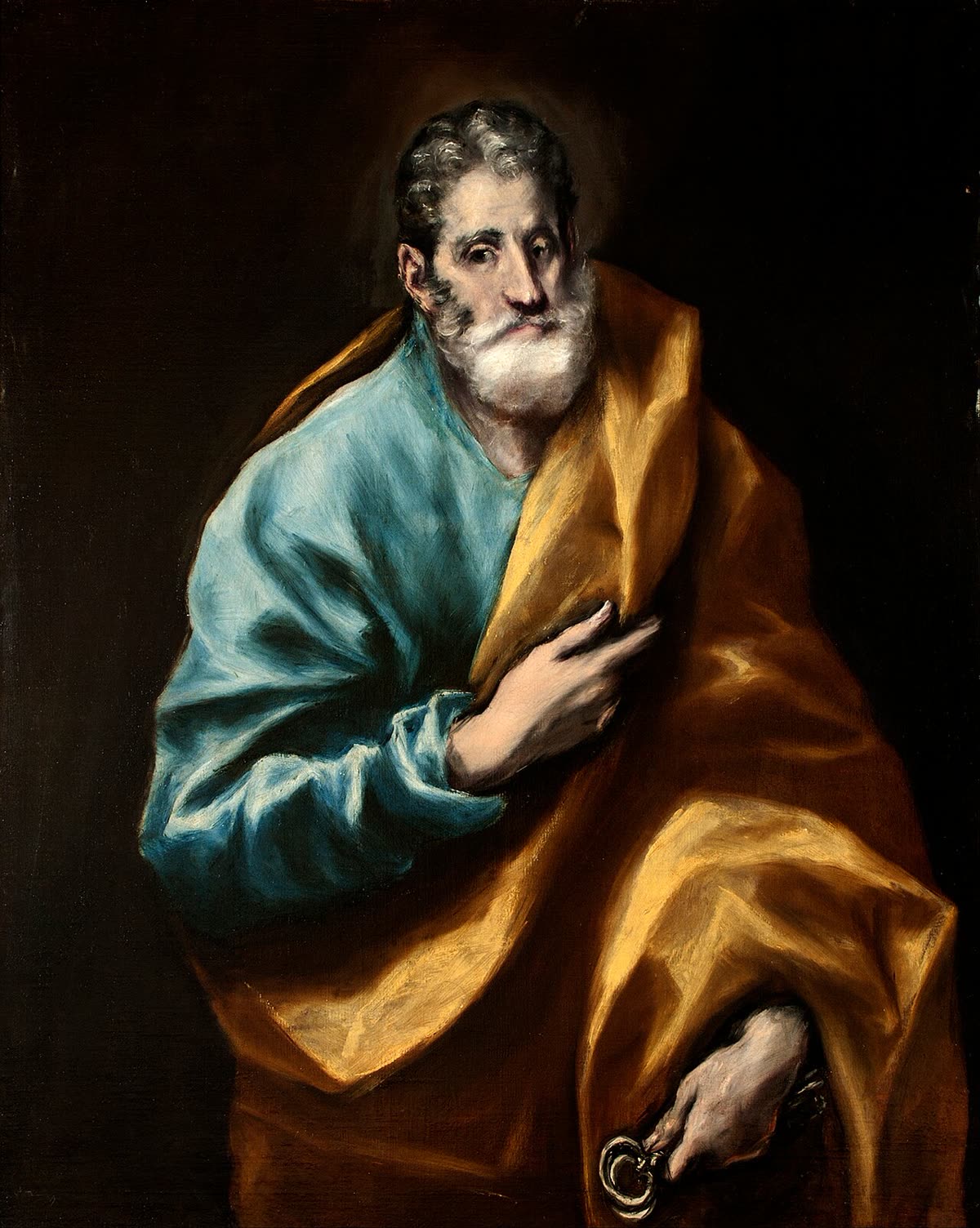
Artwork information
Title: St. Peter
Artist: El Greco
Date: c. 1600
Rights: Public domain
Patronage
- Fishermen
- The papacy
- Locksmiths and net makers
Symbols
- Keys
- A boat and nets
- An inverted cross
- A rooster
Key virtues
- Repentance without despair
- Boldness after failure
- Willingness to be corrected
Lived experience
- Public failure
- Fear under pressure
- Imprisonment
- Being restored after letting someone down
Causes served
- Unity of the Church
When you need…
- A saint who failed badly and publicly
- Reassurance after letting someone down
- Hope that a collapse under pressure is not the last word
A fisherman on the Sea of Galilee
Simon, later given the name Peter (from the Greek petros, rock), worked as a fisherman on the Sea of Galilee, likely in partnership with his brother Andrew and with James and John, the sons of Zebedee. Fishing on the Sea of Galilee in this period was a licensed trade, taxed by the Roman administration and its client rulers, and while not among the most marginal occupations, it was physically demanding manual labour, not a position of social standing.
The Synoptic Gospels describe Jesus calling Peter and his companions to leave their nets and follow him; John's Gospel places an earlier encounter through Andrew. From this point Peter appears repeatedly among the small circle closest to Jesus, along with James and John, present at moments the wider group of disciples was not, including the Transfiguration.
First to speak, first to falter
Peter is presented across the Gospels as impulsive and outspoken: he is the one who confesses Jesus as the Christ at Caesarea Philippi and is told he will be given the keys of the kingdom, and, in the very next scene in Matthew's Gospel, rebukes Jesus for predicting his own suffering and is himself rebuked in return. He attempts to walk on water toward Jesus and begins to sink from fear. He objects to Jesus washing his feet at the Last Supper, then overcorrects and asks for his hands and head washed too.
In Gethsemane, Peter draws a sword to defend Jesus at his arrest and is told to put it away. Within hours, questioned three times by bystanders about his association with Jesus, he denies knowing him three times, the last time with an oath, before a rooster crows, fulfilling Jesus' own prediction made hours earlier. Luke records that at that moment Jesus turned and looked at Peter, and Peter went out and wept bitterly.
Restoration at a second charcoal fire
John's Gospel records a resurrection appearance beside the Sea of Galilee in which the risen Jesus asks Peter three times whether he loves him, matching the number of his denials, and each time responds by entrusting Peter with the care of his sheep. Peter is grieved at being asked a third time, but the encounter ends not with punishment or a demand for explanation, only with a renewed commission and a prediction of Peter's own death.
Leadership in Jerusalem and beyond
The book of Acts presents Peter as the leading figure of the earliest Jerusalem church: preaching at Pentecost, healing in Jesus' name, and, in a pivotal episode, receiving a vision that leads him to baptize the Roman centurion Cornelius, a Gentile, opening a controversial question about whether Gentile converts needed to follow the full Jewish Law. Acts and Paul's letter to the Galatians both describe real tension over this question, including a documented public disagreement between Peter and Paul at Antioch over Peter's withdrawal from eating with Gentile Christians under pressure from a more conservative faction.
Peter is also recorded as imprisoned by Herod Agrippa I and, according to Acts, freed by an angel, and he appears at the Council of Jerusalem, described in Acts 15, arguing against imposing the full Law on Gentile converts.
Rome and martyrdom: Scripture, history, and tradition
The New Testament itself does not narrate Peter's death, though John's Gospel includes a passage, understood by the early Church as a prophecy of martyrdom, in which Jesus tells Peter that when he is old, another will bind him and carry him where he does not wish to go. First Peter, traditionally attributed to him, is addressed from 'Babylon,' widely read by scholars as a coded reference to Rome.
That Peter went to Rome and was martyred there, traditionally during Nero's persecution of Christians after the fire of Rome in AD 64, is the consistent and early testimony of Christian writers such as Clement of Rome (writing around AD 96) and later Eusebius, and is treated by most historians, Catholic and non-Catholic, as highly probable, though it rests on early Christian tradition and archaeology rather than New Testament narrative itself. The tradition that he was crucified upside down, at his own request, considering himself unworthy to die as Jesus did, comes from later sources, including the apocryphal Acts of Peter, and should be identified plainly as tradition rather than as a New Testament fact.
Galilee, honour, and a fisherman given unusual authority
Peter's world combined the daily realities of a Galilean fishing economy under Roman and Herodian taxation with the intense honour and shame dynamics of public reputation: to publicly deny association with a condemned man, as Peter did, was in that culture both an act of self-preservation and a serious act of shame, witnessed by bystanders around a fire. That the Gospels, written by and for the community Peter would go on to lead, preserved this failure in such detail, rather than softening or omitting it, is treated by scholars as a strong sign of the account's historical reliability.
Leadership he was given despite, not instead of, his failure
Acts presents Peter preaching at Pentecost, healing the sick, opening the Church's mission to Gentiles through Cornelius's baptism, and speaking at the Council of Jerusalem. The Catholic Church holds that the office given to Peter, as reflected in Matthew 16 and John 21, continues in the office of the papacy.
What he is recorded as going through
Public failure under pressure, denying Christ three times in one night, immediately after boasting he never would. Grief severe enough that Scripture records him weeping bitterly. Imprisonment under Herod Agrippa. Ongoing conflict within the early Church over how Jewish and Gentile Christians should relate to one another, in which Peter himself was, at least once, on the wrong side of the argument, according to Paul's own account in Galatians. Tradition holds he was ultimately executed for his faith in Rome.
Failure that did not disqualify him
Peter is not remembered by the Church as someone who overcame his flaws before being trusted. He is remembered as someone entrusted with leadership again immediately after his worst public failure, asked only whether he loved Jesus, not asked to first prove himself worthy again. Catholic teaching does not present this as license for carelessness; it presents it as evidence that repentance, not perfection, is what restoration actually requires.
If a serious failure, public or private, has convinced you that you have disqualified yourself from something God was asking of you, Peter's story is the direct scriptural answer to that fear, not a promise that consequences disappear, but a promise that failure is not the final word.
Scripture that runs alongside this life
Matthew 16:13-19
Thou art Peter; and upon this rock I will build my church.
Translation: Douay-Rheims (public domain) · Full passage shown because this translation is in the public domain.
John 21:15-19
Simon, son of John, lovest thou me more than these?
Translation: Douay-Rheims (public domain) · Full passage shown because this translation is in the public domain.
Prayer
Original prayer written for this site
A prayer asking St. Peter to pray with us
This prayer was written for this site; it is not an ancient or officially approved text.
St. Peter, you swore you would never fall, and then you fell in front of everyone.
You wept, and you were asked only whether you still loved him, not to explain yourself first.
Pray with everyone convinced their worst failure has disqualified them from what they were meant for.
Pray that we might be asked the same simple question you were, and find the same courage to answer honestly.
Amen.
Not a traditional prayer of the Church. You are never required to have a devotion to any particular saint: you may always pray directly to God.
How to ask this saint to pray with you
- 1.A simple 'St. Peter, pray with me' is enough.
- 2.If a specific failure is keeping you from something you believe you are still called to, name it honestly and ask him to pray with you the way Christ questioned him: without demanding an explanation first.
- 3.If shame after letting someone down is the obstacle, you might sit with John 21 and ask what it would mean to answer honestly, the way Peter did.
Reflection
Peter was not restored because he found a way to undo his denial. He was restored because he was asked, three separate times, a single honest question. Restoration in Scripture usually looks like being asked that question again, not like erasing what happened.
One actionIf you have let someone down and have been avoiding them out of shame, consider one honest, low-stakes way to reconnect this week, without over-explaining or over-apologizing.