
Biblical figure
St. Mary Magdalene
Apostle to the apostles
The first witness of the resurrection, sent by Christ himself to tell the other disciples, and not, despite centuries of retelling, a prostitute; Scripture never says this.
- Dates
- 1st century
- Feast day
- 22 July (Feast, raised from Memorial in 2016)
- Places
- Magdala · Galilee · Jerusalem
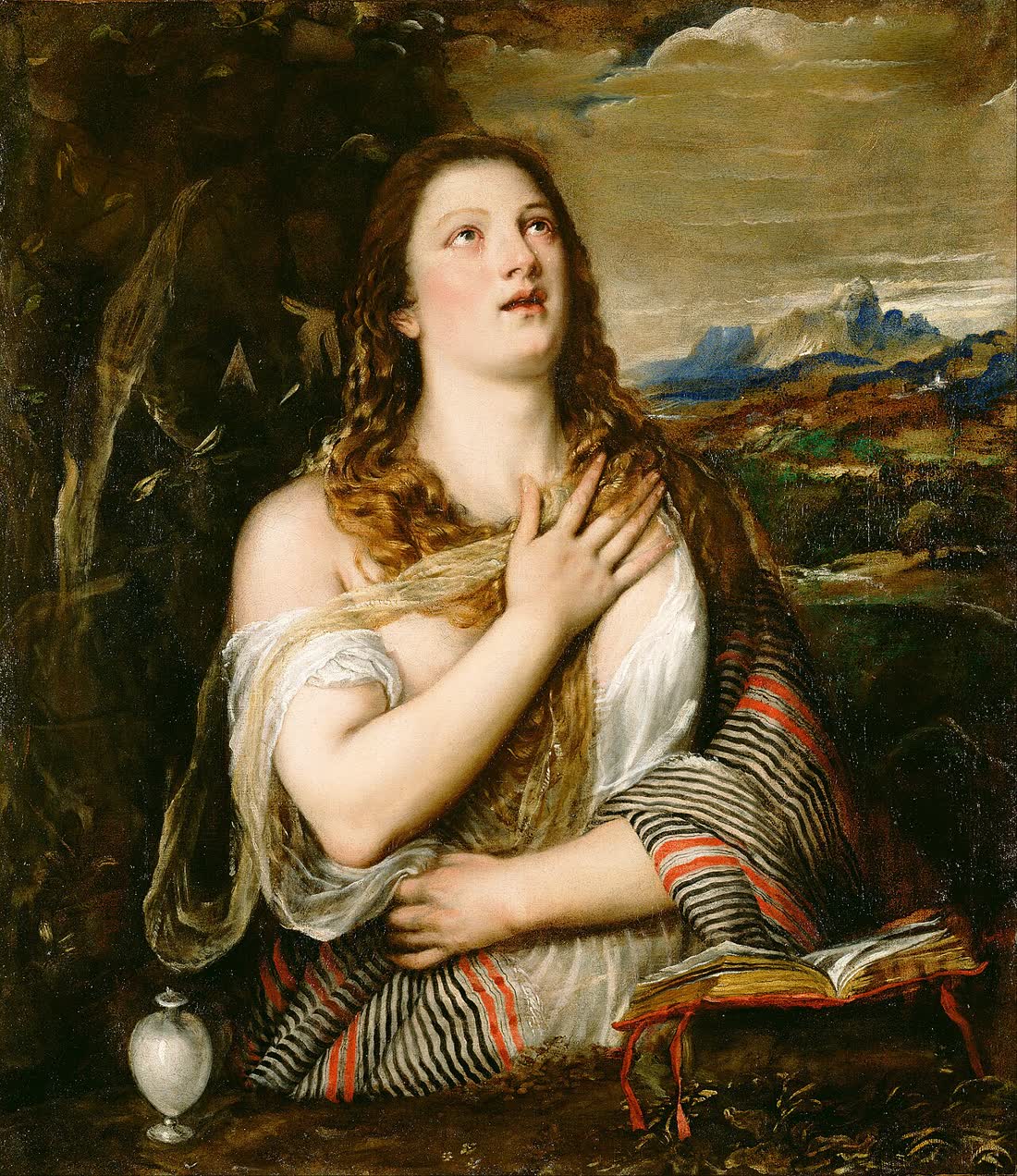
Artwork information
Title: Penitent Magdalene
Artist: Titian
Date: c. 1533
Rights: Public domain
Patronage
- Women
- Those who grieve
- Converts
- Pharmacists and perfumers (traditional, linked to the ointment jar)
- Contemplative life
Symbols
- An alabaster jar
- An egg
- A garden at dawn
Key virtues
- Fidelity in grief
- Courage to testify when disbelieved
- Perseverance at the tomb
Lived experience
- Illness or severe affliction
- Bereavement
- Being disbelieved after telling the truth
Causes served
- Women's testimony
- Accompaniment of the grieving
When you need…
- A saint for grief
- Vindication after being dismissed
- A witness who was not believed at first
Named for her town, and healed of a severe affliction
Mary Magdalene takes her name from Magdala, a Galilean town on the Sea of Galilee associated with a fishing and salting industry, distinguishing her from the other women named Mary in the Gospels. Luke's Gospel introduces her among the women who accompanied Jesus and the Twelve and who provided for them out of their own resources, describing her as someone from whom 'seven devils had gone out,' an ancient way of naming a severe affliction, likely understood at the time as possession, and not a description of sexual sin. Nothing in any Gospel identifies Mary Magdalene as a prostitute or connects her to the unnamed sinful woman who anoints Jesus' feet in Luke 7, or to Mary of Bethany.
That she had the means to travel with Jesus' itinerant group and to help support it financially suggests some degree of independent means, unusual for a woman of the period and worth noting alongside the affliction Luke records.
Present at the cross when others fled
All four Gospels name Mary Magdalene among the women who remained near the cross during the crucifixion, at a time when Mark and Matthew record that the male disciples, with the exception of the beloved disciple in John's account, had fled. This is a detail all four Gospel writers preserved independently, which historians treat as a strong indicator of its reliability: a community inventing a founding story in a culture that discounted women's testimony would have had every reason to leave this detail out.
She is also named as present at the burial of Jesus, observing where the body was laid.
First at the tomb, first to see the risen Christ
All four Gospels place Mary Magdalene among the first, or the first, to arrive at the empty tomb. In John's account, she remains at the tomb weeping after others have returned home, and the risen Jesus speaks her name; she recognizes him and is told, 'Go to my brethren, and say to them: I ascend to my Father and to your Father, to my God and your God.'
She then goes and reports what she has seen to the other disciples, who in Luke's account do not initially believe the women's report. The early Church, reflecting on this sequence, gave her the title 'apostle to the apostles' (apostola apostolorum): the first to be commissioned to announce the resurrection, to the very apostles who would go on to lead the Church.
Correcting a centuries-old conflation
In the sixth century, a homily by Pope Gregory the Great merged Mary Magdalene with the unnamed sinful woman of Luke 7 and with Mary of Bethany, presenting a single composite figure as a reformed prostitute. This reading took deep hold in Western art, preaching, and popular devotion for over a thousand years, and it has never had any basis in the Gospel text itself, which names these as separate women in separate episodes.
Modern Catholic biblical scholarship, reflected in the Church's official liturgical texts, has abandoned the conflation. The distortion mattered beyond accuracy: it took the Church's most direct witness to the resurrection and recast her primarily as a sexual sinner, a framing that has shaped how women's testimony and women's past have been treated in Christian culture for centuries.
Raised to a Feast in 2016
On 3 June 2016, the Congregation for Divine Worship and the Discipline of the Sacraments, with the approval of Pope Francis, issued a decree raising the liturgical celebration of St. Mary Magdalene on 22 July from a Memorial to a Feast, placing her liturgical rank on the same level as that given to the apostles. The accompanying commentary explicitly named her 'apostle of the apostles' and framed the change as recognition of the importance of this woman who showed such great love for Christ and was so greatly loved by Christ.
Women's testimony in the first century
In first-century Jewish legal culture, women's testimony was generally regarded as less reliable than men's and was often not accepted in formal legal proceedings. Against that background, the Gospel writers' decision to make women, led by Mary Magdalene, the first witnesses to the empty tomb and the resurrection is historically striking: it is not the choice a community would make if it were simply inventing a persuasive story for its own culture. Scholars across the theological spectrum treat this as one of the stronger arguments for the historical core of the resurrection accounts.
How she supported the mission
Luke records Mary Magdalene, along with other women, providing for Jesus and the Twelve out of their own means during his itinerant ministry in Galilee, a form of practical support without which an itinerant preaching mission could not have continued.
What she is recorded as living through
A severe affliction described as possession by seven demons, healed by Jesus. Standing at the execution of someone she loved when most of his male followers had fled. Grief at the tomb sufficiently intense that she remained after others left. Being disbelieved by the very disciples she reported the resurrection to.
A witness the Church took centuries to fully vindicate
Mary Magdalene's story carries a double vindication: within the Gospels themselves, a woman whose report is initially doubted is proven right, and within Church history, a woman wrongly recast for over a millennium as a reformed prostitute has had that error formally corrected in her own lifetime's namesake feast, raised to equal rank with the apostles in 2016. If you have told the truth about something and were not believed at first, or have been defined by something false told about you for a long time, her story does not promise it will be corrected as quickly for you as it eventually was for her, but it does insist that being disbelieved does not make you wrong, and that the record can be set right even after a very long time.
Devotion to Mary Magdalene as reformed prostitute is not Catholic teaching; it is an inherited error, and using it to imply that women who have been sexually exploited or shamed are somehow following her path back to holiness misreads her story on every level.
Scripture that runs alongside this life
John 20:11–18
Woman, why weepest thou? Whom seekest thou?
Translation: Douay-Rheims (public domain) · Short excerpt; full chapter linked.
Prayer
Original prayer written for this site
A prayer asking St. Mary Magdalene to pray with us
This prayer was written for this site; it is not an ancient or officially approved text.
St. Mary Magdalene, you were healed of a suffering none of us can fully picture, and you stayed at the cross when it was safer to run.
You were the first to see him risen, and the first to be disbelieved when you said so.
Pray with everyone who has told the truth about what happened to them and was met with doubt instead of belief.
Pray with everyone still known, unfairly, by the worst rumor ever told about them, that the record might be set right in their own lifetime.
Amen.
Not a traditional prayer of the Church. You are never required to have a devotion to any particular saint: you may always pray directly to God.
How to ask this saint to pray with you
- 1.A simple 'St. Mary Magdalene, pray with me' is enough.
- 2.If you have been disbelieved after telling the truth about something painful, you can ask her specifically to pray with you about that experience.
- 3.If a false story about your past, sexual or otherwise, has followed you unfairly, you might ask her to pray with you toward the record being set right, in whatever way that becomes possible.
Reflection
It is worth sitting with how long the false story about Mary Magdalene lasted, roughly fourteen centuries, before the Church's official liturgy stopped repeating it. Correction can take a very long time, even when it is eventually complete. That is not a reason to stop telling the truth in the meantime.
She is also simply a model of grief that stays: she did not leave the tomb when the men did. Staying with your grief, rather than being rushed out of it, is not a failure of faith.
One actionIf you know someone still being defined by an old rumor or a distorted version of their past, tell the accurate version of their story the next time it comes up, plainly and without qualification.