
Canonized saint
St. Vincent de Paul
Priest; organiser of charity
A French priest of peasant origin who built structures, congregations, confraternities, hospitals, so that care for the poor would not depend on one person's enthusiasm.
- Dates
- 24 April 1581 – 27 September 1660
- Feast day
- 27 September
- Places
- Pouy, Gascony, France · Paris, France
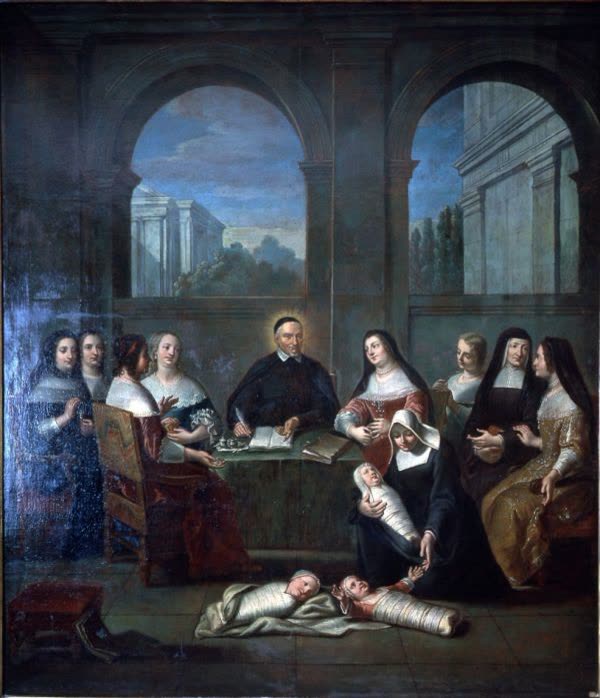
Artwork information
Title: Portrait of St. Vincent de Paul
Artist: Attributed to Jean Andre
Date: 18th century
Rights: Public domain
Patronage
- Charitable works
- Volunteers
- Hospitals
Symbols
- A child in his arms
- A bowl of soup
Key virtues
- Organisation
- Warmth
- Persistence
Lived experience
- Rural poverty
- Enslavement
- Prison ministry
Causes served
- The poor
- Abandoned children
- Galley prisoners
- Famine relief
When you need…
- A saint about doing charity well
- Structure for good intentions
A peasant's son who wanted a comfortable life
Vincent de Paul was born in 1581 to a peasant farming family near Pouy in Gascony, southwestern France. He was ordained a priest in 1600 at the unusually young age of nineteen, and by his own later admission spent his early priesthood seeking a comfortable benefice rather than a demanding vocation, a period he later regarded with some embarrassment.
According to his own later account, around 1605 he was captured by pirates while travelling by sea and enslaved in Tunis for roughly two years before escaping or being freed, an episode that, while drawn mainly from his own later letters and treated cautiously by some historians, is generally accepted as part of his early history and gave him direct experience of captivity he would later apply to his work with prisoners.
Contact with the rural poor and the galleys
Working as a rural chaplain in France, Vincent was confronted directly with the depth of poverty and religious neglect among peasant communities, an experience that reoriented his priesthood toward direct service. He later became chaplain to the royal galleys, the convict ships rowed by chained prisoners, where he ministered to men treated as expendable labour, work that permanently marked his understanding of who the Church owed its attention to.
Building lasting structures
In 1625 Vincent founded the Congregation of the Mission, known as the Vincentians or Lazarists, priests dedicated to preaching missions among the rural poor and training clergy. In 1633, together with Louise de Marillac, he founded the Daughters of Charity, a community of women who served the poor directly in homes, hospitals, and streets rather than living in traditional cloistered enclosure, a genuinely unusual model of religious life for women at the time.
Vincent organised lay confraternities of women to care for the sick and poor in their parishes, established provision for abandoned infants and foundlings in Paris at a time when they were otherwise left to die, and coordinated large-scale relief efforts during famines and the devastation of the Thirty Years' War in Lorraine and elsewhere in France.
A legacy that outlived him
Vincent died in Paris in 1660 and was canonised in 1737. The Daughters of Charity and the Congregation of the Mission both continue to operate internationally. In the nineteenth century, the layman Blessed Frédéric Ozanam founded the Society of St. Vincent de Paul, a lay confraternity dedicated to direct service of the poor that still bears his name and still operates in most countries in the world, a direct extension of the structural, durable approach to charity Vincent pioneered.
Poverty and captivity in seventeenth-century France
Vincent's France was marked by deep rural poverty, periodic famine, the ravages of the Thirty Years' War, and a legal system that condemned men to years of forced labour rowing galleys, often for minor offences or simply for being vagrants. Barbary corsairs also regularly captured and enslaved Europeans along Mediterranean shipping routes, the likely context of Vincent's own captivity.
Who he gave himself to
Galley prisoners chained to their oars. Rural peasants with little access to sacraments or preaching. Abandoned infants left to die in Paris. Families devastated by famine and war in the countryside. Vincent organised structures so this care would continue after he was gone rather than ending with him.
What he endured
By his own account, roughly two years of enslavement in North Africa as a young man. Constant resistance and slow fundraising in building new religious communities. Watching famine and war repeatedly overwhelm the relief efforts he organised, requiring the work to be rebuilt again and again.
Scripture that runs alongside this life
Matthew 25:31–46
As long as you did it to one of these my least brethren, you did it to me.
Translation: Douay-Rheims (public domain) · Short excerpt; full passage linked.
Prayer
Original prayer written for this site
A prayer with St. Vincent de Paul
This prayer was written for this site; it is not an ancient or officially approved text.
St. Vincent, you made mercy practical and repeatable, not dependent on any one person's energy.
Pray with us that our good intentions become someone's actual supper, and that the structures we build outlast our enthusiasm.
Amen.
Not a traditional prayer of the Church. You are never required to have a devotion to any particular saint: you may always pray directly to God.
How to ask this saint to pray with you
- 1.A simple 'St. Vincent de Paul, pray with me' is enough; no special formula is required.
- 2.If you organise or volunteer in charitable work, you might ask him to pray with you about sustainability rather than only good intentions.
- 3.If you have experienced captivity, forced labour, or imprisonment, you can ask him to pray with you as someone who lived that too.
Reflection
One actionLook up whether a local Society of St. Vincent de Paul conference operates near you, and consider one concrete way to support it this month.