
Canonized saint
St. Elizabeth of Hungary
Princess; widow; Franciscan tertiary
A royal daughter betrothed as a small child, who used her position to feed the starving during famine, was pushed out of court after her husband's death, and died at twenty-four running a hospital.
- Dates
- 1207 – 17 November 1231
- Feast day
- 17 November
- Places
- Hungary · Thuringia, Germany · Marburg, Germany
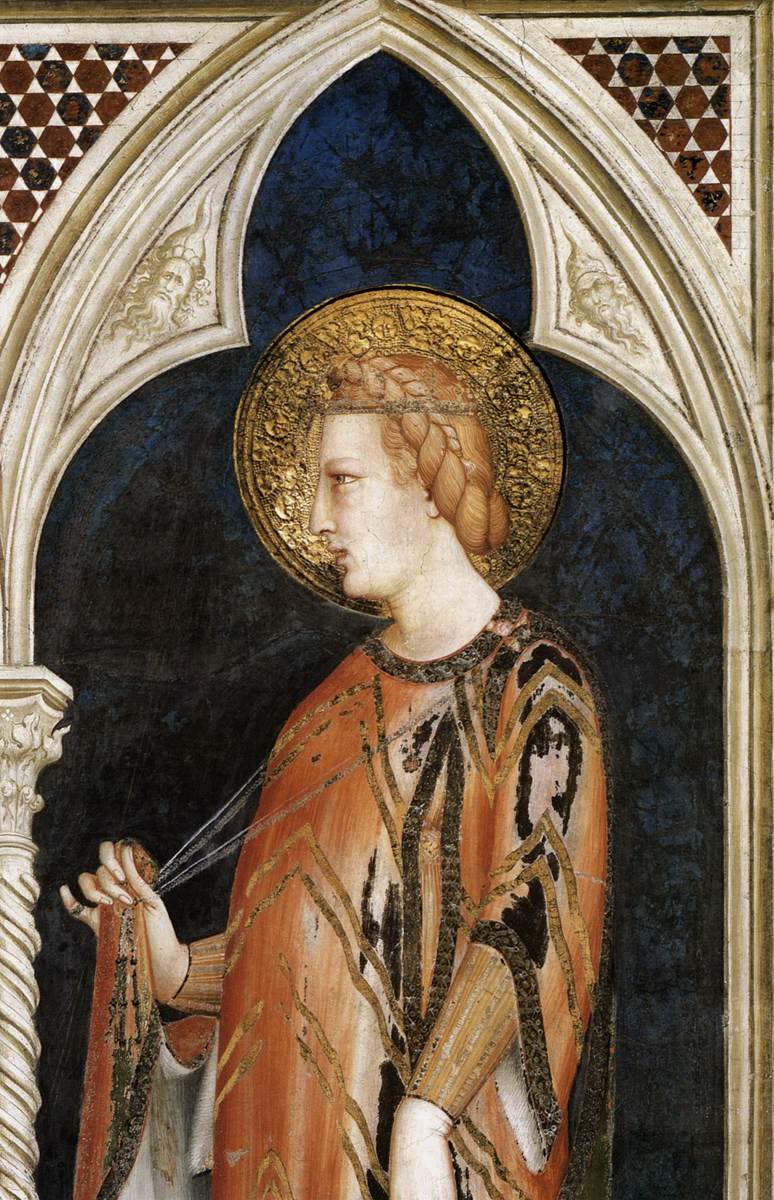
Artwork information
Title: Fresco of St. Elizabeth of Hungary
Artist: Simone Martini
Date: c. 1317, Assisi
Rights: Public domain
Patronage
- Bakers
- Charitable societies
- Widows
- The homeless
Symbols
- Roses in an apron
- A crown set aside
- Bread
Key virtues
- Generosity
- Independence
Lived experience
- Child betrothal
- Bereavement in youth
- Displacement
- Coercive and abusive spiritual direction
Causes served
- Famine relief
- Hospitals
When you need…
- A saint for young widows
- Courage to give against your household's wishes
- Recognition that a spiritual director can be abusive
A political childhood
Elizabeth was born in 1207, the daughter of King Andrew II of Hungary. As was standard practice for royal daughters at the time, she was betrothed as a small child, around the age of four, and sent to be raised at the Thuringian court in present-day Germany in preparation for marriage to the future landgrave, Ludwig IV. This was a political arrangement made entirely by adults for dynastic advantage, not a choice available to Elizabeth herself.
She married Ludwig around 1221, when she was about fourteen, and the couple had three children. Sources describe the marriage as affectionate, in contrast to many arranged unions of the period, though it remains worth naming plainly that it began as a transaction over a small child.
Famine and open granaries
During a severe famine in Thuringia around 1225, while Ludwig was away, Elizabeth opened the royal granaries and had food distributed to the starving, reportedly against the objections of some at court who considered it an excessive drain on resources. She also had a hospital built below the castle at Wartburg, where she personally cared for the sick.
A well-known legend holds that when Elizabeth was challenged while carrying bread hidden in her apron, the bread turned into roses. This is a later devotional legend, not a documented event, and should be told as legend rather than history.
Widowed and pushed out
Ludwig died of illness in 1227 while travelling to join a crusade. Widowed at twenty, Elizabeth was pushed out of, or chose to leave, the Thuringian court, accounts differ on the precise circumstances, and eventually settled in Marburg, where she became a lay member of the Franciscan third order and founded a hospital dedicated to St. Francis, dedicating herself to the care of the sick and poor there.
Her spiritual director in these final years, a priest named Conrad of Marburg, treated her with a severity that the historical sources record plainly and that should be named plainly today: he is documented as having had her beaten and having dismissed companions she was attached to, forms of control that constitute spiritual and physical abuse rather than legitimate spiritual direction, regardless of the era's different norms. This should not be softened or described as an ascetic partnership; it was harm done to her by a man with authority over her.
Death and canonisation
Elizabeth died in 1231 at the age of twenty-four, worn down by years of intense physical labour in her hospital and, very likely, by the treatment she received from Conrad. She was canonised only four years later, in 1235, an unusually rapid process reflecting the immediate and widespread popular devotion to her among the poor she had served.
Royal marriage and spiritual direction in the thirteenth century
Child betrothal among royal and noble families was standard dynastic practice in medieval Europe, arranged entirely for political alliance. Spiritual direction in this period could carry an authority over a penitent's daily life, possessions, and companions that would be recognised as abusive control if exercised today; Conrad of Marburg's treatment of Elizabeth was harsh even by some contemporaries' account, and the Church's later veneration of Elizabeth should not be read as an endorsement of how he treated her.
What she actually endured
A childhood betrothal arranged without her consent. Widowhood at twenty with three young children. Displacement from the court that had raised her. Documented physical and psychological abuse from the priest assigned as her spiritual director. Death from exhaustion at twenty-four.
Scripture that runs alongside this life
Matthew 25:31–46
As long as you did it to one of these my least brethren, you did it to me.
Translation: Douay-Rheims (public domain) · Short excerpt; full passage linked.
Luke 1:46–55 (the Magnificat)
My soul doth magnify the Lord. And my spirit hath rejoiced in God my Saviour.
Translation: Douay-Rheims (public domain) · Full text of the opening verses shown; this translation is public domain.
Prayer
Original prayer written for this site
A prayer with St. Elizabeth of Hungary
This prayer was written for this site; it is not an ancient or officially approved text.
St. Elizabeth, you fed people while others counted the cost, and you were later harmed by someone who claimed to be guiding your soul.
Pray with the young widowed, and with anyone under a spiritual director, pastor, or authority figure who frightens or controls them.
Amen.
Not a traditional prayer of the Church. You are never required to have a devotion to any particular saint: you may always pray directly to God.
How to ask this saint to pray with you
- 1.A simple 'St. Elizabeth of Hungary, pray with me' is enough; no special formula is required.
- 2.If you are newly widowed, you might ask her to pray with you about rebuilding a life you did not choose to need to rebuild.
- 3.If a religious authority in your life is controlling or frightening you, you can ask her to pray with you toward recognising that clearly and seeking help, since she experienced exactly that.
Reflection
Her story includes real spiritual and physical abuse from a man entrusted with her spiritual care. Naming it is not disloyalty to a saint; it is the only way her life can be told safely, and it may help someone today recognise similar treatment in their own life for what it is.