
Canonized saint
St. Camillus de Lellis
Former soldier and gambler; founder of the Ministers of the Sick, patron of hospitals
A tall, quick-tempered soldier who gambled away everything he owned, including the clothes off his back, before a chronic leg wound and a conversion in a Roman hospital turned him into one of the great reformers of hospital care.
- Dates
- 25 May 1550 – 14 July 1614
- Feast day
- 14 July
- Places
- Bucchianico, Italy · Rome, Italy · Naples, Italy
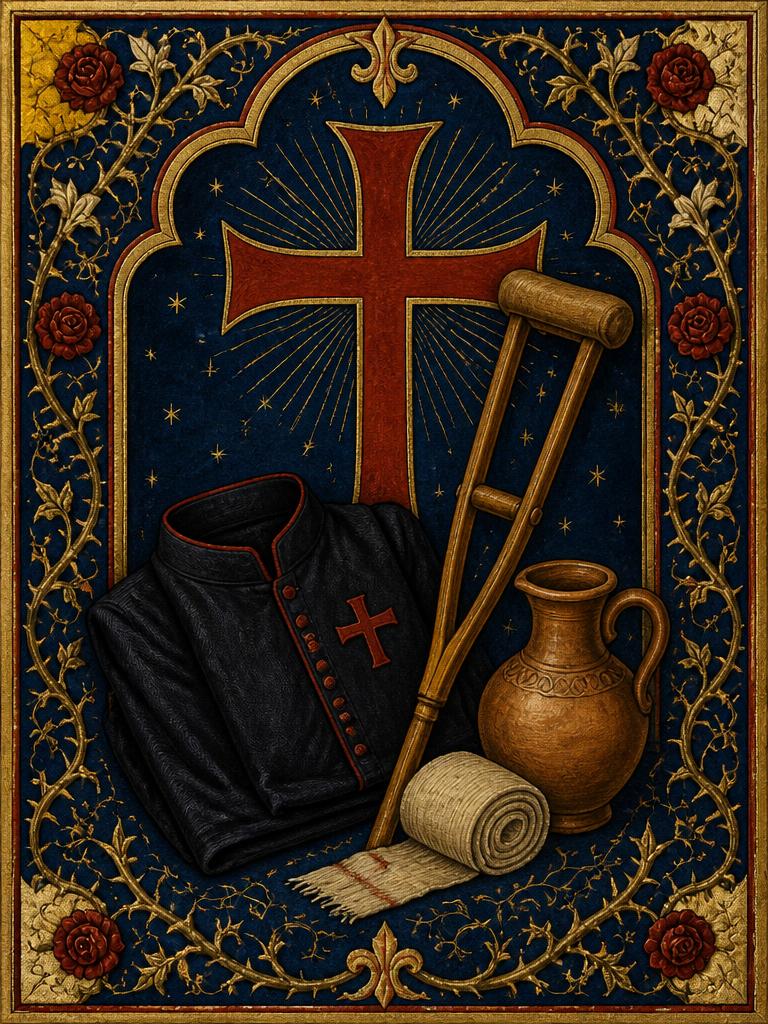
Symbolic treatment, not a likeness: A red cross, a crutch, a water ewer, and a rolled bandage
Attributes traditionally associated with this saint, painted for this site as an illuminated panel. It is a symbolic treatment, not a likeness. Painted for Thorns & Light. No photograph or historic portrait of St. Camillus de Lellis is reproduced here.
Patronage
- Hospitals
- The sick
- Nurses
- People with gambling addiction
- Hospital workers
Symbols
- A red cross worn on a black cassock
- A hospital bed
- Dice, recalling his conversion from gambling
Key virtues
- Honesty about his own failures
- Persistence through chronic pain
- Practical, hands-on mercy
Lived experience
- Addiction and recovery
- Chronic illness
- Homelessness
- Family abandonment
Causes served
- Hospital reform
- Recovery
- Elder care
When you need…
- A saint who gambled away everything he had, more than once, before he changed
- Someone who understands chronic pain that never fully resolves
- A patron for people rebuilding a life after addiction
A soldier's rough beginning
Camillus de Lellis was born in 1550 in Bucchianico, in the Abruzzo region of Italy, to a soldier father and a mother considerably older than usual for a first pregnancy, who died when Camillus was still young. He grew into a very tall, physically imposing young man with a violent temper, and by his own later admission spent his youth without serious religious practice.
He followed his father into military service, fighting as a mercenary for Venice and Naples against the Ottoman Turks. Alongside soldiering, he developed a severe gambling habit that, by his twenties, had cost him virtually everything he owned. Accounts from those who knew him describe him gambling away his money, his weapons, and even his shirt on at least one occasion, left destitute in a foreign city as a direct result.
A wound that never fully healed
During his military years Camillus developed a chronic, painful wound on his leg, likely originating from an injury that never healed properly, which troubled him for the rest of his life and eventually became disabling. Poor and injured, he sought treatment at the Hospital of San Giacomo in Rome, working there for a time as a laborer to pay for his own care while he was also a patient.
He was later dismissed from the hospital's service over his gambling and quarrelsome behavior, a detail his later biographers do not hide: his conversion did not follow immediately or easily from his hardships.
Conversion, and a second chance sought and given
In 1575, in his mid-twenties and again destitute after a run of gambling losses while working construction on a Capuchin friary, Camillus experienced a profound change of heart, reportedly while listening to a friar's exhortation. He resolved to give up gambling for good and sought to enter religious life himself, but was refused admission to the Capuchins on account of his leg wound, which made the order's physical demands impossible for him.
He returned to the Hospital of San Giacomo, this time as a changed man, and was eventually allowed to manage the hospital's operations. What he saw troubled him deeply: patients neglected by hired, often indifferent staff who treated the work as unskilled labor rather than a vocation, insufficient food, and a general lack of basic human attentiveness to the sick.
Founding the Ministers of the Sick
Camillus gathered companions committed to nursing the sick not as paid labor but as an explicit religious vocation, and in 1582 the group that would become the Order of the Ministers of the Sick (the Camillians) began taking shape in Rome. He was ordained a priest in 1584, at the urging of St. Philip Neri, in order to serve the dying more fully.
The order's members wore a distinctive red cross on their black cassocks, a symbol later widely adopted by international relief organizations. Camillus insisted on practical reforms that were unusual for the period: adequate ventilation, separation of contagious patients, better food, and members of his order staying at a patient's bedside through the night rather than treating hospital work as a daytime job.
Serving through plague and his own decline
Camillus and his brothers served in Roman hospitals during outbreaks of plague and worked aboard ships transporting the sick and wounded, at real risk to their own lives. Camillus's own health continued to decline: his old leg wound worsened, he developed additional chronic ailments, and by his last years he was in near-constant pain, at times needing to be carried to visit patients himself.
He resigned formal leadership of the order in 1607 because of his failing health but continued serving the sick as he was physically able until his death in Rome on 14 July 1614.
Canonization and patronage
Camillus de Lellis was canonized in 1746 by Pope Benedict XIV, who later named him, together with St. John of God, patron of hospitals and the sick. Pope Pius XI later added nurses to his patronage, and in recent decades he has also been invoked by name as a patron for people recovering from gambling addiction.
Hospitals as places to be avoided, not healed
The great hospitals of Camillus's Rome, including the one where he worked and was treated, were often chaotic, understaffed, and staffed by day laborers with no particular training or commitment, some of whom stole from patients or neglected them outright. For the poor, being admitted to a hospital of the period was frequently a last resort rather than a source of confidence, closer to a holding place for the dying than a center of recovery.
Camillus's insistence that care of the sick required trained, vowed, full-time religious rather than casual hired staff was a direct, practical critique of how the Church's own charitable institutions were actually being run in his lifetime, not an abstract theological point.
Who his order was built to serve
The hospitalized sick and dying poor of Rome and Naples, patients during plague outbreaks who other caregivers avoided, and the wounded transported on hospital ships. Camillus insisted his brothers treat every patient, however poor or difficult, 'as if you were their mother caring for an only sick child,' a standard his order's own historical records credit him with articulating and trying to enforce in daily practice.
What he actually endured
Years of gambling addiction that left him destitute more than once, including losing his own clothing. A chronic, worsening leg wound that caused him pain for nearly four decades and eventually made him unable to walk unaided. Rejection by the Capuchins because of that same injury. Dismissal from hospital work earlier in his life for his own bad behavior.
His addiction and injury are not presented here as a path God designed for him to walk. They were destructive and painful, full stop; what the Church honors is the honest reckoning with both that he made in his mid-twenties, and what he built afterward.
A recovering addict who reformed a broken system
Camillus's own order's records and early biographers did not erase his gambling or his early dismissal for misconduct; they are part of the standard account of his life, which is unusual candor for a canonized founder. His sanctity is not presented as though the addiction and its consequences never happened, but as a real, adult change of direction that he then spent decades building on, imperfectly and in chronic pain.
His practical reforms, night-and-day bedside presence, adequate food, separating the contagious, staffing hospitals with people committed to the work rather than indifferent day laborers, responded directly to specific, documented failures of the charitable institutions of his own city and era.
Scripture that runs alongside this life
Matthew 25:31–46
As long as you did it to one of these my least brethren, you did it to me.
Translation: Douay-Rheims (public domain) · Short excerpt; full passage linked.
Mark 1:40–45
And Jesus having compassion on him, stretched forth his hand; and touching him, saith to him: I will. Be thou made clean.
Translation: Douay-Rheims (public domain) · Short excerpt; full chapter linked.
Prayer
Original prayer written for this site
A prayer asking St. Camillus de Lellis to pray with us
This prayer was written for this site; it is not an ancient or officially approved text.
St. Camillus, you gambled away everything you owned more than once before you changed course, and you carried a wound in your leg for the rest of your life that never let you forget where you had come from.
Pray with everyone trying to walk away from an addiction today, one day at a time, and with everyone whose body still carries the cost of years they cannot get back.
Pray with the nurses and aides working overnight shifts, that they might treat the person in front of them the way you asked your brothers to.
Amen.
Not a traditional prayer of the Church. You are never required to have a devotion to any particular saint: you may always pray directly to God.
How to ask this saint to pray with you
- 1.A plain 'St. Camillus, pray with me' is enough; no special formula is required.
- 2.If you are in recovery from gambling or another addiction, you might ask him to pray with you specifically about today, not about the rest of your life all at once.
- 3.If you work in healthcare, you might ask him to pray with you before a hard shift, especially with patients who are difficult to like.
- 4.Prayer to St. Camillus is not a substitute for a recovery program, sponsor, or medical treatment; it can be part of the same effort.
Reflection
If you have lost money, relationships, or self-respect to gambling or another addiction, this saint's early life is not softened in the record the Church itself keeps. He lost everything, more than once, before he changed, and the change did not erase the chronic pain his years of hard living had already caused his body.
If you live with a chronic illness or injury that never fully resolves, Camillus's leg wound followed him for nearly forty years and eventually disabled him. His usefulness to others was not contingent on that pain going away; he kept serving from within it, adapting as his body required, including being carried to patients when he could no longer walk to them.
This life is not an argument that addiction or injury are secretly good for you, or that you must hit total rock bottom before change is possible. It is evidence that a documented, serious addiction and a lasting disability are not disqualifications from a life that does real good for other people.
One actionIf gambling or another addiction has cost you something you cannot easily name out loud, consider one concrete step this week, calling a helpline, telling one trusted person, or attending one meeting, rather than resolving to fix everything at once.