
Canonized saint
St. Margaret of Castello
Dominican laywoman; abandoned as a child for her disabilities
Born blind, with a curved spine and short stature, and abandoned by her noble parents at around six years old, she became a beloved lay Dominican in Città di Castello, serving prisoners and the sick.
- Dates
- c. 1287 – 13 April 1320
- Feast day
- 13 April
- Places
- Metola, Italy · Città di Castello, Italy
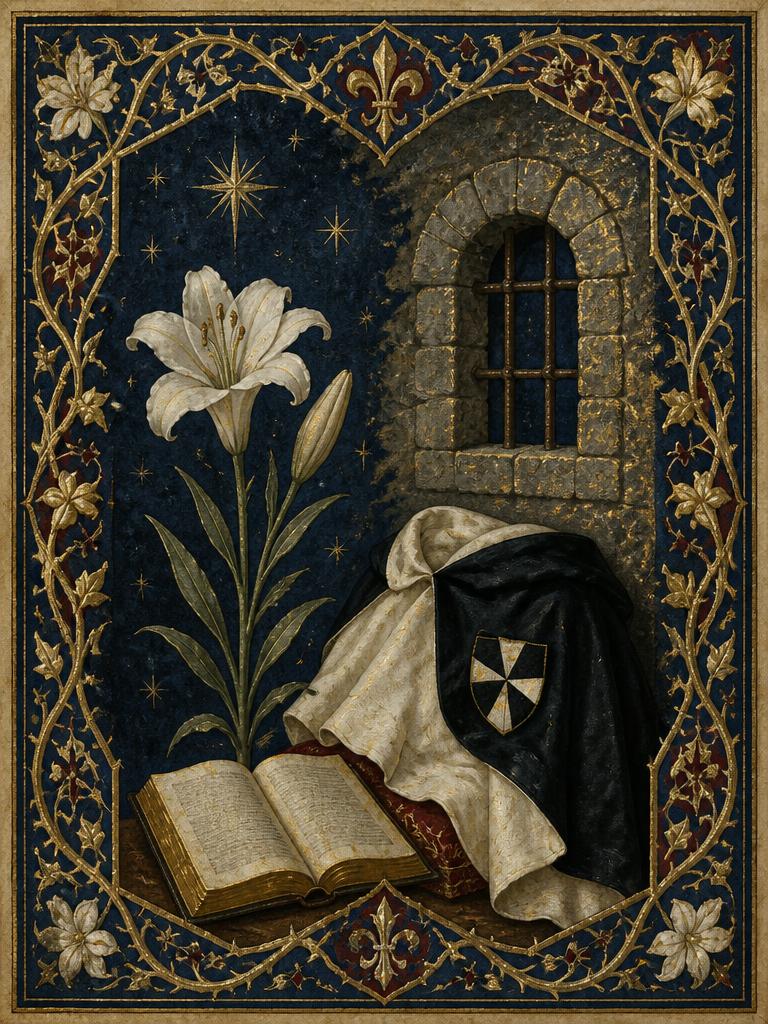
Symbolic treatment, not a likeness: A white lily, a barred window, a Dominican mantle, and an open book
Attributes traditionally associated with this saint, painted for this site as an illuminated panel. It is a symbolic treatment, not a likeness. Painted for Thorns & Light. No photograph or historic portrait of St. Margaret of Castello is reproduced here.
Patronage
- People with disabilities
- People rejected by their families
- The blind
- Pro-life causes
- Unwanted children
Symbols
- A small dog
- A Dominican habit worn as a laywoman
- A lily
Key virtues
- Joy under exclusion
- Forgiveness of parents who abandoned her
- Steady faith
Lived experience
- Disability
- Family abandonment
- Childhood neglect
- Social rejection
Causes served
- Disability dignity
- Elder care
When you need…
- A saint whose own parents gave her up because of her body
- Someone who knows what it is to be seen as a burden
- Hope that a life others called a disappointment can be declared holy
Born to parents who wanted a different child
Margaret was born around 1287 near Metola, in the hill country of central Italy, to a noble family, Parisio and Emilia, who had hoped for an heir who would strengthen an important political alliance. She was born blind, with one leg noticeably shorter than the other, a curved spine, and short stature.
Rather than raise her, her parents hid her from public view. Tradition holds that a local hermit was asked to pray for her healing and that, when no cure came, her parents concealed her for years inside a walled-off room attached to a chapel, with only a servant to care for her, so that neighbors and relatives would not learn of her condition.
Abandonment
When Margaret was around six, her parents took her to Città di Castello, reportedly in the hope that a shrine there, associated with reports of healings, would cure her. When it did not, they left her there and returned home without her. She would not see her parents again.
She was taken in first by charitable townspeople and later spent time in the household of a family who, by most accounts, treated her kindly, teaching her to read by touch and allowing her to be present at Mass and instruction, though other households she passed through in these years were far less gentle.
A life of her own choosing
As a young woman, Margaret sought admission to a community of Dominican sisters and, after an initial acceptance, tradition holds she was for a time asked to leave over a disagreement about the strictness of the community's observance; she was later received as a lay member of the Dominican Third Order, living not in an enclosed convent but in a small house in Città di Castello among the townspeople.
She spent her remaining years visiting prisoners, teaching children, and caring for the sick and dying in the town, becoming known for a steady cheerfulness that people who met her frequently remarked on, given everything she had lived through. She died in 1320, likely in her early thirties.
Incorrupt relics and centuries of local devotion
At her death the townspeople of Città di Castello reportedly insisted, against the wishes of some clergy, that she be buried inside the church rather than in the ordinary cemetery, in recognition of what her life had meant to them. Her body has remained a focus of local veneration for seven centuries and is preserved in the church of San Domenico in the town.
For most of that time she was venerated locally without a formal canonization, a common situation for medieval lay holy women whose causes were slow to reach Rome.
Canonization in 2021
Margaret was beatified in 1609. On 24 April 2021, Pope Francis formally canonized her by equipollent canonization, a process that recognizes a person's centuries-old, continuous, and widespread veneration and reputation for sanctity in place of a new investigation and miracle process. It confirmed what the people of Città di Castello had held for seven hundred years.
Disability and the medieval family
In thirteenth-century Italy, a child born visibly disabled into a noble family carrying marriage and inheritance obligations was, in the calculus many families of that class applied, a liability: unable to be married off to secure an alliance and a source of possible shame. Concealment and, in extreme cases, abandonment of disabled children were not unheard of, though outright abandonment of a living child at a shrine, as happened to Margaret, was still an extraordinary act even by the standards of the time.
The Church of the period offered Margaret no single, systematic response: some clergy and religious communities that encountered her showed real charity, and at least one community she sought to join for a time turned her away. Her eventual home was found not through an institution's planning but through the informal charity of ordinary townspeople who kept taking her in.
Who she gave herself to
As a lay Dominican in Città di Castello, Margaret visited prisoners in the town jail, a population most respectable people of her era avoided, taught catechism to children, and sat with the sick and dying, often people as poor or poorer than she was.
What she actually endured
Concealment by her own parents for years. Abandonment at a shrine by the two people responsible for her. Being handed between households, some kind and some not, with no say in the matter. Rejection, for a time, even by a religious community she sought to join.
The record does not show Margaret's family ever returning for her, apologizing, or providing for her afterward. The Church's veneration of her holiness is not a statement that this abandonment was somehow fitting or necessary; it is a statement about what she built afterward, with people who were not obligated to her by blood.
Chosen family, and a Church that took seven centuries to catch up
Margaret's story is sometimes told as though her parents' cruelty is incidental background to a sweet ending. It should not be softened that way: she was a small child left behind at a shrine by people who had the means to care for her and chose not to.
It is also worth naming plainly that the Church's formal recognition of her sanctity took roughly seven hundred years, arriving only through the modern process of equipollent canonization that acknowledges long, grassroots devotion rather than requiring a fresh case to be built. Ordinary people in Città di Castello recognized what she was long before Rome issued a decree confirming it.
Scripture that runs alongside this life
Mark 1:40–45
And Jesus having compassion on him, stretched forth his hand; and touching him, saith to him: I will. Be thou made clean.
Translation: Douay-Rheims (public domain) · Short excerpt; full chapter linked.
Isaiah 43:1
Fear not, for I have redeemed thee, and called thee by thy name: thou art mine.
Translation: Douay-Rheims (public domain) · Short excerpt; the full chapter is linked below.
Prayer
Original prayer written for this site
A prayer asking St. Margaret of Castello to pray with us
This prayer was written for this site; it is not an ancient or officially approved text.
St. Margaret, your own parents looked at you and decided you were too much to keep.
Pray with every child, and every grown child, who has been told by their family that their body or their needs made them a burden.
Pray with us toward the people who took you in when your own blood would not, and help us become people like that for someone else.
Amen.
Not a traditional prayer of the Church. You are never required to have a devotion to any particular saint: you may always pray directly to God.
How to ask this saint to pray with you
- 1.A simple 'St. Margaret of Castello, pray with me' is enough; no special formula is required.
- 2.If your own family has rejected or minimized you because of a disability, illness, or difference, you might ask her specifically to pray with you about that, by name, in your own words.
- 3.If you are the parent or relative of a disabled child, you might ask her to pray with you for patience and honesty about your own fears, rather than for the child to change.
Reflection
If your own family made you feel like a disappointment because of your body, your diagnosis, or your needs, Margaret's life does not tell you this was somehow for your good. It was not for her good either. What her life tells you is that a family's rejection is not the final verdict on your worth, and it was not the final verdict on hers.
The people who mattered in the second half of her life were not the parents who bore her but the neighbors, strangers, and fellow townspeople who chose, repeatedly, to take her in. If you have had to build a chosen family after being failed by your first one, this is a saint who did exactly that.
One actionIf you know a family raising a child with significant disabilities, offer concrete, specific help (a few hours of respite, a ride, a meal) rather than general encouragement; Margaret's real supporters were the people who did ordinary, practical things for her.