
Canonized saint
St. Jeanne Jugan
Foundress of the Little Sisters of the Poor; servant of the elderly poor
A poor Breton servant who carried a homeless blind woman up to her own bed and founded a congregation to shelter the elderly poor, then was quietly removed from leading it for the last twenty-seven years of her life.
- Dates
- 25 October 1792 – 29 August 1879
- Feast day
- 30 August
- Places
- Cancale, Brittany, France · Saint-Servan, France · La Tour Saint-Joseph, Saint-Pern, France
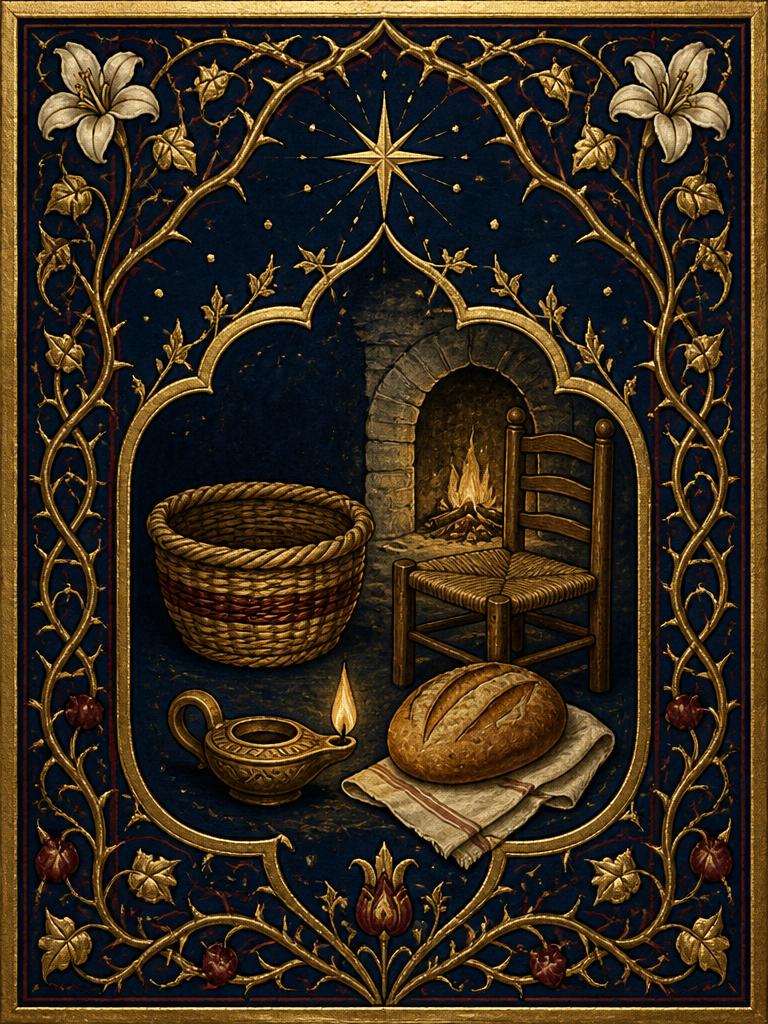
Symbolic treatment, not a likeness: A begging basket, an oil lamp, bread, and a chair by the hearth
Attributes traditionally associated with this saint, painted for this site as an illuminated panel. It is a symbolic treatment, not a likeness. Painted for Thorns & Light. No photograph or historic portrait of St. Jeanne Jugan is reproduced here.
Patronage
- The elderly
- The homeless
- Little Sisters of the Poor
Symbols
- An elderly woman carried on her back
- A begging basket
- The habit of the Little Sisters of the Poor
Key virtues
- Hospitality
- Humility
- Perseverance without credit
Lived experience
- Aging and loneliness
- Homelessness
- Exploited labor
Causes served
- Elder care
- Housing
- Street outreach
When you need…
- A saint for anyone who feels used up and set aside once the work is done
- Hope that a life of hidden, unrecognized service still counts
- A patron for the isolation of old age
A fisherman's daughter
Jeanne Jugan was born in 1792 in Cancale, a fishing town on the Brittany coast, during the upheaval of the French Revolution. Her father was lost at sea when she was four, leaving her mother to raise the family in poverty. Jeanne went into domestic service as a girl and later worked as a kitchen maid and then as a hospital nurse's aide in Saint-Servan, work that put her, daily, in close contact with the sick poor.
She declined at least one offer of marriage, telling her family she believed God wanted her for something else, though she could not yet say what. For years that 'something else' looked like nothing more than continued domestic work and care of an elderly female employer, whom she nursed until the woman's death.
One bed, one winter night
In 1839, by then in her late forties and living in a small rented room in Saint-Servan with two companions, Jeanne found a blind, paralyzed elderly widow with nowhere to sleep. She carried the woman up to her own bed and slept in the attic herself. She did the same again for a second woman soon after.
Word spread quickly in a town with no shortage of destitute elderly people and few institutions willing to take them in. Within a few years Jeanne and her companions had rented a larger house, then a former convent, taking in dozens and then hundreds of poor, sick, and abandoned elderly men and women, supported entirely by begging door to door and from local merchants.
A congregation, and a founder pushed aside
The community that grew from this work became the Little Sisters of the Poor. In 1843 the sisters elected Jeanne their superior, but a priest closely involved in guiding the young community, Abbé Le Pailleur, set the election aside and installed a younger sister in her place. He went further: he rewrote the congregation's early history to credit himself as founder and diminished Jeanne's role in the community's own records.
From 1843 until her death in 1879, thirty-six years, Jeanne Jugan held no position of authority in the community she had begun. For the last twenty-seven of those years she lived at the motherhouse of La Tour Saint-Joseph, largely unknown to the younger sisters who had joined after her removal; many did not learn until after her death that the quiet elderly sister among them was the founder at all.
A hidden end
She spent her final decades in ordinary tasks: praying, mending, sitting with the residents. She died at La Tour Saint-Joseph on 29 August 1879. Only after her death did an internal Church investigation, prompted by concerns about Le Pailleur's conduct, begin to restore an accurate account of the congregation's founding.
Abbé Le Pailleur was eventually removed from ministry by Church authorities late in his life over unrelated allegations of abuse of his position, and the congregation's own historical records were corrected over the following decades to name Jeanne Jugan as foundress.
Recognition, long delayed
The Little Sisters of the Poor spread internationally during Jeanne's lifetime and after, eventually serving the elderly poor on several continents, largely through the same method she began with: door-to-door begging on their residents' behalf rather than fixed fees.
Jeanne Jugan was beatified by Pope John Paul II in 1982 and canonized by Pope Benedict XVI on 11 October 2009, under her religious name, St. Mary of the Cross.
Old age and poverty in nineteenth-century France
France in the 1840s had no old-age pension system and only limited, often punitive, poor relief. Elderly people without family to support them commonly ended their lives in overcrowded almshouses or on the street, dependent on the charity of neighbors who were themselves poor.
The demand for what Jeanne and her companions offered, a bed, food, and company, was immediate and overwhelming, precisely because almost nothing else existed for this population.
Who she served
Elderly men and women who were blind, paralyzed, senile, or simply alone, taken in regardless of their ability to pay, fed and housed through door-to-door begging carried out by the sisters themselves.
The model deliberately refused to distinguish the 'deserving' poor from anyone else. Age and need were the only requirements.
What was taken from her, inside the Church
The central hardship of Jeanne Jugan's later life was not poverty but displacement: a founder set aside by a cleric within her own community, her authority removed, her history rewritten, and her identity obscured from the very sisters carrying on her work.
This was not persecution by outsiders. It was institutional mismanagement and personal ambition inside the Church, and it went uncorrected for decades. The record of it should be told plainly, not softened into a story about humility freely chosen; she did not choose to be removed.
What her life says
Jeanne Jugan's holiness is found in the work: seeing one abandoned woman and giving up her own bed, then doing it again and again until an institution existed. It is not found in, and does not require, the years of being sidelined that followed.
The Church's later correction of the record, naming her foundress after the fact, matters. Institutions can misname who did the work, and the truth can still surface, even generations later.
Scripture that runs alongside this life
Matthew 25:31–46
As long as you did it to one of these my least brethren, you did it to me.
Translation: Douay-Rheims (public domain) · Short excerpt; full passage linked.
Isaiah 43:1
Fear not, for I have redeemed thee, and called thee by thy name: thou art mine.
Translation: Douay-Rheims (public domain) · Short excerpt; the full chapter is linked below.
Prayer
Original prayer written for this site
A prayer asking St. Jeanne Jugan to pray with us
This prayer was written for this site; it is not a historic text passed down from St. Jeanne Jugan's own community.
St. Jeanne Jugan, you gave up your bed for a stranger and then gave up credit for the work your own hands began.
Pray with everyone growing old without anyone to notice, and with everyone whose real contribution has been quietly written out of the story.
Ask God to see clearly what was actually done, and by whom.
Amen.
Not a traditional prayer of the Church. You are never required to have a devotion to any particular saint: you may always pray directly to God.
How to ask this saint to pray with you
- 1.You do not need special words. 'St. Jeanne Jugan, pray with me' is enough.
- 2.If you care for an aging parent or neighbor and feel unseen for it, you can ask her to keep you company in that specific work.
- 3.If you have been pushed aside after doing real work, in a church, a family, or a job, you can name that plainly when you ask her prayers; she understood it firsthand.
- 4.Her feast day, 30 August, is a fitting day to visit or call an elderly person who is often alone.
Reflection
If you are old and feel like a burden, or lonely in a way other people seem not to notice, her first act, giving up her own bed for one woman with nowhere to sleep, was not a grand policy. It was one person deciding one other person's dignity mattered enough to act on that night.
If you have done real work and then watched someone else take the credit, or been quietly removed from a role you built, this is not a story that tells you to be grateful for the removal. The Church later corrected the record. Sometimes correction takes decades. That delay was not justice while it lasted, and it is named as an injustice here.
One actionIf you know an elderly person who lives alone, a short regular visit or phone call, on a set day each week, does more for isolation than an occasional long one. If you or someone you know is an unpaid caregiver for an aging relative, local Catholic Charities affiliates and Area Agencies on Aging (in the US, eldercare.acl.gov) can point to respite care and other concrete support.