
Canonized saint
St. Kateri Tekakwitha
Mohawk laywoman
Orphaned by smallpox and left scarred and partly blind, she was baptised at twenty and left her village for a mission settlement near Montreal, amid the violence and pressure of colonisation.
- Dates
- 1656 – 17 April 1680
- Feast day
- 14 July (United States); 17 April (Canada)
- Places
- Ossernenon (present-day Auriesville, New York) · Kahnawake, Quebec
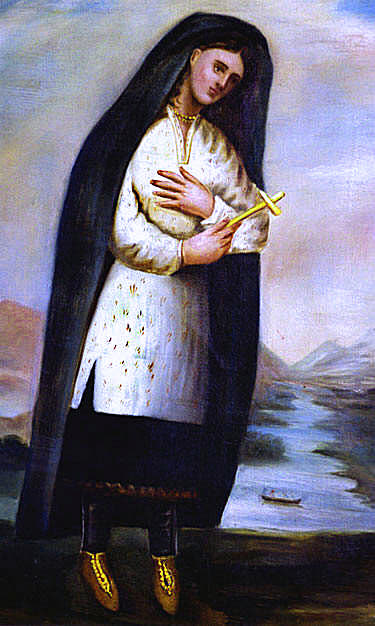
Artwork information
Title: Portrait of Kateri Tekakwitha
Artist: Fr. Claude Chauchetiere
Date: c. 1696
Rights: Public domain
Patronage
- Indigenous peoples of the Americas
- Ecology and the environment
Symbols
- A turtle
- A cross of sticks
- Lilies
Key virtues
- Quiet resolve
- Prayerfulness
Lived experience
- Epidemic
- Orphanhood
- Disability and disfigurement
- Family and community opposition
- Colonisation
Causes served
- Indigenous dignity
When you need…
- A saint from a colonised people
- Faith chosen against family pressure
- Living with a disfigurement or disability others stare at
Smallpox and its aftermath
Kateri was born around 1656 in the Mohawk village of Ossernenon, in present-day New York State, to a Mohawk father and a Christian Algonquin mother who had herself been captured and adopted into the Mohawk community, a common practice at the time. When Kateri was about four, a smallpox epidemic, one of the diseases introduced by European contact that devastated Indigenous nations who had no prior immunity, swept through the village, killing her parents and infant brother.
Kateri survived but was left with facial scarring and significantly impaired eyesight from the disease, conditions that shaped how her community and later hagiography described her; she was raised afterward by an uncle who had become a village leader.
Missionaries, division, and baptism
Jesuit missionaries had been present among the Mohawk since the 1640s, in a mission effort inseparable from French colonial expansion into Mohawk territory and from decades of conflict, including earlier Mohawk killings of Jesuit missionaries such as Isaac Jogues near the same village. Christianity divided Mohawk communities, with converts often facing suspicion as aligned with French interests against their own people's autonomy.
Kateri was baptised in 1676 at the age of about twenty by the Jesuit missionary Jacques de Lamberville, having reportedly resisted family pressure to marry and shown interest in Christian teaching for some time beforehand. Following her baptism she faced hostility and harassment from members of her village who saw conversion as a betrayal of Mohawk identity and alliances, an understandable response given the colonial context in which conversion arrived.
Kahnawake
In 1677 Kateri travelled roughly two hundred miles to Kahnawake, a Christian Mohawk mission settlement near Montreal, where a number of converts, including relatives, had already relocated. There she lived a life centred on prayer, care for the sick and elderly, and, by later accounts, practices of physical penance that her Jesuit confessors reportedly urged her to moderate as excessive; these practices should be understood in the context of the intense penitential culture the missionaries themselves promoted, not celebrated as a model to imitate.
She died at Kahnawake in 1680, at about twenty-four, of an illness worsened by her already fragile health.
Canonisation and an honest reckoning
Kateri was beatified in 1980 and canonised by Pope Benedict XVI in 2012, the first Native American recognised as a saint by the Catholic Church. Her canonisation is a source of real significance and pride for many Indigenous Catholics in North America.
Her devotion also sits, honestly, alongside the documented harms of the mission system and, later, of Catholic-run residential and boarding schools for Indigenous children in Canada and the United States, harms the Church has since acknowledged and, in various statements, apologised for. Telling Kateri's story well means holding both: her own genuine, freely chosen faith, and the coercive colonial system her conversion took place within.
Epidemic disease and the mission system
Smallpox and other introduced diseases killed a large proportion of Indigenous populations across the Americas following European contact, with mortality in many communities estimated at well over half. The Jesuit mission to the Mohawk operated within, and was often used to advance, French colonial interests in the region, and conversion carried real social and political costs for Indigenous people who chose it.
What she endured
The death of her parents and brother to smallpox in early childhood, and lasting facial scarring and impaired vision from the same illness. Family and community pressure and hostility after her baptism. Displacement from her home village to a mission settlement two hundred miles away. A short life marked by chronic poor health.
Scripture that runs alongside this life
Isaiah 43:1
Fear not, for I have redeemed thee, and called thee by thy name: thou art mine.
Translation: Douay-Rheims (public domain) · Short excerpt; the full chapter is linked below.
Prayer
Original prayer written for this site
A prayer with St. Kateri Tekakwitha
This prayer was written for this site; it is not an ancient or officially approved text.
St. Kateri, you kept faith amid disease, disfigurement, and a colonial world that used your conversion for its own purposes.
Pray with Indigenous communities today, with anyone living with a disfigurement or disability that draws stares, and with anyone whose faith costs them their household's approval.
Amen.
Not a traditional prayer of the Church. You are never required to have a devotion to any particular saint: you may always pray directly to God.
How to ask this saint to pray with you
- 1.A simple 'St. Kateri, pray with me' is enough; no special formula is required.
- 2.If your faith has put you at odds with your family or community, you might ask her to pray with you as someone who lived exactly that.
- 3.If you live with a disfigurement, disability, or chronic illness that draws unwanted attention, you can ask her to pray with you in that specific experience.
Reflection
Devotion to Kateri should not be used to smooth over the harms of the mission system and, later, residential schools. Her own faith was real and freely chosen; the system she lived within was not innocent, and both facts can be told together.