
Canonized saint
St. Charles Lwanga
Ugandan layman; head of the royal pages; martyr
A young leader among the royal pages of the Buganda court who resisted the king's sexual coercion of the boys and young men in his charge, protected those under his care, and was burned alive for his faith in 1886.
- Dates
- c. 1860 – 3 June 1886
- Feast day
- 3 June
- Places
- Buganda (present-day Uganda) · Namugongo, near Kampala
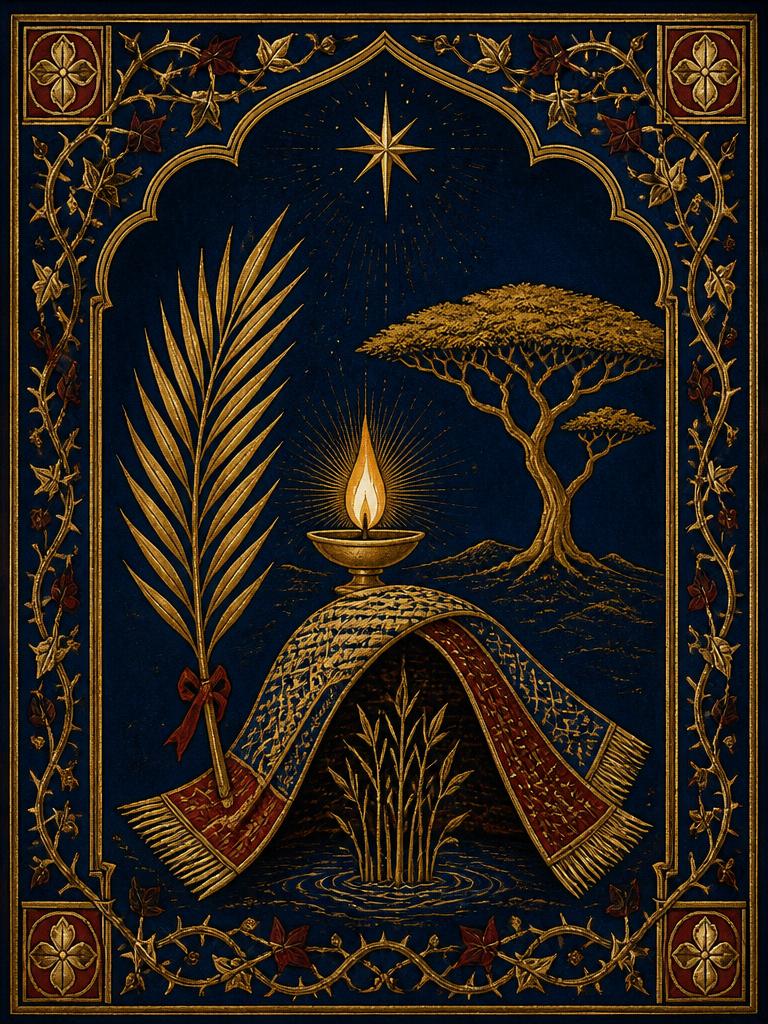
Symbolic treatment, not a likeness: A martyr's palm, a steady flame, a sheltering mantle, and an acacia
Attributes traditionally associated with this saint, painted for this site as an illuminated panel. It is a symbolic treatment, not a likeness. Painted for Thorns & Light. No photograph or historic portrait of St. Charles Lwanga is reproduced here.
Patronage
- Uganda
- Africa's youth
- Torture victims
- Altar servers
Symbols
- A palm branch
- Fire
- A royal court robe
Key virtues
- Protective courage
- Integrity under threat
- Steadfastness
Lived experience
- Sexual coercion or abuse of power
Causes served
- Safeguarding
When you need…
- Someone who refused an abuser's demands and protected others from the same abuser
- A patron for young people under the power of someone dangerous
- Hope that resisting abuse, not enduring it, is what the Church honours
Life at the royal court of Buganda
Charles Lwanga was born around 1860 in Buganda, a powerful kingdom in what is now Uganda. As a young man he entered royal service as a page at the court of the kabaka (king), a position that placed him, along with many other boys and young men, under the direct daily authority of the ruler.
Catholic missionaries, the White Fathers, had begun instructing members of the court, and Lwanga was among a growing number of pages who were catechised and baptised. He became a leader among them, known for his steadiness and for his particular attentiveness to the younger boys serving alongside him.
A king who abused his power over the pages
King Mwanga II, who came to the throne in 1884, used his absolute authority over the royal household to demand sexual access to the pages under his command, a pattern of coercion by someone with total power over young people who had no ability to refuse him and no one else to appeal to. This was an abuse of power, not a cultural custom the pages had agreed to, and it is described here plainly and without detail out of respect for the young men it harmed.
As the pages converted to Christianity, many of them, with Lwanga among the clearest voices, refused the king's demands and worked to shield the younger boys in the royal household from him, understanding correctly that saying no publicly put their own lives at risk.
Escalation and the death of Joseph Mukasa
Joseph Mukasa, the Catholic head of the pages and a mentor to Lwanga, had repeatedly confronted Mwanga over his treatment of the boys and his execution of an Anglican bishop. Mwanga had Mukasa beheaded on 15 November 1885. Lwanga was appointed to take his place as head of the pages, inheriting both the responsibility of protecting them and the king's anger.
Lwanga continued instructing the younger pages in the faith and continued resisting Mwanga's demands, knowing what had already happened to his predecessor.
Arrest and execution at Namugongo
In May 1886, Mwanga discovered that a young page, Mwafu, had been receiving Christian instruction from Lwanga and refused the king. Mwanga ordered a mass arrest of Christian pages and courtiers. Lwanga baptised at least one boy, Kizito, the night before their execution, aware of what was coming.
On 3 June 1886, Lwanga and a group of companions, many still teenagers, were marched to Namugongo, wrapped in reed mats, and burned alive after refusing to renounce their faith. Lwanga was reportedly burned first and separately from the others.
Canonisation and lasting significance
Lwanga and twenty-one Catholic companions, along with a number of Anglican martyrs killed in the same persecution, were beatified in 1920 and canonised by Pope Paul VI in 1964, the first canonised saints from sub-Saharan Africa in the modern era. The Namugongo shrine is now one of the largest pilgrimage sites in Africa.
Power, conversion, and a kingdom in transition
Buganda in the 1880s was a centralised, highly organised kingdom where the kabaka held near-total authority over his court, including the bodies and futures of the young men serving him. Christian conversion introduced, for the first time for many pages, a framework that named the king's demands as sin rather than as an unquestionable royal prerogative.
Mwanga's persecution was driven both by rage at losing unquestioned control over the pages and by fear that Christian and Muslim converts represented a foreign threat to his rule. The Anglican and Catholic missions themselves were entangled with British and French colonial rivalry, a complication that does not diminish what the pages personally suffered and resisted.
Who he protected
The younger pages of the royal household, boys as young as thirteen, whom Lwanga is specifically remembered for shielding from the king's demands, at real cost to his own safety.
New converts among the court who needed instruction and a model for how to hold to their faith inside a dangerous household.
Naming what happened clearly
Lwanga and the other pages lived under a ruler who used his absolute power to coerce sexual access to young people in his household, a serious abuse of power. Resisting that coercion, and trying to protect others from it, put them at direct risk of torture and death, which is exactly what followed.
It is important to state plainly: enduring the king's abuse would not have been virtuous, and no one facing coercion by a powerful person is required to resist publicly the way Lwanga did in order to be believed or to matter. His courage does not set a standard that every survivor must meet.
Resistance, not endurance
The Church honours Lwanga for refusing an abuser and for protecting others under his care, not for suffering itself. His death was murder in retaliation for that refusal and for his faith, not a fate he sought or that God required.
His witness speaks directly to anyone who has tried to protect someone younger or more vulnerable from a person with power over them both: that instinct to shield others is itself a form of holiness the Church recognises.
Scripture that runs alongside this life
Hebrews 12:1
We also having so great a cloud of witnesses over our head, let us lay aside every weight.
Translation: Douay-Rheims (public domain) · Short excerpt; full chapter linked.
Romans 8:38–39
Nor any other creature shall be able to separate us from the love of God, which is in Christ Jesus our Lord.
Translation: Douay-Rheims (public domain) · Short excerpt; full chapter linked.
Prayer
Original prayer written for this site
A prayer asking St. Charles Lwanga to pray with us
This prayer was written for this site; it is not a historic or officially approved text.
St. Charles Lwanga, you refused a powerful man's demands and stood between him and the boys in your care.
Pray with everyone who is being pressured by someone with power over them, and with everyone trying, right now, to protect a child or a young person from harm.
Ask God to bring safety, and real help, to the people this abuse has touched.
Amen.
Not a traditional prayer of the Church. You are never required to have a devotion to any particular saint: you may always pray directly to God.
How to ask this saint to pray with you
- 1.You do not need formal words. 'St. Charles Lwanga, pray with me' is enough.
- 2.You can ask him to pray specifically for someone you know who is protecting a young person from an unsafe adult.
- 3.If his story touches something in your own experience, it is entirely reasonable to pause and come back to it later, or to talk with a counselor first.
Reflection
If someone with power over you (an employer, a clergy member, a family authority, anyone) has pressured or coerced you sexually, what happened was not your fault, and enduring it silently is not what this saint's life asks of you. Refusing is not the only faithful response, and safety comes first.
If you are a survivor, please know this page is not asking you to imitate a martyrdom. It is naming, honestly, that the Church recognises resisting an abuser as courage, and that reporting abuse and seeking safety and professional support are the concrete next steps, not prayer alone.
One actionIf you or someone you know is being coerced or abused by someone with power over them, contact a safeguarding professional or, in the United States, the Childhelp National Child Abuse Hotline (1-800-422-4453) or a local safeguarding office; if a child is at immediate risk, contact local emergency services.