
Canonized saint
St. Katharine Drexel
Heiress who funded and founded schools for Black and Native American students
She inherited a banking fortune, gave essentially all of it away, and founded a religious congregation and dozens of schools, including Xavier University of Louisiana, in the segregation-era United States.
- Dates
- 26 November 1858 – 3 March 1955
- Feast day
- 3 March
- Places
- Philadelphia, Pennsylvania · The American South and West
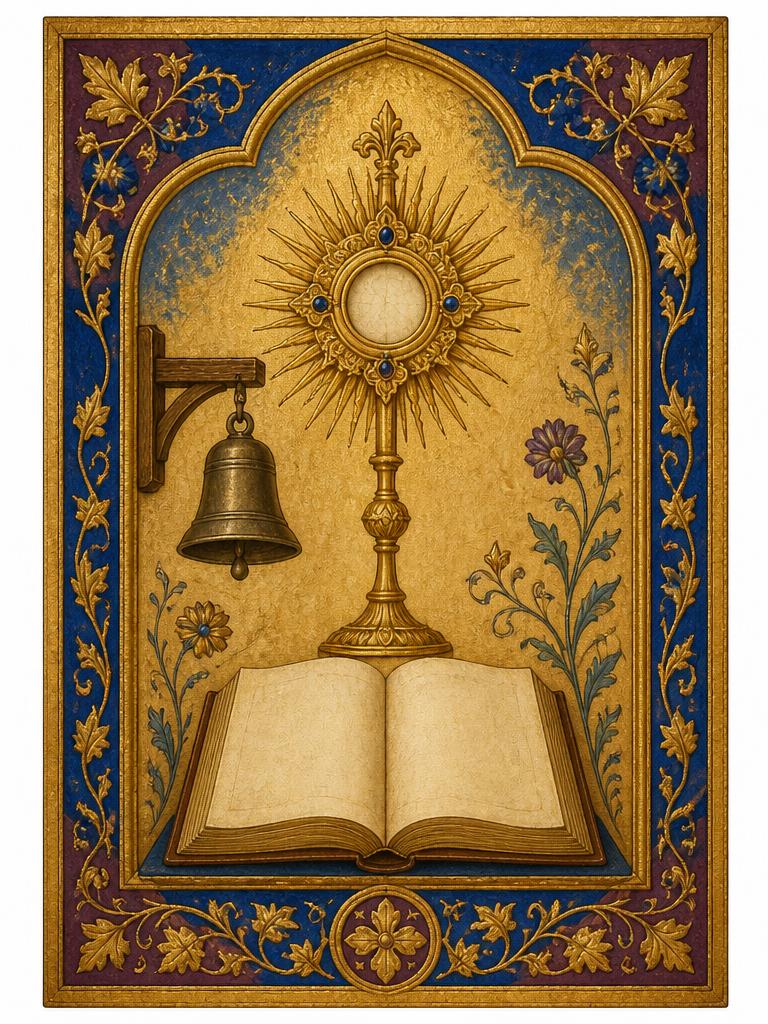
Symbolic treatment, not a likeness: An open book, a school bell, and a monstrance
Attributes drawn from her documented life, painted for this site as an illuminated panel. The book and bell recall the schools she founded and funded, the monstrance her daily Eucharistic prayer. Painted for Thorns & Light. No photograph or historic portrait of St. Katharine Drexel is reproduced here.
Patronage
- Racial justice
- Philanthropists
Symbols
- A schoolhouse
- An open ledger
Key virtues
- Generosity
- Steadiness against opposition
- Perseverance in illness
Lived experience
- Wealth given away
- Threats and hostility
- Stroke and long disability
Causes served
- Education
- Racial justice
- Native American rights
When you need…
- A saint about money
- Persistence against racism
- A saint for long disability
A Philadelphia fortune
Katharine Drexel was born in Philadelphia in 1858 into one of the wealthiest banking families in the United States. Her stepmother, Emma Bouvier Drexel, organised regular distributions of food, clothing, and rent assistance to the poor from the family's own home, a practice Katharine and her sisters took part in from childhood, alongside a devout Catholic upbringing.
In her twenties, travelling in the American West, Katharine saw firsthand the poverty and displacement imposed on Native American communities under federal policy, and grew convinced that the Catholic Church in the United States was failing to provide adequately for Black and Native American Catholics, a failure that reflected the broader complicity of many white Catholic institutions of her era in the racial order of the time.
Founding the Sisters of the Blessed Sacrament
After her father's death left her a substantial inheritance, and after an audience with Pope Leo XIII in which she reportedly asked him to send more missionaries and he suggested she become one herself, Katharine founded the Sisters of the Blessed Sacrament for Indians and Colored People in 1891, professing vows the following year and directing the bulk of her inheritance toward the congregation's work.
Over the following decades the congregation established and staffed dozens of schools and missions for Black and Native American communities across the South and West, at a time of legal segregation, widespread disenfranchisement, and, in many regions, active violence against Black institutions and Native communities.
Xavier University and organised opposition
In 1925 Katharine founded Xavier University of Louisiana in New Orleans, which remains the only historically Black Catholic university in the United States. Schools she funded and staffed in the South were repeatedly the targets of threats, harassment, and, in documented instances, arson by opponents of Black education, consistent with the broader pattern of violence against Black schools and churches during this period.
It should be stated plainly that Katharine's work took place within, and against, a Catholic Church in the United States whose parishes, schools, and religious orders were frequently segregated or otherwise complicit in the racism she was working to counter; her congregation was a notable and costly exception rather than typical practice at the time.
Illness and later years
A severe heart attack in 1935 left Katharine with lasting physical limitations, and she stepped back from active governance of the congregation, spending roughly the last two decades of her life largely confined by illness, occupied with prayer and correspondence rather than travel and direct oversight. She died in 1955 at the age of ninety-six.
She was canonised by Pope John Paul II in 2000, only the second American-born saint canonised at the time.
Segregation-era Catholic education
During Katharine's active ministry, Jim Crow laws enforced legal segregation across the American South, and federal Indian policy pursued forced assimilation, including boarding schools that separated Native children from their families and languages, a system in which some Catholic institutions also participated. Katharine's schools operated as a direct, expensive, and dangerous alternative within that landscape, funded almost entirely from her personal wealth rather than from broad Church support.
Who she gave herself to
Black and Native American children and young adults denied adequate education by segregation and federal policy, served through a network of schools, a university, and missions that in many cases had no other Catholic or public alternative available to them.
What the work actually cost her
Threats and, in documented cases, arson against schools she funded. Opposition from within parts of the Church as well as from segregationists outside it. A debilitating heart attack in 1935 that left her limited for the last two decades of her long life.
Scripture that runs alongside this life
Matthew 25:31–46
As long as you did it to one of these my least brethren, you did it to me.
Translation: Douay-Rheims (public domain) · Short excerpt; full passage linked.
Galatians 3:28
There is neither Jew nor Greek: there is neither bond nor free: there is neither male nor female. For you are all one in Christ Jesus.
Translation: Douay-Rheims (public domain) · Short excerpt; full chapter linked.
Prayer
Original prayer written for this site
A prayer with St. Katharine Drexel
This prayer was written for this site; it is not an ancient or officially approved text.
St. Katharine, you turned an inheritance into classrooms in a country and a Church that often resisted you.
Pray with us about what we are holding on to, and about the institutions we belong to that still need honest reckoning.
Amen.
Not a traditional prayer of the Church. You are never required to have a devotion to any particular saint: you may always pray directly to God.
How to ask this saint to pray with you
- 1.A simple 'St. Katharine Drexel, pray with me' is enough; no special formula is required.
- 2.If you work in education or philanthropy, you might ask her to pray with you about using resources honestly rather than symbolically.
- 3.If you are grappling with your own Church's history of racism, you can ask her to pray with you in that discomfort rather than around it.
Reflection
Katharine's canonisation is sometimes told as a simple story of generosity. It is also a story about a Church that needed an heiress's stubbornness to do what it should have done as a matter of course. Both facts belong in the telling.