
Canonized saint
St. Josephine Bakhita
Religious sister; survivor of kidnapping and enslavement
Kidnapped as a child in Darfur and sold repeatedly, she was declared free by an Italian court, became a Canossian sister, and spent decades as a doorkeeper in Schio.
- Dates
- c. 1869 – 8 February 1947
- Feast day
- 8 February
- Places
- Olgossa, Darfur (present-day Sudan) · Khartoum · Venice · Schio, Italy
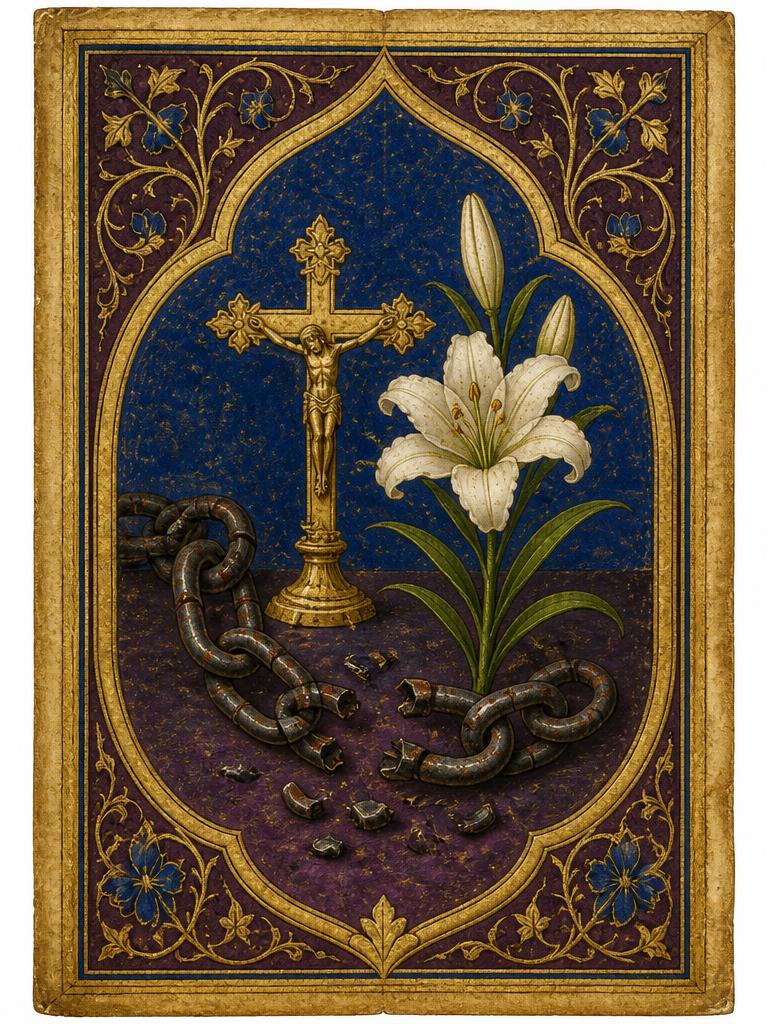
Symbolic treatment, not a likeness: Broken slave chains, a crucifix, and a white lily
Attributes drawn from her documented life, painted for this site as an illuminated panel. The broken chains recall her freedom from slavery and the lily her consecrated life. Painted for Thorns & Light. No photograph or historic portrait of St. Josephine Bakhita is reproduced here.
Patronage
- Sudan
- South Sudan
- Survivors of human trafficking and slavery
Symbols
- A crucifix
- Broken chains
- A dark habit and white veil
Key virtues
- Gentleness
- Endurance
- Freedom
Lived experience
- Trafficking
- Enslavement
- Childhood trauma
- Displacement
- Racism
Causes served
- Abolition
- Care of the poor
- Welcoming the stranger
When you need…
- Someone who knows what it is to be owned by another person
- Hope that trauma is not the last word about you
- A saint for survivors of trafficking
A childhood taken
She was born around 1869 in Olgossa, a village in the Darfur region of what is now Sudan, into a family with land and standing. As a young child (accounts vary between roughly seven and nine years old) she was seized by slave raiders.
The trauma was severe enough that she lost her own name. 'Bakhita', the name she was known by for the rest of her life, was given to her by her captors. She was sold and resold in the markets of El Obeid and Khartoum, and in one household was scarred in a prolonged act of cruelty. Her later accounts of these years are restrained; the record of her body was not.
Italy, and a court that said she was free
In Khartoum she was bought by Callisto Legnani, an Italian official, and travelled with his household to Italy, where she was placed in the service of the Michieli family and became nursemaid to their daughter Mimmina.
When the family arranged to return to Africa, Bakhita and the child were left in the care of the Canossian Daughters of Charity in Venice. She refused to leave. In 1889 an Italian court found that, since slavery was not recognised under Italian law and had been outlawed in Sudan before her birth, she had never lawfully been anyone's property. She was free, and, for the first time, able to choose.
Baptism and religious life
She was baptised in 1890, taking the name Giuseppina Margherita Fortunata, and in 1896 made her profession as a Canossian sister. She was sent to the community at Schio, in northern Italy, where she remained for roughly half a century.
Her work was ordinary: cooking, sewing, tending the door. Generations of townspeople knew her simply as the sister who answered the bell. She was asked, late in life, to dictate her story; the resulting account brought her national attention she had not sought. She died at Schio on 8 February 1947.
Canonisation
She was beatified in 1992 and canonised by Pope St. John Paul II in 2000. Her feast is kept on 8 February, which is also observed in many places as an international day of prayer and awareness against human trafficking.
The world she was born into
The nineteenth-century slave trade across Sudan and the Red Sea region continued long after Atlantic slavery had been formally abolished by European powers. Raiding parties targeted villages precisely because children could be moved and sold quickly.
European Catholicism at the time was entangled with colonial power, and Bakhita's story was sometimes told in ways that flattered her Italian hosts. Reading her honestly means holding both facts: the Church gave her freedom, community, and a name she chose, and the same era's Church was slow, and often complicit, on the question of race and empire.
What she actually endured
Abduction as a child. Repeated sale. Beatings. Ritual scarring. The loss of her family, her language, and her own name: she was never able to recover it.
Her later gentleness is often described as though the suffering produced it. That framing should be resisted. Catholic teaching does not hold that abuse is a gift, or that it was willed by God for her formation. What the Church honours is what she did with a freedom that was stolen and then returned to her.
Why her story is told
Accounts from her community record that she spoke of her captors without bitterness and said she would not curse them. Those accounts are hers to make; no one may require that response of another survivor, and the Church does not.
Her witness is not 'forgive quickly'. It is that a person can be trafficked, sold, scarred, and still be, in the fullest sense, someone: named, free, and capable of a life she chose.
Scripture that runs alongside this life
Isaiah 43:1
Fear not, for I have redeemed thee, and called thee by thy name: thou art mine.
Translation: Douay-Rheims (public domain) · Short excerpt; the full chapter is linked below.
Luke 4:16–21
The Spirit of the Lord is upon me: wherefore he hath anointed me to preach the gospel to the poor.
Translation: Douay-Rheims (public domain) · Short excerpt; full chapter linked.
Prayer
Original prayer written for this site
A prayer with St. Josephine Bakhita
St. Josephine Bakhita, you were taken as a child and called by a name that was not yours.
Pray with everyone still being bought and sold tonight, and with everyone who got out and cannot yet feel free.
Ask God to give us back our names.
Amen.
Not a traditional prayer of the Church. You are never required to have a devotion to any particular saint: you may always pray directly to God.
How to ask this saint to pray with you
- 1.Asking a saint to pray is like asking a friend to pray for you: the prayer still goes to God.
- 2.You can simply say: 'St. Josephine Bakhita, pray with me.' Nothing more is required.
- 3.If her story is too close to your own today, it is entirely fine to set it down and come back another time.
Reflection
If you have been treated as property (by a trafficker, an employer, a family, a partner) her life says plainly that this was a lie told about you, not a truth about you.
Freedom, in her case, arrived partly through a court. Legal help, advocacy, and safe housing are not lesser than prayer; they are how mercy usually reaches a body.
One actionIf you suspect someone is being controlled or exploited, the National Human Trafficking Hotline (1-888-373-7888, or text 233733 in the US) will talk through options with you, including doing nothing yet.