
Canonized saint
St. Francis of Assisi
Founder of the Friars Minor
A merchant's son who renounced his inheritance publicly, embraced people with Hansen's disease, and rebuilt a movement around poverty.
- Dates
- c. 1181 – 3 October 1226
- Feast day
- 4 October
- Places
- Assisi, Italy · Egypt
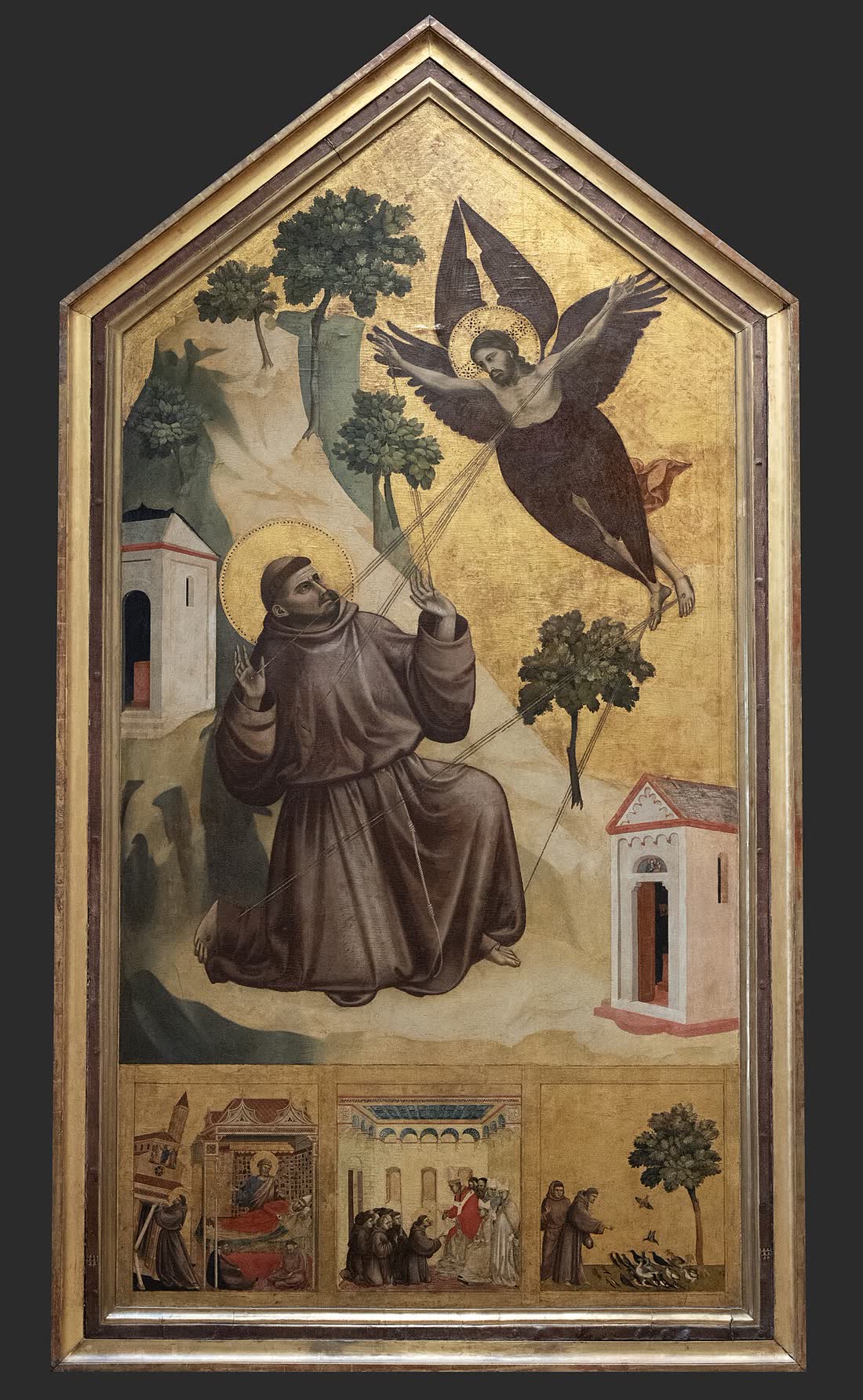
Artwork information
Title: St. Francis Receiving the Stigmata
Artist: Giotto
Date: c. 1300
Rights: Public domain
Patronage
- Ecology
- Italy
- Animals
Symbols
- A wolf
- Birds
- The Tau cross
Key virtues
- Poverty
- Joy
- Peacemaking
Lived experience
- Prisoner of war
- Illness
- Conflict with his father
Causes served
- Creation
- Peace
- The poor
When you need…
- Simplicity
- A saint for creation and for peace
A cloth merchant's son
Francesco di Pietro di Bernardone was born in Assisi around 1181 or 1182, the son of a prosperous cloth merchant. He was not poor and did not grow up poor. He had money, clothes, friends, and the social confidence of the new merchant class in an Italian hill town that was busy quarrelling with its neighbours.
In 1202 Assisi fought Perugia at Collestrada. Francis was captured and held for roughly a year, apparently in poor conditions, and was released after his father paid. He came home ill and stayed ill for a long time. A later attempt to join a military expedition ended when he turned back at Spoleto. What followed was several years of drift that his contemporaries found embarrassing: a young man who had been popular and was now aimless.
Outside the walls
In his Testament, dictated near the end of his life and one of the few texts we have in his own voice, Francis says that his conversion began when he was led among lepers and showed them mercy, and that what had been bitter to him became sweetness of soul and body. He locates the turn there, not in a vision.
People with Hansen's disease in thirteenth-century Umbria lived in lazar houses outside the town walls under legal and religious restrictions. Approaching them meant crossing a boundary the whole town maintained. His later account of embracing them is the historically primary claim; the well known story of the crucifix at San Damiano speaking to him comes from biographies written after his death and belongs to early tradition rather than to his own testimony.
The break with his father
Francis sold cloth from his father's stock, and by some accounts a horse, to fund repairs to churches. Pietro took him before the bishop of Assisi to recover the property and to force him back under paternal authority. Francis renounced his inheritance publicly and, in the account of Thomas of Celano, handed back even the clothes he was wearing.
This was a legal and family rupture, not a photogenic gesture. A father lost his heir and his firm's future in front of the town. There is no record of reconciliation. Anyone who has been cut off by a parent, or has had to cut off a parent, can read this without needing it softened.
A movement he could not fully control
Companions joined him and in 1209 or 1210 Pope Innocent III gave verbal approval to a short rule. Clare of Assisi left her family in 1212 to follow the same way of life. The brothers preached, worked with their hands, begged when work was not given, and refused ownership of property either individually or in common.
Growth broke the original design. By the time the group numbered in the thousands, questions of study, buildings, clerical status, and governance could not be answered by the early rule, and Francis stepped back from leadership around 1220. The written Rule of 1223 is a compromise document. Within decades of his death the order divided bitterly over how literally his poverty should be kept, and popes intervened repeatedly. His ideal was not simply received; it was contested from the beginning by his own brothers.
Egypt, La Verna, and death
In 1219, during the Fifth Crusade, Francis crossed the lines at Damietta and met the Sultan al-Malik al-Kamil. Both Christian and later Muslim sources agree a meeting took place and that he was received and sent back unharmed. What was said is not recoverable; claims that either man nearly converted the other are legend. What can be said is that he went unarmed into a war his own Church had called, and came back without a conquest.
In 1224, on Mount La Verna, his companions reported the stigmata, wounds resembling those of the crucified Christ. Brother Elias announced them after his death and Celano described them; they are attested devotional testimony rather than something a historian can independently confirm. His last years were marked by near blindness, probably trachoma contracted in Egypt, and by painful and futile medical treatment. He died on 3 October 1226, aged about forty five, and was canonised in 1228.
Why voluntary poverty was radical, and why it is not a prescription
Twelfth and thirteenth century Italy was rapidly monetising. Merchant wealth, credit, and civic ambition were reordering towns, and religious movements criticising Church wealth were multiplying, several of which were condemned as heretical. Francis said much of what those movements said, and remained inside the Church largely because he sought approval and obedience rather than confrontation.
His poverty was chosen by a man who could have chosen otherwise, and could have gone home. That is the crucial difference from involuntary destitution, and Catholic social teaching draws it clearly: poverty forced on people by injustice is something to be fought, not admired. If you are poor because you have no options, Francis is not a rebuke to you, and no one may use his story to tell you that your hunger is a spiritual opportunity.
What his life actually cost him
A year of captivity in his early twenties, followed by long illness. Public humiliation and permanent estrangement from his father. Ridicule in his own town. The loss of practical control over the movement he began, and open disagreement with brothers he loved about what he had founded. Near blindness, chronic stomach illness, and crude cauterising treatments in his final years.
The birds, the wolf, and the garden statues have made him seem gentle in a weightless way. He was gentle. He was also a sick man who died young after a public family rupture and a decade of institutional conflict.
Creation, and Laudato Si'
The Canticle of the Creatures, which he composed in Umbrian dialect near the end of his life while nearly blind, calls sun, moon, water, and even death brother and sister. It is not sentimental nature writing; it is a claim that everything created shares one origin and therefore one kinship. Pope Francis built the encyclical Laudato Si' on that text, joining care for the earth to care for the poor as a single obligation.
The same instinct explains the crib at Greccio in 1223, where he arranged a living nativity scene. His interest was in the poverty and physical vulnerability of the Incarnation: God arriving among animals, without property.
Prayer
Traditional prayer
From the Canticle of the Creatures
Most high, all powerful, good Lord, yours are the praises, the glory, the honour, and every blessing.
Praised be you, my Lord, with all your creatures, especially Sir Brother Sun.
Praised be you, my Lord, through those who forgive for love of you, and bear infirmity and trial.
Source: Text of the Canticle as quoted in Laudato Si', 87
Original prayer written for this site
A prayer asking St. Francis to pray with us
This prayer was written for this site; it is not an ancient or officially approved text.
St. Francis, you crossed a boundary your whole town kept, and found God on the other side of it.
Pray with everyone whose illness or poverty makes other people step away, and with everyone whose family has closed a door on them.
Ask God to make us people who go outside the walls without needing to be thanked for it.
Amen.
Not a traditional prayer of the Church. You are never required to have a devotion to any particular saint: you may always pray directly to God.
How to ask this saint to pray with you
- 1.'St. Francis, pray with me' is enough. You do not need the Peace Prayer, which is a twentieth century French text and not his work.
- 2.If you have been disowned or cut off by family, you can ask him specifically for that; it is his own experience.
- 3.If you are drawn to his poverty, begin with something you can actually give away rather than with a vow.
- 4.Read the Canticle slowly outdoors once, and notice what you are being asked to call brother or sister.
Reflection
The famous Peace Prayer, 'Lord, make me an instrument of your peace,' is not by Francis. It first appeared in French in 1912. It is a good prayer, and honesty about its origin matters more than the attribution.
His conversion did not start with certainty about doctrine. It started with a decision to go near people everyone else avoided, and the belief followed.
One actionGo where you would normally not go this week: a nursing home, a shelter meal, a neighbour whose illness has made visits awkward. Bring nothing to fix.