
Find God
Start wherever you actually are.
No theology background needed. No assumptions about what you believe. Read one page, or none, and come back whenever.
The face the tradition kept
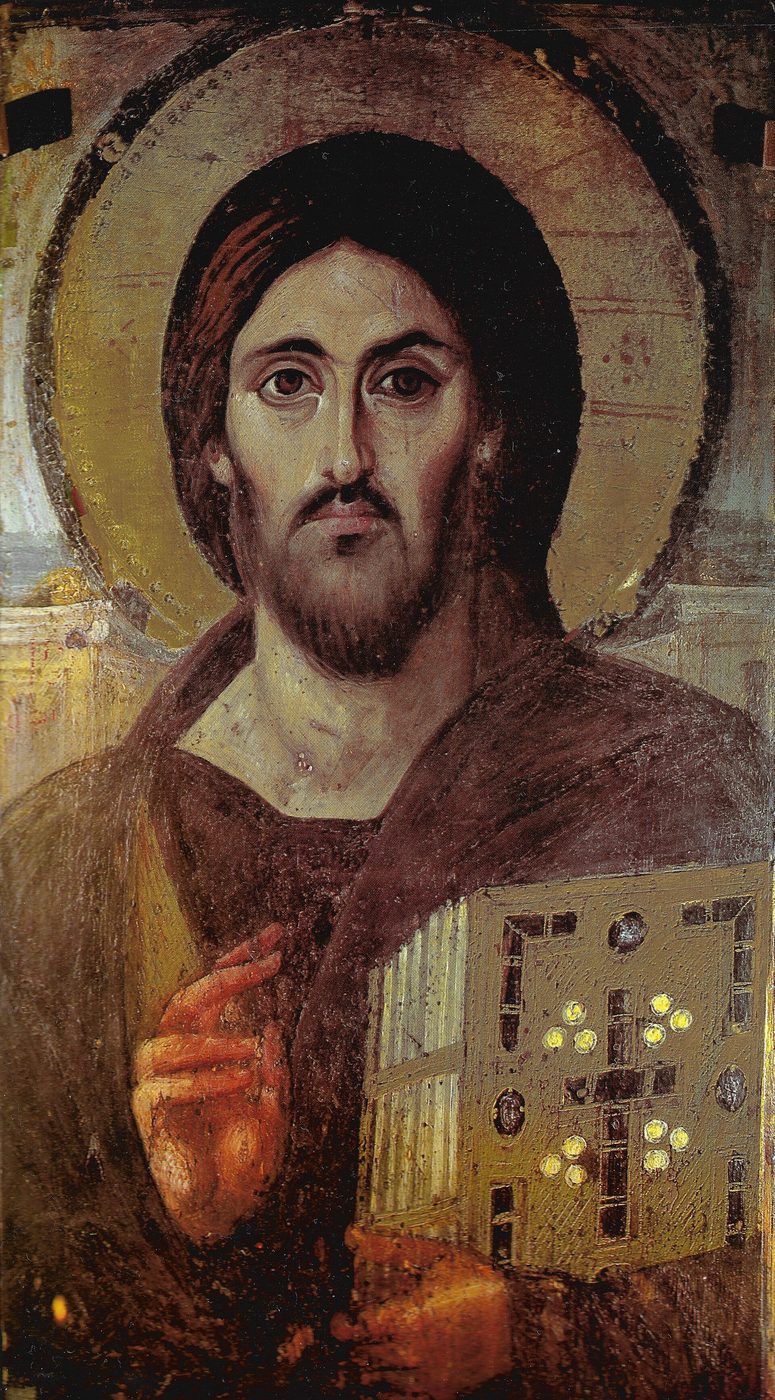
Christ Pantocrator, Unknown iconographer, Saint Catherine's Monastery, Sinai, 6th century.
One of the oldest surviving images of Christ, painted while the Roman world was still standing.
Artwork information
Title: Christ Pantocrator
Artist: Unknown iconographer, Saint Catherine's Monastery, Sinai
Date: 6th century
Rights: Public domain (copyright expired)
Whatever you were told about God, the Christian claim is narrower and stranger than most of it: that God took a face, a voice, and a body, and used them to move toward the people everyone else stepped over.
This icon was painted at Sinai in the sixth century and has been looked at ever since. One hand blesses. The other holds the book. The two sides of the face are famously unalike, one steady and one gentler, which is why people have spent fifteen hundred years saying it holds both judgment and mercy without letting go of either.
You do not have to feel anything in front of it. It is here because the questions below are not abstract ones. They are about a person.
Christ among the rejected
To encounter Christ is to see whom he approached
You can learn what someone believes from their doctrine. You learn who they are from who they walk toward.
Jesus was born poor, taken across a border as a small child because a ruler wanted him dead, raised in a town nobody expected anything from, and executed as a condemned man. From inside that life he moved deliberately toward people his own society avoided: the sick, the ritually unclean, the publicly shamed, the foreign, the grieving, the collaborator, the child, the criminal beside him.
The Incarnation is the claim that God took on that position rather than observing it. The Cross is what the world did with him. The Resurrection is God's answer, and it does not erase the wounds: the risen Christ still shows them. This is why Catholics read Matthew 25:40 as a present-tense statement about where he can be found.
I
Born poor, laid in a feeding trough
Luke 2:1-7
II
Taken into Egypt when his life was threatened
Matthew 2:13-15
III
Raised in a town no one expected anything from
John 1:45-46
IV
He moved toward the people others avoided
Luke 4:16-21, Matthew 8:1-4, John 4:1-42, Mark 10:46-52
V
Falsely accused, condemned, and executed
Luke 23:13-25, Hebrews 13:3
VI
Risen, and still with his people
Luke 24:36-43, Matthew 25:40
Questions people actually ask
- The rejected ChristPoor at birth, displaced as a child, condemned at the end: God chose the position of the people the world discards.
- Who is Jesus?Before doctrine, before rules: a person who came looking for us, and who kept going toward the people everyone else avoided.
- What is the Gospel?Good news, in plain language, with nothing hidden in the fine print, and nothing you have to perform first.
- Does God really love me?Not the version of you that has it together. You.
- Why does God allow suffering?An honest look at the hardest question, without tidy answers.
- How do I start praying?Lower the bar. Then lower it again.
- What if I don't believe?Doubt is not disqualifying. Come in anyway.
- What if I'm angry with God?The Bible is full of people shouting at God. They were not punished for it.
- Why Catholicism?What the Catholic Church claims to be: said plainly, without pressure.
- I want to come back to the ChurchWhatever the gap has been (five years or fifty) there is a way back that does not begin with humiliation.
- How to attend Mass for the first timeWhat happens, when to stand, and what to do if you feel lost.
If you have been away for a long time
You do not need to explain your absence to anyone. You may walk into any Catholic church, sit at the back, and leave when you want.
If part of why you left was harm done to you by the Church or by someone in it, that deserves its own space, not a page that hurries you back.