Skip to content
Are you in immediate danger?Get help now
Thorns & Light

Serve

Christ said he is there.

Not as a metaphor. Matthew 25 identifies Jesus personally with the hungry, the stranger, the sick, and the imprisoned. This page grounds volunteering and giving in that claim, then hands you real ways to act on it.

Service hub

Matthew 25 is not a general appeal to kindness. It is a direct claim: whoever fed, welcomed, clothed, visited, or freed the person in front of them did it to Christ himself. Whoever refused, refused Christ himself. The chapter gives no religious test, no worthiness screen, and no exception for people who make helping difficult.

The corporal and spiritual works of mercy grew out of this passage and out of the whole pattern of the Gospels: Jesus consistently moves toward people his own society had learned to walk past. Reading these encounters in their historical context, rather than as timeless slogans, keeps the claim honest: this happened among real people, in a real place, under real power.

What follows connects eleven concrete human realities to a Gospel passage read in its own setting, a short Catholic reflection, a prayer, and one action sized to fit an ordinary week. None of it substitutes for professional, medical, legal, or emergency help; all of it assumes Christ is already present in the person you are trying to reach.

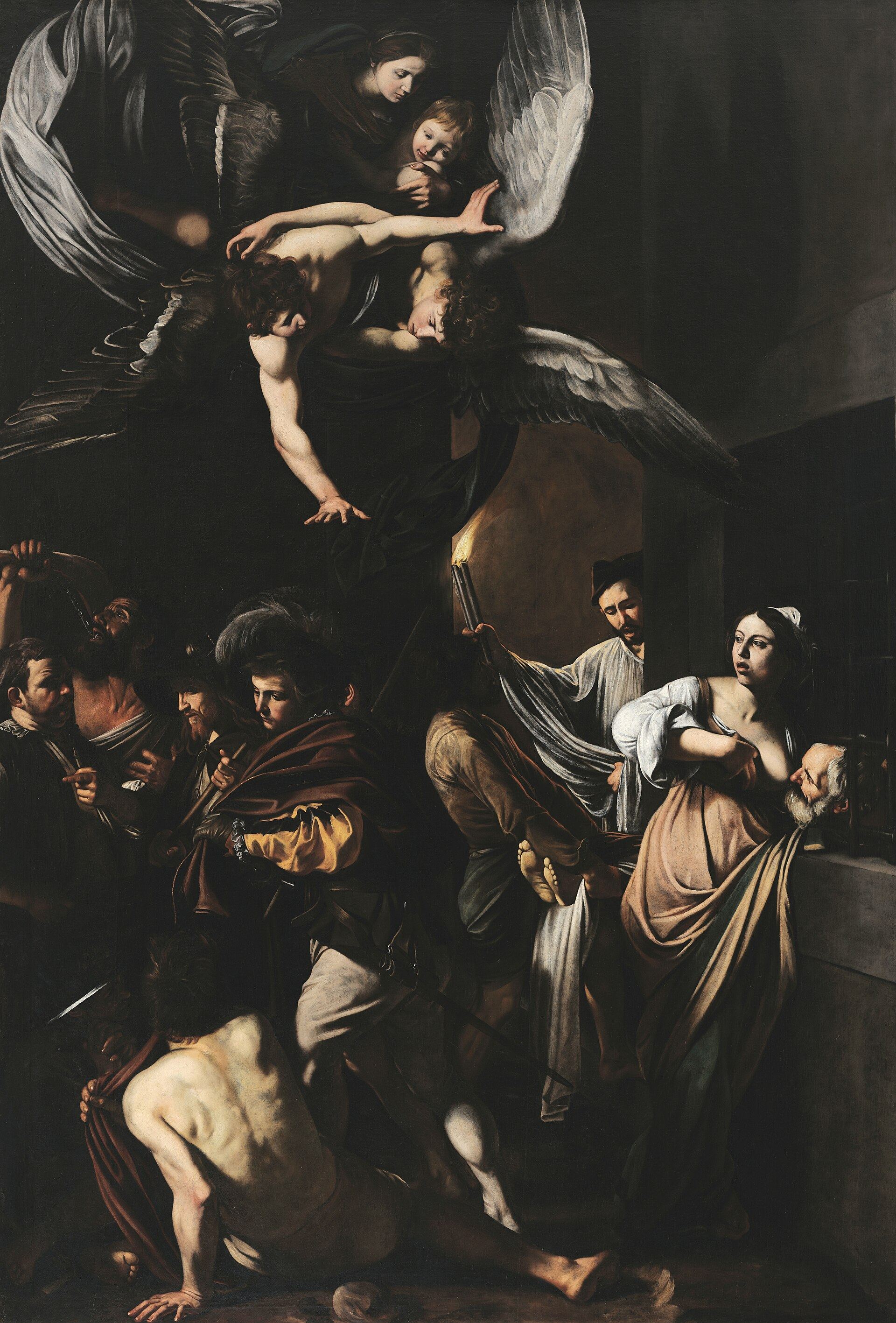
Crowded altarpiece painted for a Naples charity, showing ordinary people feeding the hungry, giving drink, clothing the naked, sheltering a stranger, visiting a prisoner, and burying the dead, with Mary and the child above them.

The Seven Works of Mercy, Michelangelo Merisi da Caravaggio, 1607.

Artwork information

Title: The Seven Works of Mercy

Artist: Michelangelo Merisi da Caravaggio

Date: 1607

Rights: Public domain (copyright expired)

Source record at Wikimedia Commons

Matthew 25:31-46

The passage this whole page is built on

Matthew 25:31-46

As long as you did it to one of these my least brethren, you did it to me.

Translation: Douay-Rheims (public domain) · Full text shown; this translation is in the public domain.

Eleven human realities

Scripture read in context, cause by cause

Each of these connects a real human need to a Gospel passage read in its own historical setting, a Catholic reflection, a prayer, and one practical action.

Hunger

Christ names the hungry first among those he identifies with in judgement.

Matthew 25:35, 37-40

For I was hungry, and you gave me to eat.

Translation: Douay-Rheims (public domain) · Full text shown; this translation is in the public domain.

Historical context

First-century Galilee and Judea lived close to subsistence; a bad harvest or an unjust tax could mean real hunger within weeks. The early Church organised a daily distribution of food significant enough that deacons were appointed to run it fairly (Acts 6:1-6).

Catholic reflection

Feeding the hungry is the first corporal work of mercy the Catechism names, and Catholic social teaching insists food is not a favour granted to the deserving but a basic claim every person has by virtue of being human (CCC 2447).

Prayer & one action

Lord, you fed the crowds before you taught them anything else. Teach me that order.

Support a food bank with a standing monthly gift, and give it in the months no one is asking.

Housing insecurity

The Holy Family had nowhere to stay at the birth, and became refugees soon after.

Matthew 25:35; Luke 2:7

I was a stranger, and you took me in.

Translation: Douay-Rheims (public domain) · Short excerpt; full chapters linked.

Historical context

Hospitality to travellers was a serious duty across the ancient Mediterranean, and the word hospitality shares a root with hospital. Monasteries were bound by rule to receive any guest as Christ himself.

Catholic reflection

Most homelessness today is invisible: people doubled up with relatives, sleeping in cars, or moving between temporary arrangements. The Church's teaching on the universal destination of goods says housing is not a luxury awarded to the fortunate.

Prayer & one action

Lord, let me see the housing crisis around me as clearly as I see the one in the Christmas story.

If you know someone at risk of eviction, help them find emergency rent assistance this week rather than after the notice expires.

Isolation and loneliness

Jesus stops for the people everyone else has learned to walk past.

Mark 10:46-52

And Jesus said to him: Go thy way, thy faith hath made thee whole.

Translation: Douay-Rheims (public domain) · Short excerpt; full chapter linked.

Historical context

Widows, the elderly without family, and people with disabilities had few social protections in the ancient world, which is part of why the earliest Christian communities were known for caring for widows and orphans directly.

Catholic reflection

Loneliness is now understood as a genuine health risk, and Catholic teaching on solidarity treats consistent presence, not sentiment, as the actual content of love for a neighbour.

Prayer & one action

Lord, keep me from mistaking a card or a like for a visit.

Call or visit someone consistently for a whole year, on a schedule they can rely on.

Imprisonment

Christ was arrested, held, tried, and executed, and he names visiting prisoners as visiting him.

Matthew 25:36; Luke 23:39-43

I was in prison, and you came to me.

Translation: Douay-Rheims (public domain) · Short excerpt; full chapters linked.

Historical context

Confraternities in the medieval Church accompanied the condemned to execution and buried them decently. Religious communities carried letters, food, and medicine into prisons the state did not provision at all.

Catholic reflection

Reentry, not sentencing, is often the hardest and least supported moment: identification, an address, a phone, and work are all needed at once, right when support has usually disappeared.

Prayer & one action

Lord, do not let me disappear the moment someone's sentence ends.

Support the family of someone incarcerated, since visits and phone calls carry real, ongoing cost.

Migration and displacement

Jesus himself was a refugee before he could walk.

Matthew 2:13-15

Arise, and take the child and his mother, and fly into Egypt.

Translation: Douay-Rheims (public domain) · Short excerpt; full chapter linked.

Historical context

Herod's documented cruelty toward perceived rivals gives the flight into Egypt a concrete political backdrop rather than a symbolic one; Egypt already held a large Jewish community that could receive refugees.

Catholic reflection

Immigration advice given by well-meaning volunteers, however sincere, can cost someone their case; the Church's own social teaching pairs welcome with real legal and material support rather than sentiment alone.

Prayer & one action

Lord, give me patience for the paperwork that stands between a family and safety.

Accompany someone to an appointment, a school, or a clinic; presence and translation help even when you cannot fix the legal process.

Disability and accessibility

Jesus touches the people illness and disability had made untouchable.

Mark 1:40-45

And Jesus having compassion on him, stretched forth his hand; and touching him, saith to him: I will. Be thou made clean.

Translation: Douay-Rheims (public domain) · Short excerpt; full chapter linked.

Historical context

Ritual purity codes in first-century Judaism carried real social consequences; the man in Mark 1 would have lost family, worship, and livelihood along with his health.

Catholic reflection

Accessibility is not hospitality extended as a favour; it is a right already owed, and a ramp or an accessible liturgy is a theological statement as much as a practical one.

Prayer & one action

Lord, help me see access as justice, not generosity.

Ask a disabled person directly what would help, and believe the answer even when it costs more than you expected.

Illness and caregiving

Healing occupies more of the Gospels than almost anything else Jesus does.

Mark 2:1-12

Son, thy sins are forgiven thee... Arise, take up thy bed, and go into thy house.

Translation: Douay-Rheims (public domain) · Short excerpt; full chapter linked.

Historical context

Christians built some of the earliest institutions recognisable as hospitals, open to people who could not pay, and religious orders were founded specifically to nurse the plague-stricken and the dying.

Catholic reflection

Caregivers are frequently a second, hidden patient; offering concrete relief is often more useful than sympathy alone, and prayer accompanies medicine rather than replacing it.

Prayer & one action

Lord, remember the person caring for the sick person, too.

Offer a fixed, repeating slot of help, rather than an open-ended offer that requires someone exhausted to ask.

Grief and loss

Jesus weeps at a grave he is about to act at, refusing to skip past the loss.

John 11:32-36

Jesus wept.

Translation: Douay-Rheims (public domain) · Short excerpt; full chapter linked.

Historical context

Public mourning customs in first-century Judea were extensive and communal; John's Gospel deliberately places Jesus inside that customary grief rather than above it.

Catholic reflection

Catholic pastoral practice increasingly recognises that presence, not explanation, is what grief usually needs, and that saying a religious platitude too soon can wound rather than console.

Prayer & one action

Lord, let me say the name of the person who died, rather than avoiding it.

Bring specific, dated help, such as a meal on a named day, rather than a vague offer to be there if needed.

Abuse recovery

Jesus refuses both to pretend nothing happened and to let a person be destroyed by a crowd's judgement.

John 7:53-8:11

He that is without sin among you, let him first cast a stone at her.

Translation: Douay-Rheims (public domain) · Short excerpt; full passage linked. See the textual note on this passage.

Historical context

The law cited in the passage carried the death penalty and required both parties to be brought; the scene's manuscript history is itself carefully documented rather than settled, which is why a textual note belongs alongside it.

Catholic reflection

Recovery from abuse is not a test of a survivor's forgiveness, and the Church's own teaching distinguishes forgiveness from reconciliation, restored trust, or continued access to someone unsafe.

Prayer & one action

Lord, protect the people I cannot see who are afraid to speak.

Learn the safeguarding process of any organisation before referring someone to it, and never take on a survivor's disclosure as your own project.

Care for creation

The same Christ present in the hungry and imprisoned is also present in a groaning creation.

Romans 8:19-22

For the expectation of the creature waiteth for the revelation of the sons of God.

Translation: Douay-Rheims (public domain) · Short excerpt; full chapter linked.

Historical context

Genesis assigns humanity responsibility to till and to keep creation, a stewardship rather than an ownership; Catholic teaching has increasingly drawn out the connection between ecological harm and harm to the poor.

Catholic reflection

Care for creation is not a separate cause from care for the marginalized; flooding, drought, and pollution consistently strike the poorest communities first and hardest.

Prayer & one action

Lord, do not let me treat the earth as disposable, or the people who depend on it as invisible.

Support an established relief or development agency's environmental and resilience work rather than treating this as unrelated to almsgiving.

Advocacy for human dignity

Paul insists that no inherited rank has the power to determine a person's worth.

Galatians 3:28

There is neither Jew nor Greek: there is neither bond nor free: there is neither male nor female. For you are all one in Christ Jesus.

Translation: Douay-Rheims (public domain) · Short excerpt; full chapter linked.

Historical context

Roman society was explicitly stratified by citizenship, ethnicity, and legal status; the early Church's mixed table fellowship of enslaved and free, Jew and Gentile, was noted and resented by outside observers.

Catholic reflection

Advocacy for human dignity is not a departure from charity but its public form: structures, laws, and habits that keep producing the same suffering are a legitimate object of Christian concern.

Prayer & one action

Lord, give me the courage to name unjust structures, not only to comfort their casualties.

Learn one policy question behind a cause you already care about, and engage it as seriously as you would a personal act of charity.

Already mapped

This connects directly to the works of mercy

The 7 corporal and 7 spiritual works of mercy, and 17 practical pathways by human need, live on the Help Someone page. This page exists to ground volunteering and giving in the same theology, then connect you to listed organizations rather than duplicating that material.

Ten of the saints in this library met homelessness, disability, addiction, migration, neglect, or the abuse of power by someone stronger. Their histories are told without pretending the harm was good for them.

Saints who knew the margins from the inside