
Canonized saint
St. Martin de Porres
Dominican lay brother; nurse to the poor of Lima
The mixed-race son of a Spanish nobleman and a freed African woman, refused full membership for years because of his ancestry, who ran what amounted to a free clinic in colonial Lima.
- Dates
- 9 December 1579 – 3 November 1639
- Feast day
- 3 November
- Places
- Lima, Peru
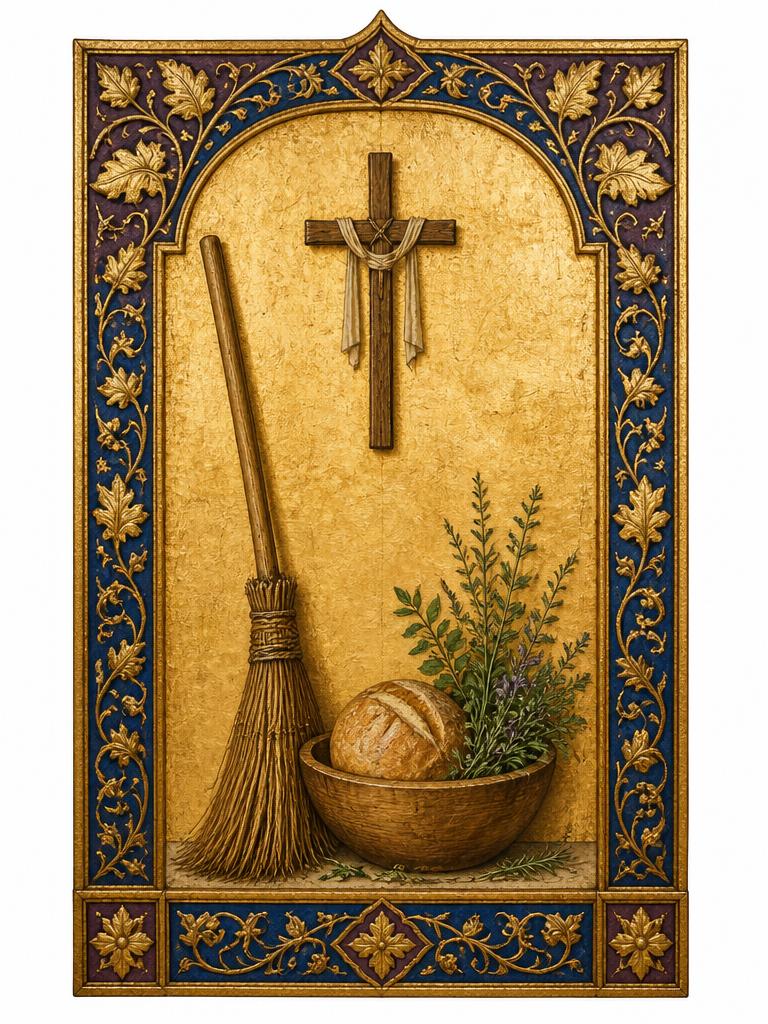
Symbolic treatment, not a likeness: A broom, a bowl of bread and herbs, and a wooden crucifix
Attributes drawn from his documented life, painted for this site as an illuminated panel. The broom recalls the humble work he chose and the herbs the sick he nursed. Painted for Thorns & Light. No photograph or historic portrait of St. Martin de Porres is reproduced here.
Patronage
- Interracial justice
- Barbers
- Public health workers
- Mixed-race people
Symbols
- A broom
- A bowl of food
- Animals at his feet
Key virtues
- Humility
- Practical mercy
- Perseverance under exclusion
Lived experience
- Racism
- Illegitimacy
- Poverty
- Institutional exclusion
Causes served
- Racial justice
- Healthcare for the poor
- Orphans
When you need…
- A saint who was excluded by the Church itself
- Dignity in unnoticed work
- Healing of the body
Born outside the categories
Martin was born in Lima in 1579 to Juan de Porres, a Spanish nobleman, and Ana Velázquez, a freed African woman. His father did not acknowledge him for years. In a colonial society organised meticulously by caste, a dark-skinned child of an unmarried mother had almost no path upward.
He was apprenticed to a barber-surgeon, learning to cut hair, draw blood, set bones, and dress wounds: the medical trade of the day.
Admitted, but not fully
At around fifteen he joined the Dominican priory of the Holy Rosary as a servant (a status below that of a religious brother) because Peruvian law and custom barred people of African or Indigenous descent from full religious profession.
He accepted the menial work. After roughly nine years, the community, having watched him, set the restriction aside and received him as a professed lay brother. The exclusion was real, and it was the institution's failure, not his.
The work
He was placed in charge of the infirmary and became, in effect, the city's free physician. He nursed enslaved Africans arriving in the port, treated the priory's own sick, distributed food daily to the poor of Lima, and raised funds for dowries for girls who would otherwise have had no options.
He helped found an orphanage and school. He was known for taking in stray animals: the detail that survives in almost every image of him.
Canonisation
He died on 3 November 1639. Devotion in Lima was immediate and durable, but formal canonisation took more than three centuries: he was beatified in 1837 and canonised by Pope St. John XXIII in 1962, during the civil-rights era, and named a patron of interracial justice.
Colonial Lima
Lima was a port city of the Spanish empire with a large enslaved African population and a rigid legal hierarchy of ancestry. Religious orders participated in that system, including in the ownership of enslaved people.
Martin's sanctity was recognised inside an institution that was itself unjust to him. Both halves of that sentence belong in his story.
Who he served
The sick who could not pay. Enslaved people newly landed and ill. Orphaned children. Anyone at the priory door at the hour food was given out.
Scripture that runs alongside this life
Matthew 25:31–46
As long as you did it to one of these my least brethren, you did it to me.
Translation: Douay-Rheims (public domain) · Short excerpt; full passage linked.
Galatians 3:28
There is neither Jew nor Greek: there is neither bond nor free: there is neither male nor female. For you are all one in Christ Jesus.
Translation: Douay-Rheims (public domain) · Short excerpt; full chapter linked.
Prayer
Original prayer written for this site
A prayer with St. Martin de Porres
St. Martin de Porres, you were let in through a side door and stayed to serve everyone who came to it.
Pray with those the Church has ranked and overlooked.
Amen.
Not a traditional prayer of the Church. You are never required to have a devotion to any particular saint: you may always pray directly to God.
How to ask this saint to pray with you
- 1.He is often asked to pray for the sick and for those working night shifts in hospitals.
- 2.Simply: 'St. Martin, pray with me for this person who is ill.'
Reflection
If a parish or community has made you feel that you belong less because of your race, background, or family situation, Martin's life is evidence that the fault lies with the ranking, not with you.
One actionLearn who provides free or sliding-scale healthcare in your area, and keep the number somewhere you can find it for someone else.