
Canonized saint
St. Thérèse of Lisieux
Carmelite nun; Doctor of the Church
She died at twenty-four having done nothing remarkable by the world's measure, and taught that small, hidden love is the path.
- Dates
- 2 January 1873 – 30 September 1897
- Feast day
- 1 October
- Places
- Alençon and Lisieux, France
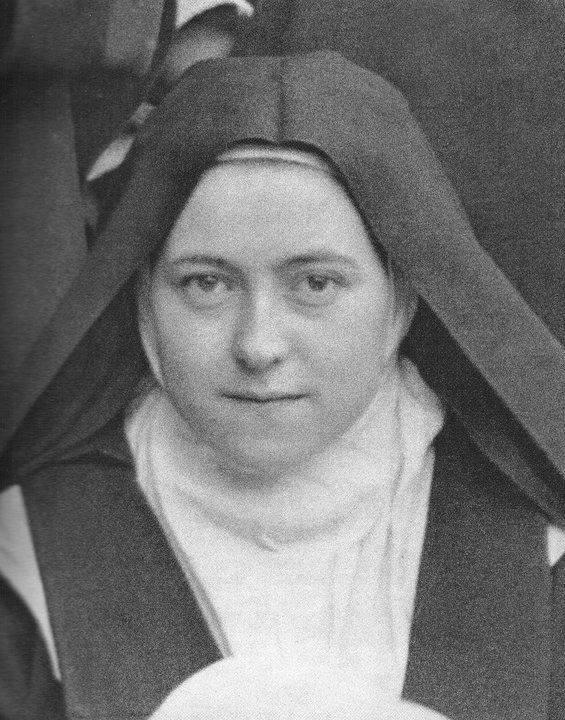
Artwork information
Title: Thérèse of Lisieux
Artist: Céline Martin
Date: 1895
Rights: Public domain
Patronage
- Missions
- Florists
- France
- Aviators
Symbols
- Roses
- A crucifix
Key virtues
- Littleness
- Trust
- Perseverance in darkness
Lived experience
- Bereavement in childhood
- A parent's mental illness
- Scrupulosity
- Tuberculosis
- Doubt
Causes served
- Ordinary holiness
- Missions
When you need…
- Permission to be small
- A saint for scrupulosity and doubt
- Company in a parent's illness
A childhood marked by loss
Thérèse Martin was born in Alençon, France, in 1873, the youngest of nine children of Louis and Zélie Martin, of whom five daughters survived infancy. Her mother died of breast cancer in 1877, when Thérèse was four. The family moved to Lisieux to be near relatives, and her father and older sisters largely raised her afterward.
By her own account in her autobiography, Story of a Soul, written under obedience to her prioress in her final years, this early loss left her an anxious, easily wounded child. She described a period of what she and others around her called scrupulosity: an exaggerated fear of having sinned or displeased God, a real and documented struggle rather than an ordinary childhood worry.
Entering Carmel at fifteen
Thérèse felt drawn to the cloistered Carmelite life from childhood, following two older sisters who had already entered the Carmel of Lisieux. Because of her age, the local bishop and then, during a pilgrimage to Rome in 1887, Pope Leo XIII himself had to be petitioned directly before she was permitted to enter at fifteen, in 1888, younger than was ordinarily allowed.
Inside the convent she lived an unremarkable religious life by the visible standards of her community: she held ordinary duties, was not given special roles, and by her own account struggled with some of the sisters she lived alongside. Her spiritual writing, composed for an internal community readership and only published after her death, describes what she called 'the little way': not extraordinary penances or visible achievements, but small, ordinary acts of patience and love done consistently, and a deliberate trust in God's mercy rather than confidence in her own spiritual performance.
Her father's illness
Louis Martin, Thérèse's father, suffered a series of strokes and a serious mental decline beginning in 1889, the year after she entered Carmel. He experienced delusions and had to be committed to a psychiatric institution, the Bon Sauveur asylum at Caen, where he remained for roughly three years before being brought home in a diminished state; he died in 1894.
Thérèse and her sisters found their father's illness and institutionalisation a source of real and prolonged grief and social humiliation, at a time when mental illness carried heavy stigma. She wrote of this period as a genuine trial rather than something to be minimised, and it shaped the compassion running through her later writing on suffering.
Illness and a documented darkness of faith
In 1896 Thérèse began coughing blood, an early sign of the tuberculosis that would kill her. Over her final eighteen months the disease progressed without effective treatment available at the time, and her physical suffering in the last weeks was severe and is recorded plainly by the sisters who nursed her.
In the same period she recorded, in her own words, a night that had descended over her interior life: a sustained inability to feel the presence of God or the reality of heaven, which she described using stark language of darkness and near-despair, even as she continued to choose faith and love without the comfort of feeling either. Catholic readers should not romanticise this: it was a genuine and painful trial of faith and physical suffering together, not a spiritual technique or something to be sought out. She died on 30 September 1897, aged twenty-four.
Recognition after death
Story of a Soul was published in an edited form the year after her death and spread widely, particularly among ordinary Catholics and later among soldiers in the First World War. She was canonised by Pope Pius XI in 1925 and named patroness of the missions in 1927, despite having never left her convent. In 1997 Pope John Paul II declared her a Doctor of the Church, one of only a small number of women to hold that title, citing her teaching on spiritual childhood and trust.
Nineteenth-century France and enclosed religious life
Thérèse lived in a France still working through the aftermath of revolution and shifting relations between Church and state. Cloistered convents such as the Carmel of Lisieux offered women a recognised vocation of prayer and asceticism, largely separated from the wider world, with strict rules of silence, poverty, and communal life that shaped the small, hidden character of her spirituality.
Tuberculosis was a leading cause of death in this period and had no reliable cure; her decline and death, and the mixture of physical agony and calm recorded by witnesses, were typical of the disease's course at the time.
What she actually carried
The death of her mother at four. A period of documented scrupulosity as a child. Her father's mental breakdown, institutionalisation, and death during her time in Carmel. Chronic tuberculosis with no effective treatment, and a final illness marked by real physical suffering. In her last months, a sustained experience of spiritual darkness in which the reward she had preached about, heaven, felt unreal to her.
Scripture that runs alongside this life
Matthew 11:28–30
Come to me, all you that labour, and are burdened, and I will refresh you.
Translation: Douay-Rheims (public domain) · Full passage shown because this translation is in the public domain.
Prayer
Original prayer written for this site
A prayer with St. Thérèse of Lisieux
This prayer was written for this site; it is not an ancient or officially approved text.
St. Thérèse, you taught a little way and then you were asked to walk it through real darkness, without romantic feeling to carry you.
Pray with anyone whose faith has gone quiet or gone dark, and with anyone carrying a parent's illness they did not choose.
Help us believe that small, unglamorous love still counts, especially on the days it does not feel like enough.
Amen.
Not a traditional prayer of the Church. You are never required to have a devotion to any particular saint: you may always pray directly to God.
How to ask this saint to pray with you
- 1.A simple 'St. Thérèse, pray with me' is enough; no special formula is required.
- 2.If you are caring for a parent with mental illness or dementia, you might ask her to pray with you specifically about that grief, since she lived it.
- 3.If your faith currently feels dark or absent rather than comforting, you can tell her that directly; she wrote about exactly that experience.
Reflection
Thérèse is often reduced to roses and sweetness. Her actual life included a parent's mental illness, a slow and painful death, and a documented loss of felt faith at the end. None of that erases her holiness; it is part of what her holiness looks like in a real life.
If your own faith has gone dark, this is not evidence that you have failed. It may be closer to her experience than the rose petals suggest.
One actionIf someone in your life carries the stigma of a parent's or loved one's mental illness, consider one honest, unashamed conversation about it this week.