
Canonized saint
St. Moses the Black
Desert monk; former enslaved man and bandit leader
Remembered in Desert Father tradition as a violently enslaved man turned robber, who became a monk in the Egyptian desert and refused, famously, to judge another monk's sins.
- Dates
- c. 330 – c. 405
- Feast day
- 28 August (Roman Catholic); 24 Paona / 1 July (Coptic)
- Places
- Egypt · Scetes (Wadi El Natrun)
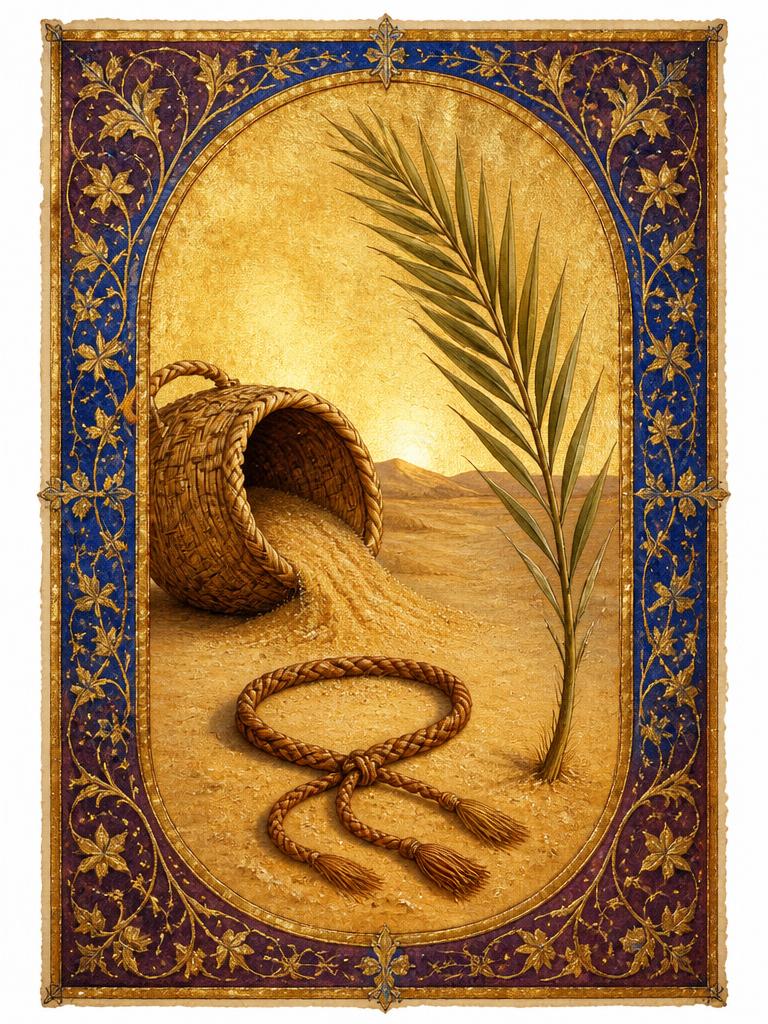
Symbolic treatment, not a likeness: A basket leaking sand, a monastic rope belt, and a palm frond
Attributes drawn from the desert tradition about him, painted for this site as an illuminated panel. The leaking basket recalls the story of his refusal to condemn another monk's fault. Painted for Thorns & Light. No photograph or historic portrait of St. Moses the Black is reproduced here.
Patronage
- Africa
- Nonviolence
- People with a criminal past
Symbols
- A basket of sand
- A desert cell
Key virtues
- Repentance
- Refusal to condemn
- Nonviolence
Lived experience
- Enslavement
- Violence
- A criminal past
- Racism among his own brethren
Causes served
- Reconciliation
- Nonviolence
When you need…
- A saint with a past
- Freedom from other people's judgement
- Hope after violence you caused
A life known through monastic memory, not modern documentation
Almost everything known about Moses comes from the Sayings of the Desert Fathers (the Apophthegmata Patrum) and related monastic writings compiled in the generations after his death: texts assembled to form and teach later monks, not modern biographical records, and their details should be read with that in mind. They describe him as an Egyptian or Ethiopian man, of the region generally referred to in these sources as 'the Ethiopian', once enslaved in the household of a government official, from which he was dismissed, by tradition for theft or violent conduct.
After his dismissal, tradition holds that Moses became the leader of a band of robbers operating in the Nile region, described in the sources as violent and feared. This part of his story is preserved specifically because the monastic tradition wanted to hold it up against the transformation that followed, not to sensationalise it.
Turning toward the monks at Scetes
By the account preserved in monastic memory, Moses, fleeing pursuit or in a moment of crisis, took refuge among the Christian monks living in the desert region of Scetes, a major center of early Egyptian monasticism. He stayed, underwent a long and difficult period of conversion marked by continued temptation and struggle that the sayings record honestly rather than glossing over, and eventually became a monk and, later, a priest, one of relatively few Black monastic leaders whose memory the desert tradition preserved by name.
The sayings record that some fellow monks reacted to him with racism, on at least one occasion testing or insulting him because of his race and past; other sayings show him responding to such treatment with striking humility rather than retaliation, presented in the tradition as an example precisely because the mistreatment was real.
The basket of sand
The best-known story about Moses tells of him arriving deliberately late to a meeting called to judge a brother monk's fault, dragging behind him a basket leaking sand through holes he had made in it. Asked why, he said his own sins were running out behind him where he could not see them, while he had come to judge another man's sin. The community is said to have forgiven the brother. This is a teaching story preserved in the monastic tradition to instruct on humility and against judging others, not a documented historical event with witnesses in the modern sense.
Death and veneration
Tradition holds that Moses died around 405 when a group of raiders attacked the monastic settlement at Scetes, and that he refused to take up arms or flee, choosing nonviolence in keeping with his understanding of the Gospel, and was killed along with several companions, an episode remembered in both Coptic and later Western tradition as a martyrdom of nonresistance.
Moses the Black is venerated as a saint in the Coptic Orthodox Church, where he holds particular significance as an African monastic father, and in the Roman Catholic Church and Eastern Orthodoxy more broadly, where his story of radical conversion from violence continues to be cited in ministries working with people recovering from criminal pasts or addiction.
Early Egyptian desert monasticism
Scetes was one of the principal centres of Christian monastic life in fourth-century Egypt, where men and women withdrew into the desert to live lives of prayer, manual labour, and asceticism under the guidance of experienced elders. The sayings of these monks were transmitted orally and then compiled in writing over the following century, shaping Christian spirituality for both East and West.
What the tradition says he carried
Enslavement and dismissal. A period of violent crime that the sources do not minimise. Racist treatment from some of his fellow monks after his conversion. Ultimately, death by violence, met, according to the tradition, without retaliation.
Scripture that runs alongside this life
John 7:53–8:11
He that is without sin among you, let him first cast a stone at her.
Translation: Douay-Rheims (public domain) · Short excerpt; full passage linked. See the textual note on this passage.
Prayer
Original prayer written for this site
A prayer with St. Moses the Black
This prayer was written for this site; it is not an ancient or officially approved text.
St. Moses, you carried a violent past honestly and would not add to anyone else's shame.
Pray with those trying to begin again after the worst thing they have done, and with anyone facing racism from people who claim to share their faith.
Amen.
Not a traditional prayer of the Church. You are never required to have a devotion to any particular saint: you may always pray directly to God.
How to ask this saint to pray with you
- 1.A simple 'St. Moses the Black, pray with me' is enough; no special formula is required.
- 2.If you are rebuilding a life after violence, addiction, or incarceration, you might ask him to pray with you specifically about that, since the tradition remembers him as having lived it.
- 3.If you have faced racism inside a faith community, you can ask him to pray with you in that experience, since fellow monks are recorded as having treated him that way.
Reflection
Moses the Black is remembered through teaching stories, not modern documentation, and his life should be told as tradition, not verified history. What the tradition insists on, repeatedly, is that no past disqualifies a person from a completely different future.
Sources
- The Sayings of the Desert Fathers (Apophthegmata Patrum), monastic tradition, trans. Benedicta Ward
- Coptic Orthodox Church Network, biography of St. Moses the Black