
Canonized saint
St. Peter Claver
Jesuit priest at the slave port of Cartagena
A Catalan Jesuit who met slave ships as they docked in Cartagena for nearly forty years, bringing water, medicine, and interpreters to people in the holds.
- Dates
- 1580 – 8 September 1654
- Feast day
- 9 September
- Places
- Verdú, Catalonia · Cartagena de Indias (present-day Colombia)
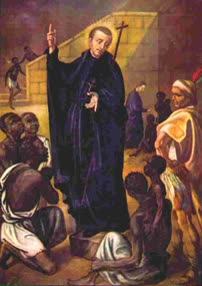
Artwork information
Title: Portrait of St. Peter Claver
Artist: Unknown artist
Date: 18th century
Rights: Public domain
Patronage
- Enslaved people
- African missions
- Ministry for racial justice
Symbols
- A ship
- Chains
- A water jug
Key virtues
- Constancy
- Physical courage
- Attention to the body
Lived experience
- Witnessing atrocity
- Institutional resistance
- Chronic illness in old age
Causes served
- Abolition
- Care of the enslaved
- Medical care
When you need…
- A saint who showed up at the worst place, repeatedly
- Endurance in long, unglamorous work
Sent to a slave port
Born in Verdú in Catalonia in 1580, Claver entered the Society of Jesus and was sent to New Granada, arriving at Cartagena (one of the principal ports of the Atlantic slave trade) in 1610. He was ordained there in 1616.
Thousands of enslaved Africans were landed at Cartagena each year, many of them dying in transit or shortly after arrival.
Forty years at the dock
Claver's method was concrete: when a ship arrived he went into the hold with food, water, medicine, and a group of interpreters he had trained, several of them formerly enslaved themselves, so that people could be spoken to in their own languages.
He tended wounds and dysentery, baptised those who asked for it, and pressed slave owners about the treatment of the people they held. He also visited the city's hospitals and prisons. He described himself in his vow as the slave of the Africans forever: a formula recorded in his religious profession.
The end of his life
In his last years he was largely paralysed and, by contemporary accounts, badly neglected: left in a cell and attended carelessly. He died on 8 September 1654. The city that had resented his interference turned out in force for his funeral.
He was canonised in 1888 by Pope Leo XIII, who also named him patron of missionary work among African peoples.
What he did not do
Claver did not abolish slavery, did not free the people he served, and worked inside a Church and empire that permitted the trade. Honest devotion to him has to say so.
Papal condemnations of the enslavement of peoples exist from the fifteenth century onward and were widely ignored; the Church's teaching and the Church's practice were not the same thing. Later popes, including Gregory XVI in 1839 and Leo XIII, condemned the trade explicitly.
Who he served
People arriving in the holds of slave ships: sick, terrified, and without a shared language. Prisoners. Sailors. Patients in the city's hospitals, including those with Hansen's disease.
Scripture that runs alongside this life
Matthew 25:31–46
As long as you did it to one of these my least brethren, you did it to me.
Translation: Douay-Rheims (public domain) · Short excerpt; full passage linked.
Galatians 3:28
There is neither Jew nor Greek: there is neither bond nor free: there is neither male nor female. For you are all one in Christ Jesus.
Translation: Douay-Rheims (public domain) · Short excerpt; full chapter linked.
Prayer
Original prayer written for this site
A prayer with St. Peter Claver
St. Peter Claver, you went down into the hold when everyone else stayed on the dock.
Pray with those doing hard, repetitive work for people the world has written off, and with those still being trafficked today.
Amen.
Not a traditional prayer of the Church. You are never required to have a devotion to any particular saint: you may always pray directly to God.
How to ask this saint to pray with you
- 1.Ask him to pray for people working in shelters, ports, detention centres, and emergency rooms.
Reflection
Mercy in his life looked like water, bandages, and interpreters. Spiritual care that ignores the body is not the Catholic tradition.
One actionFind out which organisations in your area meet people at the moment of arrival (refugees, released prisoners, hospital discharges) and ask what they need.
Sources
- Vatican, life of St. Peter Claver
- Pope Gregory XVI, In supremo apostolatus (1839), condemning the slave trade