Skip to content
Are you in immediate danger?Get help now
Thorns & Light

Find Healing

A woman's voice belongs in the Church.

For women who have felt unseen, silenced, reduced, blamed, or asked to disappear.

You are not a lesser image of God. You are not a supporting character in someone else's faith.

Being told to be quiet is not the same as being called to humility.

Your worth was never measured by your marital status, your fertility, your body, or your usefulness.

If a person used Scripture to control you, that was misuse, not obedience.

Get help now

Quick exit leaves this page immediately and opens a neutral search page. It cannot delete your browsing history: if someone may check your device, consider using a device they cannot access.

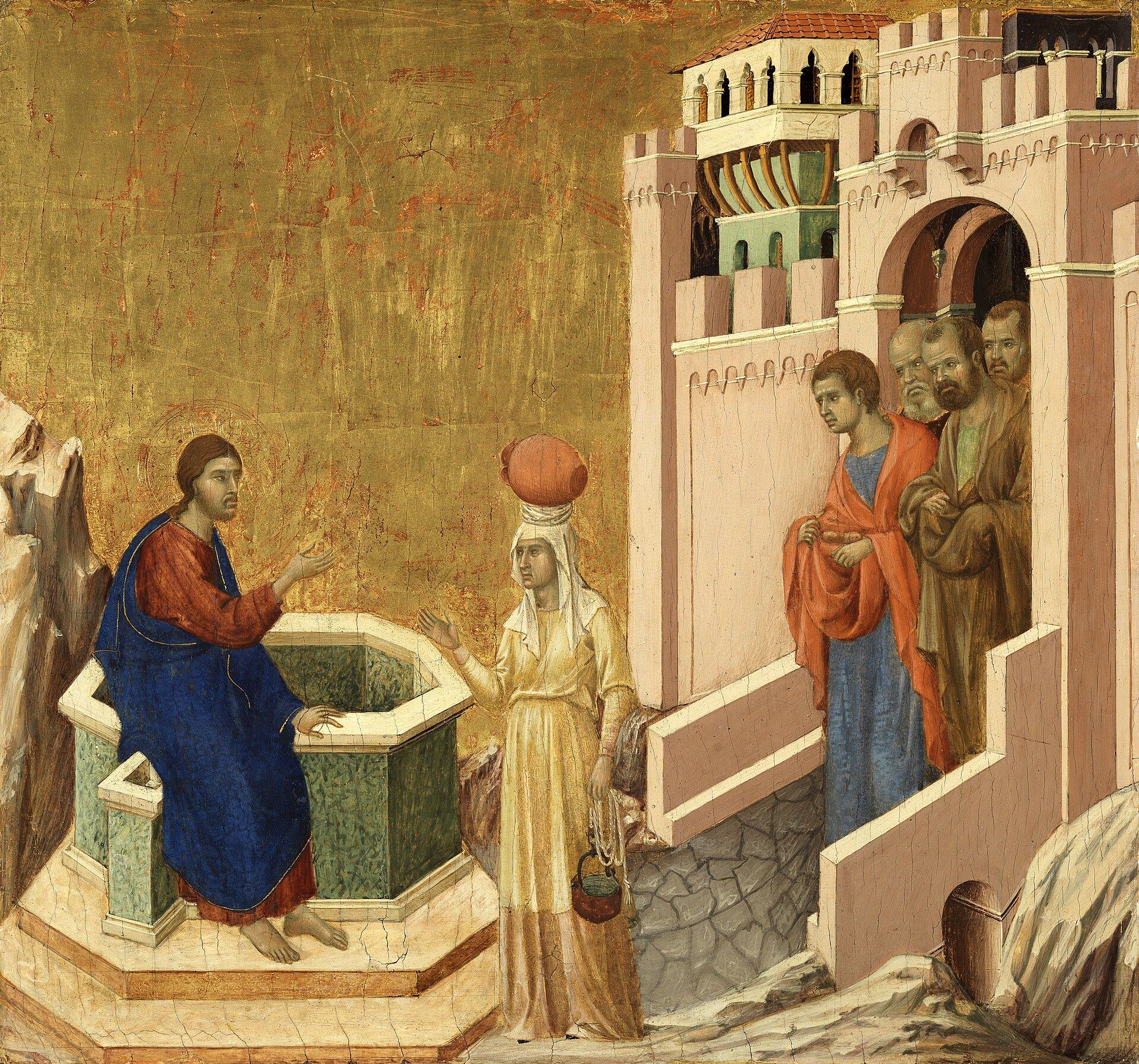
Gold-ground panel of Christ seated at a well in conversation with a Samaritan woman who holds her water jar, the disciples standing apart at the edge of the scene.

Christ and the Samaritan Woman, Duccio di Buoninsegna, c. 1310 to 1311.

Christ speaks at length with a woman at the well while the disciples stand apart. The conversation was public, and she was the one sent to tell the town.

Artwork information

Title: Christ and the Samaritan Woman

Artist: Duccio di Buoninsegna

Date: c. 1310 to 1311

Rights: Public domain (copyright expired)

Source record at Wikimedia Commons

Jesus listened to women publicly

Not privately, not reluctantly, and not on the condition that they first became respectable.

He spoke with a woman in public and did not lower his voice

At the well in Samaria, Jesus began a long theological conversation with a woman whose history had been used against her. The Gospel notes that the disciples were surprised he was speaking with her at all. She then went and told her town, and people believed because of her words. John 4.

He refused to let shame be a public sentence

When a woman was dragged before him to be condemned, Jesus did not join the accusation. He turned the question back on the crowd, and when they had gone, he spoke to her without contempt. John 8.

He defended a woman's right to learn

Mary of Bethany sat at his feet in the posture of a student. When her role in the house was questioned, Jesus said she had chosen well and would not be taken from it. Luke 10.

He let a woman interrupt him and changed the direction of the day

A woman who had bled for twelve years reached for his cloak in a crowd. Rather than treating her as unclean, he stopped, looked for her, and called her daughter. Mark 5.

He received a woman's argument

A Syrophoenician mother pressed him on behalf of her daughter, and the Gospel records that her answer moved the encounter forward. Mark 7.

He entrusted the resurrection to a woman first

Mary Magdalene was the first to meet the risen Christ and the first sent to tell the others. The Church's tradition of calling her apostle to the apostles rests on that morning. John 20.

These are not marginal scenes. They sit at the center of the Gospels, and in several of them a woman's testimony is what carries the news forward. A Church that follows this Christ has no basis for treating a woman's voice as an interruption.

When submission language was used to control you

Teaching about marriage was never a permission slip for domination.

Some women are handed a verse instead of help. Ephesians 5 is read at them as an instruction to comply, while the same passage's call for husbands to love as Christ loved, giving himself entirely, goes unmentioned. When a text is used to end your objection rather than to invite mutual self gift, it is being misused.

Coercive control is abuse. Monitoring your phone, isolating you from friends and family, controlling money, dictating what you wear, threatening custody or immigration status, tracking your movements, and punishing you with silence are patterns of harm, not household order.

Sexual violence within marriage is violence. Marriage is not consent given once for all time. A spouse who coerces or forces sex has committed a grave wrong, and you are not obligated to submit to it.

Forced dependence is a tactic. If you were discouraged from working, studying, driving, or holding your own documents so that leaving would be impossible, that was strategy, not virtue.

No one may tell you that staying in danger is your cross, that your suffering will convert him, or that separation would scandalize the parish. The Church does not require you to remain in a home where you or your children are being harmed. Separation for safety is permitted, and safety comes before appearances.

If you are planning to leave, planning is not disloyalty. Documents, savings, a trusted contact, and a route out are ordinary prudence.

Quick exit leaves this page immediately and opens a neutral search page. It cannot delete your browsing history: if someone may check your device, consider using a device they cannot access.

Purity culture and unequal shame

The same behavior was often treated as a stumble in a man and a ruin in a woman.

Purity culture takes a real Catholic value, chastity as an integrated way of loving, and turns it into surveillance aimed mostly at girls. Its language is loss: something you can be broken, used up, or disqualified by. That is not the Gospel. Grace is not a finite substance that runs out, and no one else's sin can spend yours.

The shame was rarely distributed evenly. Women were held responsible for other people's desires, asked to account for their bodies, and judged by circumstances they did not choose.

Assault

If you were assaulted, nothing about your clothing, your presence, your past, or your body invited it. Violence done to you is the sin of the person who did it. Purity was never something an attacker could take from your soul.

Sexuality

You are not a temptation with a face. Being taught to see your own body as a threat to other people's holiness is a distortion, and unlearning it is not rebellion.

Pregnancy

Pregnancy outside of what a community expected is not a public offense to be managed by gossip. A woman carrying a child deserves practical support, medical care, and privacy.

Infertility

Infertility is a grief, not a failure of faith or a punishment. No one may tell you that enough prayer would have produced a child.

Motherhood

Mothering is real work, often invisible work. It is also not the whole measure of a woman. Honoring mothers should never require diminishing women who are not mothers.

Singleness

A single woman is not in a waiting room. Your baptism, not your relationship status, is the foundation of your vocation and your place in the Church.

Divorce and separation

Leaving a marriage that was unsafe was not a lack of faith. If you have questions about annulment, separation, or the sacraments, they deserve honest answers rather than shame.

Abortion history

If abortion is part of your story, whether chosen freely, under pressure, or under coercion, you are not beyond mercy and you are not required to relive it for anyone's benefit.

Menopause and aging

Your value does not decline with your fertility or your appearance. Aging is not a loss of standing before God or in the Church.

Work and ambition

Competence is not pride. Wanting to use your intelligence, training, and gifts well is not a betrayal of femininity or of your family.

Caregiving

Caring for children, parents, or a sick spouse is serious labor. It should be shared, resourced, and named, not assumed silently because you are a woman.

Motherhood is a genuine good and, for many women, a central one. It is still not the definition of womanhood. A woman's life before God is not a role she fills for others. It is her own.

What Catholicism teaches honestly

Stated plainly, including the part that hurts, and without pretending the ache is settled.

Equal dignity is not a concession. Man and woman are both created in the image of God and both possess the same human dignity. Baptism makes no ranked classes of Christians. Whatever anyone told you, the Church does not teach that women are spiritually secondary.

Your vocation begins at baptism. Every baptized person shares in the mission of Christ and is called to holiness and to work in the world and in the Church. That call does not arrive through a husband and is not held in reserve until your life looks conventional.

Women serve and lead across the Church. Women preach through catechesis and teaching, run schools, hospitals, and religious orders, hold diocesan and Vatican offices, direct parish life, study and teach theology, and have been named Doctors of the Church. Where this is not happening in your parish, the obstacle is local practice rather than doctrine.

At the same time, the Church currently reserves priestly ordination to men and teaches that it has no authority to change this. That is the teaching as it stands. Many faithful women hold that teaching and still carry real grief about being excluded from ordained ministry and from decision making that has historically followed it. Others disagree with it outright.

This page will not resolve that for you, and it will not pretend the grief is a misunderstanding. You are allowed to love the Church, take her teaching seriously, and still feel the loss. Honest sorrow is not disobedience, and you do not have to perform contentment to belong here.

Women who carried the Church

Not decoration in the story. Load bearing.

Mary Magdalene

She stayed at the cross and came to the tomb. She met the risen Christ first and was sent to tell the others. Tradition calls her apostle to the apostles.

Read her profile

Mary, Mother of God

Her consent was asked and given freely. In the Magnificat she names God as the one who lifts up the lowly and unseats the powerful, which is not the voice of a woman told to stay quiet.

Read her profile

Phoebe

Paul commends her to the church at Rome as a deacon of the church at Cenchreae and as one who had helped many, including himself. She appears to have carried his letter. Romans 16.

Priscilla

With her husband Aquila she hosted a church in their home and instructed Apollos, an educated preacher, in the faith. Scripture often names her first. Acts 18 and Romans 16.

Catherine of Siena

A laywoman of the fourteenth century who wrote to popes and rulers, worked for peace in a divided Church, and urged the papacy to return to Rome. She was declared a Doctor of the Church in 1970.

Teresa of Avila

A sixteenth century reformer who founded houses across Spain, wrote enduring works on prayer under suspicion from authorities, and was named a Doctor of the Church in 1970.

Josephine Bakhita

Kidnapped and enslaved as a child in Sudan, she later won her freedom in Italy, became a Canossian sister, and spent her life in ordinary service. She is a patron of survivors of trafficking.

Read her profile

If a parish dismissed you

What happened to you was a failure of people, and it can be named.

Perhaps you reported abuse and were asked to consider the scandal. Perhaps you raised a concern and were called divisive. Perhaps you were passed over, spoken about rather than to, or told that your feelings were a spiritual problem. Perhaps you were simply never asked.

You are allowed to name it plainly. You may write it down with dates. You may bring another person with you to a meeting. You may ask for a written answer. You may go to the diocese when the parish will not respond, and to civil authorities when a crime may have occurred. None of that is a lack of faith.

You are also allowed to rest. Some women need distance from a building in order to keep their faith. Taking that distance is not leaving God, and returning later is always open to you.

Never require a woman to reconcile with someone who harmed her

Forgiveness is interior and unfolds over time. Physical proximity, shared ministry, or a meeting with an abuser must never be presented as a condition for the sacraments or for belonging.

Report abuse to civil authorities

Allegations of violence, sexual abuse, or harm to a child go to police and child protective services, following the diocesan safe environment policy, not only to an internal conversation.

Do not use submission language to settle conflict

Teaching on marriage should never be used to end a woman's objection, silence a complaint, or persuade someone to remain in danger.

Give women real authority, not only tasks

Women should serve on finance and pastoral councils, direct catechesis and formation, teach adults, hold paid roles with clear job descriptions, and be present where decisions are actually made.

Pay and credit the work

Roles filled by women are often unpaid or unnamed. Publish the position, pay the wage, and put the name in the bulletin.

Make a complaint path that does not depend on one person's goodwill

Publish who receives concerns, what happens next, and how a woman can escalate to the diocese if the parish response fails. Keep a written record.

Prayer for women who were asked to disappear

Offered for the days when speaking feels costly and silence feels safer.

A prayer for the woman who was told to be quiet

God, I was asked to make myself smaller so that a room could stay comfortable. You did not ask that of me. Give me back my voice, and let me use it without fear. Amen.

Original prayer from Thorns & Light

A prayer when Scripture was used against me

Lord, words meant to be good news were turned into a leash. Separate your voice from the voice that harmed me. Let me hear you say that I am not owned. Amen.

Original prayer from Thorns & Light

A prayer for a body I was taught to be ashamed of

God, you made this body and called creation good. I was taught to watch it, hide it, and apologize for it. Teach me to live in it as your dwelling and not as a danger. Amen.

Original prayer from Thorns & Light

A prayer in grief I cannot resolve

Christ, I love this Church and I am still grieving inside it. I do not have a tidy conclusion. Stay with me in the unresolved place, and do not let bitterness be my only home. Amen.

Original prayer from Thorns & Light

A prayer for the parish that did not listen

Lord, I brought something true and it was set aside. Heal what that did to my trust. Give the people there the courage to hear the next woman who comes. Amen.

Original prayer from Thorns & Light

A prayer for women who came before me

God of Magdalene and of every unnamed woman who kept the faith alive, thank you for the ones who stayed, the ones who taught, and the ones who left to survive. Let their courage reach me today. Amen.

Original prayer from Thorns & Light

Quick exit leaves this page immediately and opens a neutral search page. It cannot delete your browsing history: if someone may check your device, consider using a device they cannot access.