
A Samaritan woman
He asked a rejected woman for help
The longest recorded conversation Jesus has with anyone in the Gospels is with a woman her own town avoided.
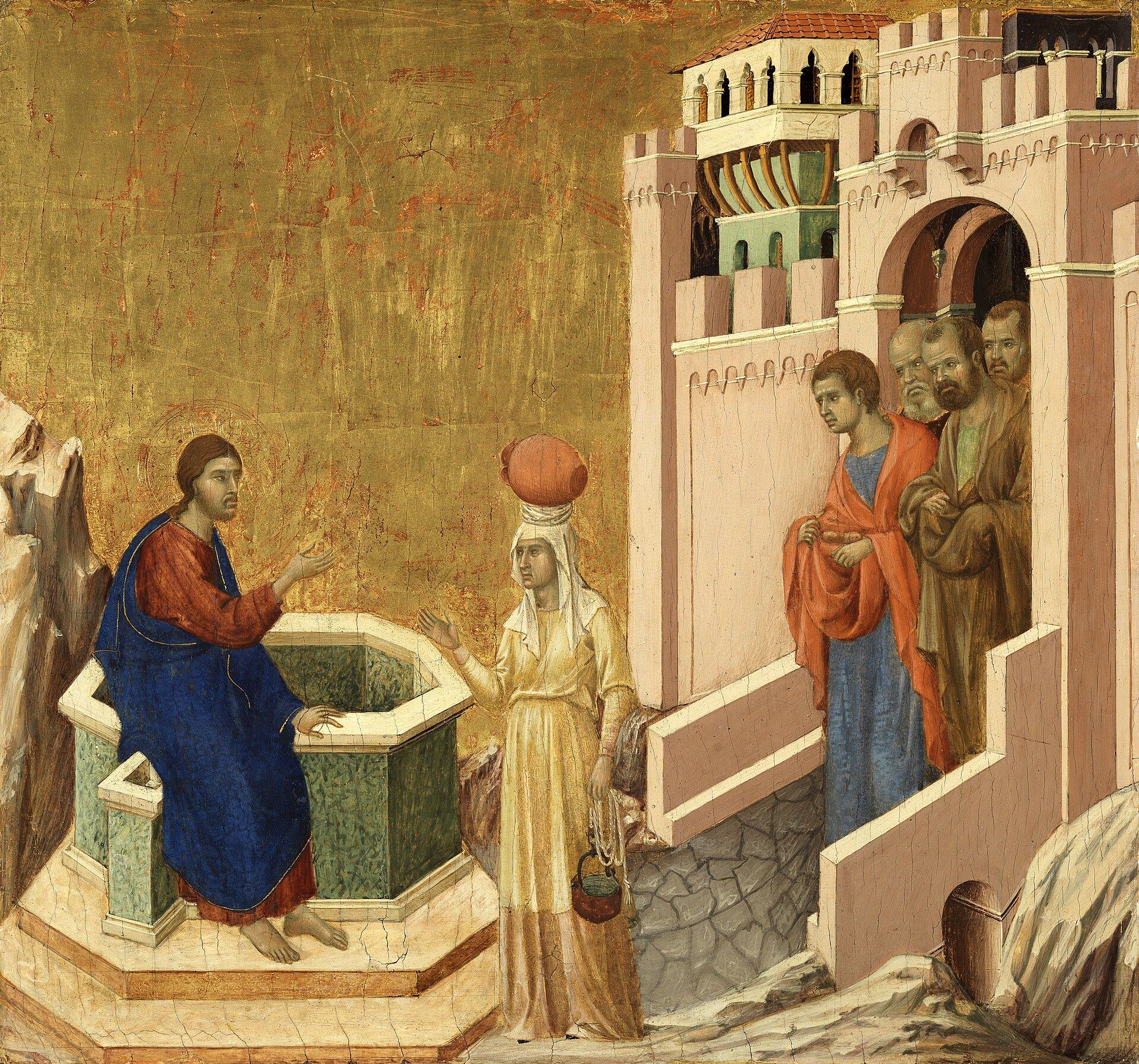
Christ and the Samaritan Woman, Duccio di Buoninsegna, c. 1310 to 1311.
Sacred art is used here for its theological meaning, never as decoration.
Artwork information
Title: Christ and the Samaritan Woman
Artist: Duccio di Buoninsegna
Date: c. 1310 to 1311
Rights: Public domain (copyright expired)
What happened
Tired from travelling, Jesus sat alone at Jacob's well near noon: an hour women usually avoided to escape the crowd and the gossip. A Samaritan woman arrived to draw water, and Jesus asked her for a drink. Their conversation moved from water to worship to her own life, and she left to tell her town about him.
Historical & social context
Jews and Samaritans had centuries of mutual religious and ethnic contempt behind them, rooted in a divided worship history going back to the Assyrian conquest of the northern kingdom. A Jewish man was not expected to speak to a Samaritan, let alone a Samaritan woman, in public. Coming to the well at noon rather than the cooler morning hours, when other women drew water together, suggests she was avoiding company: the text later reveals a marital history that would have made her a subject of local judgment.
Who held power
Jewish religious identity and male social privilege both stood between her and an ordinary conversation with Jesus; John notes even his own disciples were startled that he was speaking with her at all.
What Jesus did
He opened by asking her for something, rather than offering her something: placing himself, a Jewish teacher, in a position of need toward a Samaritan woman. He spoke to her about deep theology, addressed her history without shaming her, and revealed himself as the Messiah to her before he did so to almost anyone else in John's Gospel.
Why it challenged exclusion
Ethnic contempt, gender convention, and personal reputation all argued against this conversation happening. Jesus ignored all three barriers at once and treated her as capable of receiving the deepest thing he had to say.
Why it mattered
She became, in effect, the first missionary in John's Gospel, going to tell her town what she had encountered. Many Samaritans in that town believed because of her testimony.
What we learn
Being fully known (including the parts of a life that others have judged) does not have to mean being turned away. It can be the beginning of being sent.
What this passage does not ask of you
The Cross does not ask a survivor to stay within reach of someone who is hurting them. Christ carried his cross once, freely, toward a definite end. Being coerced, humiliated, or endangered by another person is not a cross given by God.
Christ moving toward a person who was suffering is never an instruction to that person to stay in reach of whoever is causing it. If you are in danger, safety comes first, and it is not a failure of faith.
Scripture
John 4:7-9
There cometh a woman of Samaria, to draw water. Jesus saith to her: Give me to drink.
Translation: Douay-Rheims (public domain) · Short excerpt; full chapter linked below for context.
Reflection
Notice the order: he does not require her theology or her past to be sorted out first. The conversation itself is what changes her.
She runs to tell others before the conversation has, in any external sense, resolved anything about her life. Encounter comes before answers.
A prayer for being fully known
Lord, you spoke to her about everything, and stayed.
I am afraid of being fully known.
Teach me that you already know, and have not left.
Written for this site, not a traditional prayer of the Church.
A practical next step
- Consider one relationship where you hold back the full truth of your life out of fear of judgment, and pray about a next honest step.
- Read John 4 in full rather than only the excerpt above.
- If you are avoiding a place or group because of your own history, ask whether that avoidance still serves you.