
A man condemned and crucified beside him
He promised paradise to a dying criminal
With nothing left to offer and no time left to prove anything, a condemned man asked to be remembered. Jesus promised him paradise that same day.
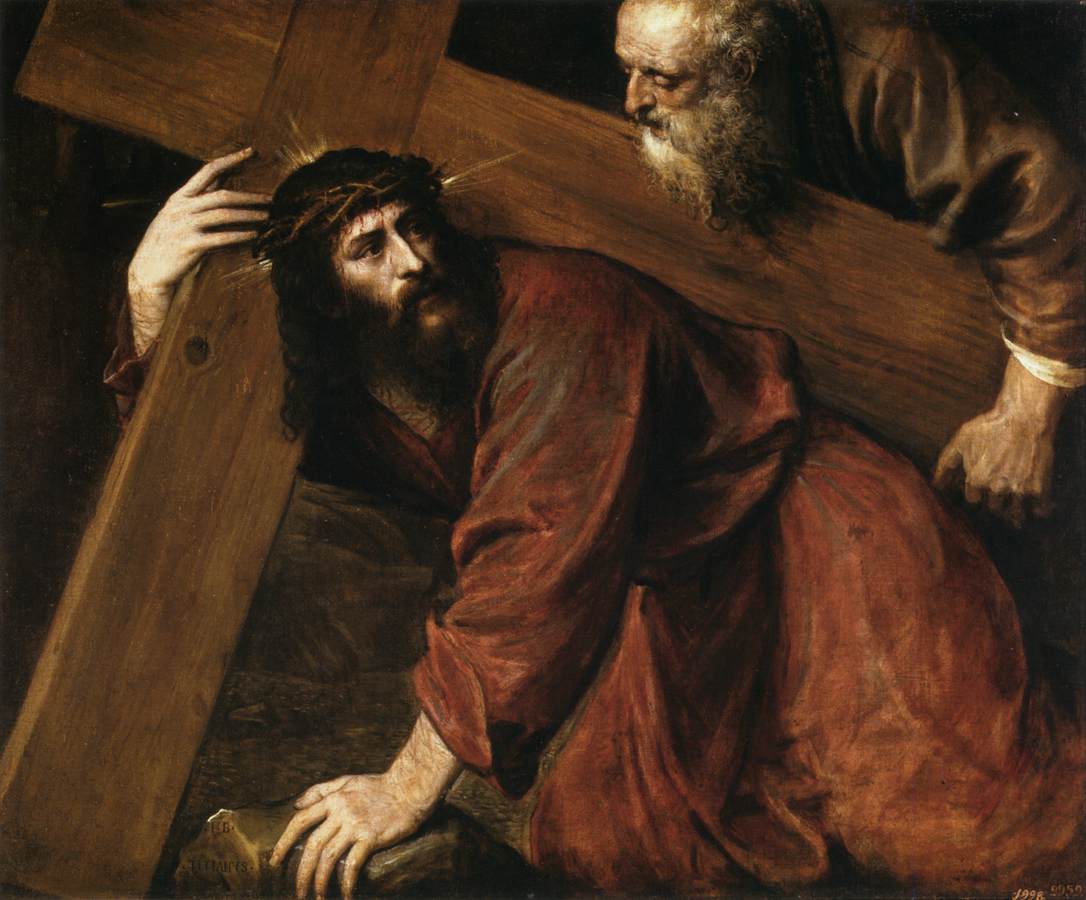
Christ Carrying the Cross, Titian (Tiziano Vecellio), c. 1565.
Sacred art is used here for its theological meaning, never as decoration.
Artwork information
Title: Christ Carrying the Cross
Artist: Titian (Tiziano Vecellio)
Date: c. 1565
Rights: Public domain (copyright expired)
What happened
Two criminals were crucified alongside Jesus. One mocked him. The other rebuked his companion, acknowledged that their own punishment was just, stated that Jesus had done nothing wrong, and asked Jesus to remember him when he came into his kingdom. Jesus answered, "Truly, I say to you, today you will be with me in Paradise."
Historical & social context
Crucifixion was Rome's method of execution for those it wanted to punish and publicly humiliate, often reserved for rebels, enslaved people, and the lowest social classes as a deterrent; it was designed to be as shameful as possible, carried out in public view. A person being crucified had no legal standing left, no path to reputation or restitution, and no time remaining to perform any visible change of life.
Who held power
Roman imperial authority, which controlled both the method of execution and the condemned man's total absence of options or advocates.
What Jesus did
From his own cross, in his own agony, Jesus responded to the man's simple request for remembrance with an immediate, unconditional promise, without requiring any further proof, restitution, or ritual.
Why it challenged exclusion
The man had no way to demonstrate change through future action: there was no future left to demonstrate it in. Jesus' promise did not wait on works that were, by that point, structurally impossible.
Why it mattered
Catholic tradition has long pointed to this moment as the clearest Gospel evidence that repentance and mercy remain possible up to the very last moment of a life, however that life has been spent.
What we learn
No one is too late, and no history is too damaged, for that particular door to still be open.
What this passage does not ask of you
The Cross does not ask a survivor to stay within reach of someone who is hurting them. Christ carried his cross once, freely, toward a definite end. Being coerced, humiliated, or endangered by another person is not a cross given by God.
Christ moving toward a person who was suffering is never an instruction to that person to stay in reach of whoever is causing it. If you are in danger, safety comes first, and it is not a failure of faith.
Scripture
Luke 23:40-43
Neither dost thou fear God, seeing thou art condemned under the same condemnation?
Translation: Douay-Rheims (public domain) · Full passage shown; public domain translation.
Reflection
The man does not ask to be spared the consequences of his life. He asks only to be remembered. That is a different, humbler request, and Jesus answers it generously.
This is one of the last recorded conversations of Jesus' earthly life, and he spends part of it on someone with nothing left to offer him.
A prayer for the last hour
Lord, remember me, not because I have earned it, but because you promised him you would.
If it is not too late for him, it is not too late for me.
Written for this site, not a traditional prayer of the Church.
A practical next step
- If you believe some past choice has permanently disqualified you from mercy, this passage directly addresses that fear.
- Consider Catholic prison and chaplaincy ministries, which carry this same conviction into places most people have written off.
- Pray for anyone facing death without reconciliation, named or unnamed.