
Physical access
Steps at the only usable entrance, no ramp, heavy doors, narrow aisles, no accessible restroom, gravel parking, and a long walk from the lot can make attendance impossible regardless of desire.
Find Healing
For disabled, chronically ill, neurodivergent, and homebound Catholics, and for anyone who has been treated as an inconvenience at the door.
Your body is not a barrier between you and God. Sometimes a building is.
Chronic illness is not unconfessed sin, and disability is not a lesson someone else needed to learn.
If you cannot get there, you have not been left out of the Church.
Needing accommodation is not asking for a favor.
Quick exit leaves this page immediately and opens a neutral search page. It cannot delete your browsing history: if someone may check your device, consider using a device they cannot access.
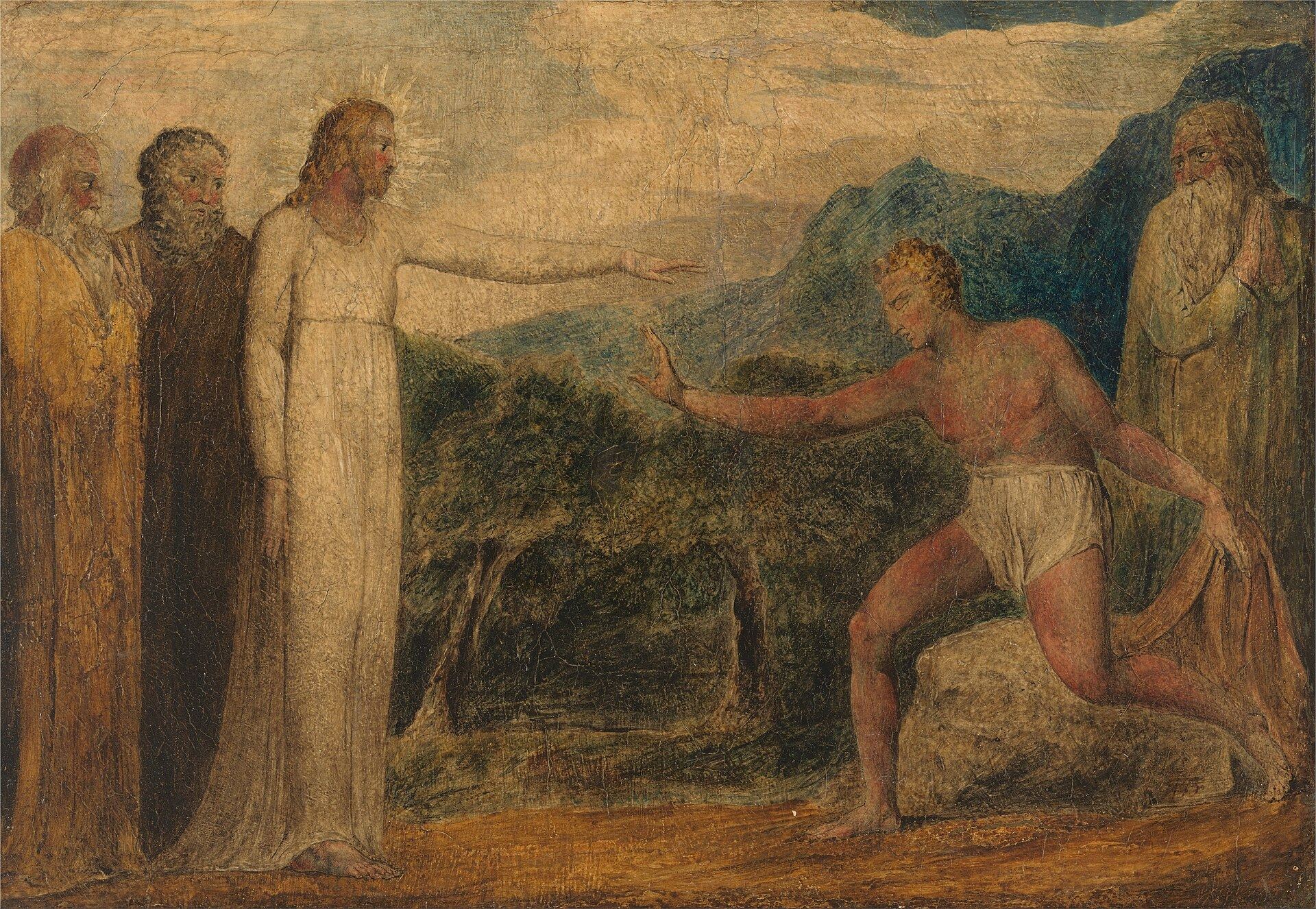
Christ Giving Sight to Bartimaeus, William Blake, c. 1799 to 1800.
Christ stops for a blind beggar the crowd wanted to hush. He asks him what he wants rather than speaking over him.
Title: Christ Giving Sight to Bartimaeus
Artist: William Blake
Date: c. 1799 to 1800
Rights: Public domain (copyright expired)
Your condition is not a verdict, a debt, or a message about your soul.
Chronic illness is not unconfessed sin. Disability is not a consequence of a parent's failure or a family's history. Pain is not a bill being settled. When Jesus was asked whose sin had caused a man's blindness, he rejected the question outright.
You are not a lesson given to other people so they can practice patience. You are not an inspiration on demand. You are a person with a life, a mind, and a vocation, and your worth does not rise or fall with what your body can do this week.
The Church holds that human dignity is not measured by capacity, independence, or productivity. That is not a comforting phrase attached to your situation. It is the reason a parish owes you access rather than pity.
Some suffering is carried rather than solved. Saying so is not resignation, and it does not mean you should stop seeking treatment, adaptations, or relief. Decisions about your care belong to you and the clinicians you trust.
The obstacle is often the environment rather than your will.
Steps at the only usable entrance, no ramp, heavy doors, narrow aisles, no accessible restroom, gravel parking, and a long walk from the lot can make attendance impossible regardless of desire.
Pews with no space for a wheelchair or walker, no aisle seat, nowhere to sit during long standing sections, and no room for a service dog turn Mass into an endurance test.
A failing sound system, no hearing loop, no captions, no interpreter, and readers who step away from the microphone can leave you present for a liturgy you cannot follow.
Small print worship aids, dim lighting, no large print or braille options, and slides that flash past can shut you out of the words everyone else is holding.
Incense, perfume, cleaning chemicals, loud music, echo, fluorescent flicker, and crowding can trigger migraine, asthma, nausea, panic, or sensory overload.
Unpredictable order, long homilies, unwritten expectations, no quiet space, and disapproval of stimming or movement can make participation unsustainable even when you want to be there.
Panic in crowds, agoraphobia, trauma linked to churches, and dissociation are real limits. They are not a lack of reverence.
Post exertional crash, flares, unpredictable mornings, and pain that spikes after sitting can mean the cost of one hour is three days. Pacing is medicine, not laziness.
More than one of these can be true at once, and they interact. A ramp does not help if the incense sends you into a migraine. A quiet room does not help if the only door with level access is locked. Access is the whole path, from the parking lot to the reception of Communion and back home.
General information, not a ruling on your situation.
Catholics are ordinarily obliged to participate in Mass on Sundays and holy days. That is the general norm, and it exists because the Eucharist matters, not to trap anyone.
The Church's own law and long tradition recognize that no one is bound to what is impossible. Illness, care of infants and dependents, and other serious reasons excuse a person from the obligation, and a pastor can also dispense or commute it. Where fulfilling the obligation is physically or morally impossible, the obligation does not bind.
This page cannot tell you whether that applies to your situation. Only your own pastor, or a priest who knows your circumstances, can speak to your case. What can be said plainly is that you are not required to risk collapse, injury, exposure to infection, or a serious flare in order to prove your faith, and that nobody in a parish has the standing to declare you in sin for staying home.
If it would help you to have this settled rather than carried, you can ask a priest directly. A short note is enough: "My condition makes attendance impossible on many Sundays. I would like to talk about the obligation and about receiving Communion at home." A good pastor will treat that as an ordinary pastoral request.
Homebound Communion, visits, accessible Confession, and what a livestream is and is not.
Communion at home is normal Catholic practice. A priest, deacon, or trained extraordinary minister can bring the Eucharist to you. This is not an exception grudgingly made; it is one of the oldest habits of the Church. You can ask the parish office, and you can ask again if the first request goes unanswered.
A priest can also visit to hear Confession and to celebrate the Anointing of the Sick. Anointing is not only for the last hours of life. It is for serious illness, before surgery, and in the course of a long condition, and it can be repeated.
Confession can be adapted. If you cannot kneel, you may sit. If a screen makes hearing impossible, you may ask to be face to face. If speech is difficult, you may write, use a device, or bring a note. Ask for what you need before you begin.
A livestreamed Mass is real prayer and a real good. It is not a sacramental substitute. Watching does not give you sacramental Communion, and the Church does not treat it as fulfilling the obligation in the way being present does. What it can do is keep you joined to the words, the readings, and the community, and it pairs well with an act of spiritual communion, in which you ask Christ to come to you where you are.
Other things belong to you as well: a spiritual director who meets by phone, a parish group that gathers online, someone who brings you the bulletin, and a priest who knows your name. If your parish offers none of this, the diocesan office for persons with disabilities or the pastoral care office may be able to connect you.
No one gets to make your continued illness a report card on your faith.
Praying for healing is good and ancient. What is not good is the version that arrives with an explanation for failure. If you were told that you were not healed because you lacked faith, held on to sin, spoke negatively, did not believe hard enough, or secretly wanted to stay sick, that was a false teaching and it was cruel.
Christ healed people freely. He never told anyone that their remaining illness proved their soul was defective. God is not withholding a cure until your interior state reaches a required standard.
You are allowed to decline being prayed over. You are allowed to say no to being touched, surrounded, filmed, named from the front of a room, or made the subject of a group's intensity. Consent applies in churches too.
Nobody may tell you to stop treatment, discard equipment, cancel appointments, or reduce medication as an act of faith. If someone does, that is a safety matter. Decisions about medication and treatment belong to you and your prescriber.
Quick exit leaves this page immediately and opens a neutral search page. It cannot delete your browsing history: if someone may check your device, consider using a device they cannot access.
Concrete, checkable, and mostly inexpensive.
Put entrance, parking, restroom, hearing loop, quiet room, and interpreter details on the parish website and in the bulletin, so no one has to phone and explain themselves.
An accessible door that is locked, blocked, or reachable only by asking a stranger is not accessible. Check it before every Mass.
Remove a section of pew for wheelchair users with a companion seat beside it, reserve aisle seats, and welcome sitting whenever standing or kneeling is not possible.
Maintain the loop, test microphones weekly, offer captioning where possible, and arrange sign language interpretation on request with reasonable notice.
Keep large print worship aids and readings at the door, and offer digital text that screen readers can use.
Name a low sensory Mass with no incense, softer music, gentler lighting, and a stated welcome for movement and noise. Ask people not to wear fragrance at it.
A room where a person can regulate while still hearing the liturgy lets families stay rather than leave.
Offer a reconciliation room with level access and space for a wheelchair, an option for those who cannot kneel or cannot hear through a screen, and privacy for someone who needs a communication aid.
Maintain a current list, train ministers of Communion for the sick, schedule visits reliably, and make sure a request is answered rather than lost.
Include disabled and chronically ill people on the group that reviews access, and pay attention when they say something is not working.
None of this requires a building campaign to begin. Unlocking a door, moving a microphone, printing larger text, and answering a phone message about Communion at home are all available this week.
For Sunday mornings at home, for flares, and for the days when getting there is not possible.
God, I am not there today. I want to be. Let this room be a church, and let my longing be the offering I cannot carry up the aisle. Amen.
Original prayer from Thorns & Light
Lord, the doors were not made for me and I felt it. Do not let me confuse a building with your welcome. Give the people there eyes to see the step they never noticed. Amen.
Original prayer from Thorns & Light
Christ, my body hurts and I have no strength for beautiful words. Sit with me here. You know what it is to be in a body that suffers. Amen.
Original prayer from Thorns & Light
Jesus, you came to houses. Come to this one. Until you are placed in my hands again, be with me in the waiting, and bless the person who makes the trip. Amen.
Original prayer from Thorns & Light
God, I have prayed and I am still ill. I will not accept that this is my fault. Keep my faith from being turned into a test I am failing, and stay near me as I am. Amen.
Original prayer from Thorns & Light
Lord, bless the person who drives, lifts, advocates, and stays awake with me. Give them rest that is really rest, and let them be cared for too. Amen.
Original prayer from Thorns & Light
Quick exit leaves this page immediately and opens a neutral search page. It cannot delete your browsing history: if someone may check your device, consider using a device they cannot access.